




AI Should Amplify You, Not Absorb You
Episode 4: Whose intelligence are you actually building?
From
Alexander D. L. Oliver
The Founder Infrastructure Map
A free PDF map showing exactly what to build underneath your public presence, in what order, with what tools, and why it matters now.

There is a question most founders have not asked yet about the AI tools they use every day.
Not whether the tools work. Not whether the output is good enough. Not even whether the cost is justified.
The question is this: whose intelligence are you actually building?
Because there is a version of AI adoption that genuinely amplifies what you know, how you think, and what you can produce. And there is a version that absorbs it. Quietly extracting the expertise you spent years developing and feeding it into a system that does not belong to you and will eventually compete with you.
Most founders are doing the second one. Without knowing it.
1. The Difference Between Amplification and Extraction
AI as amplification looks like this. You have a point of view, a framework, a way of thinking about a problem that took years to develop. AI helps you express it faster, more clearly, at greater scale. The intelligence is yours. The tool accelerates the expression of it.
AI as extraction looks like this. You feed your thinking, your client notes, your frameworks, your voice into a platform you do not control. That platform uses what you give it to train models that serve every other user on the system. Your intellectual work becomes a resource for a machine you do not own and cannot audit.
"The tool should serve your intelligence. Not consume it."
The distinction sounds philosophical. It is actually commercial. Your frameworks, your methodology, your way of approaching a client problem are the assets that justify your fees, build your reputation, and create the compound value in your business over time. When you feed them carelessly into systems designed to extract and generalize, you are not just using a tool. You are depreciating an asset.
2. What Is Actually Happening to Your Content
In September 2024, LinkedIn quietly activated a toggle defaulting every user into AI training. It used their posts, articles, and videos to train Microsoft and LinkedIn's models. Before updating their terms of service.
Reddit licensed its entire corpus of user-generated content to Google for approximately sixty million dollars a year. The volunteer moderators and contributors who built that content received nothing.
Meta's court documents revealed that the company internally approved using a dataset containing 7.5 million pirated books and 81 million academic papers to train Llama 3. An internal note described books as more important than web data.
"The most valuable thing about what you produce is not the output. It is the thinking behind it. That is what the platforms want."
Ed Newton-Rex, a former VP at Stability AI who resigned over AI training ethics, put the commercial case plainly. AI scales. A single AI trained on all of the world's content can produce enough output to replace the demand for much of that content. No individual human can scale in that way. When you feed your work into these systems without intention, you are contributing to a machine that may eventually devalue the expertise it learned from you.
This is not speculation. It is the documented business model of every major AI platform.

3. The Knowledge Base Problem
Most founders using AI tools think about them as productivity tools. They are not wrong. AI can genuinely compress work that used to take days into hours.
But there is a version of AI productivity that creates a hidden liability. Every prompt you send to a commercial AI tool is potentially training data. Every document you upload, every framework you describe, every client scenario you walk through, depending on the tool, the terms, and the settings you have not checked, may be retained and used.
LinkedIn's toggle was defaulted on. X enrolled users in Grok training by default in 2024, burying the opt-out in desktop settings only. Tumblr and WordPress prepared to sell user content to OpenAI and Midjourney, with an internal admission that the data transfer accidentally included content that should not have been included.
"The default assumption on every platform is that you have consented simply by showing up. You have not. But you have to actively reclaim what you did not actively give away."
The practical response is not to stop using AI tools. It is to use them with intention about what you feed in and where.
4. What Amplification Actually Looks Like
AI that amplifies your authority does not replace your thinking. It extends it.
It takes the frameworks you have already built and helps you express them at greater volume and speed. It takes the point of view you have earned through years of client work and helps you communicate it across more surfaces. It takes your voice and helps you maintain it consistently across channels you could not physically manage alone.

The critical variable is the direction of the intelligence. In amplification mode, you bring the thinking and the AI extends it. In extraction mode, the AI harvests the thinking and generalizes it away from you.
"AI should amplify your authority, not absorb it. Your knowledge base is an asset. Do not casually feed it into tools you do not control."
The founders building AI into their operations with sovereignty intact are doing a few specific things. They use AI within controlled systems where their data does not train external models. They treat their methodology as something to be documented and owned before being expressed through AI. They choose tools where the data stays theirs.
That is not a complicated posture. It is a considered one.
5. The Question Worth Asking Now
Before you use any AI tool with content that matters, client frameworks, proprietary methodology, earned positioning, ask one question: whose model am I training?
If the answer is unclear, or if the answer is the platform's, the posture is simple. Use the tool for tasks where the input is generic. Reserve the tools you control for the thinking that actually makes you irreplaceable.
The goal is not to avoid AI. The goal is to use it in a way that compounds your authority rather than extracting it.
The AI era will reward the founder who understood this early. The one who used AI to go faster without giving the machine what made them worth listening to in the first place.
"The next founder risk is not automation. It is training the machine that replaces your market position."
Conclusion: The Direction of Intelligence
Every tool you adopt either compounds your expertise or cannibalizes it. The question is not whether AI is useful. It is. The question is whether you are using it in a direction that builds your position or erodes it.
Amplification is the deliberate use of AI to extend your thinking at scale. Extraction is the careless use of AI that feeds your expertise into a machine you do not control.
The difference is not in the tool. It is in the intention behind the feed.

If You Want to Know What to Build First
Knowing the gap is not the same as knowing the sequence. Most founders understand they should be building owned infrastructure. Fewer know what to build first, what good looks like when it is in place, and what tools to use without over complicating it.
I mapped it out. Six foundations, in order, with a clear explanation of what each one does and where to start. It is called the Founder's Infrastructure Map.
Download: The Founder Infrastructure Map
The two-layer model. The six foundations. What to build, in what order, with what tools, and what good looks like when it is done.
Link: Download The Founder Infrastructure Map PDF
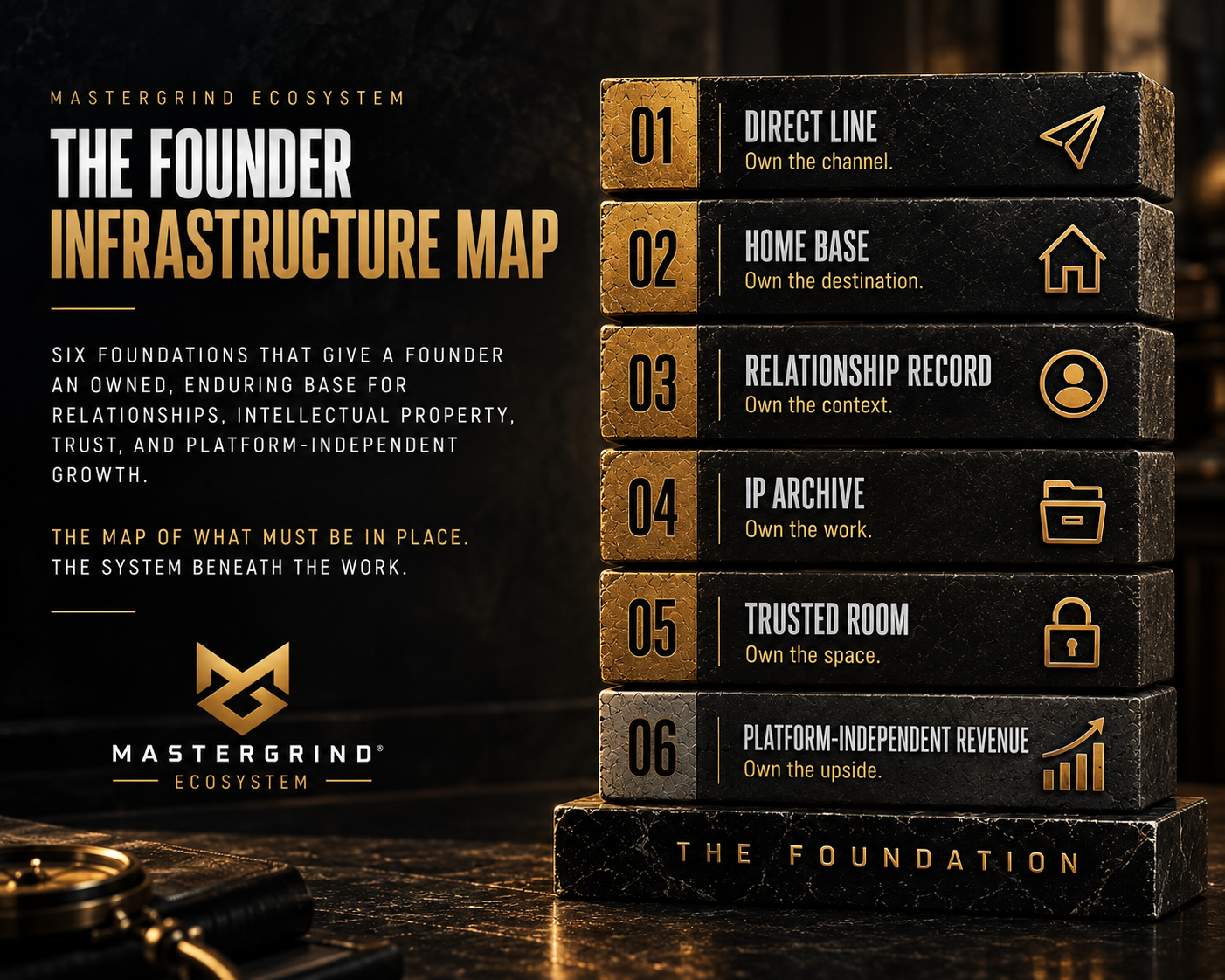
Download: Infrastructure Map
Download a free PDF map showing exactly what to build underneath your public presence, in what order, with what tools, and why it matters now.

Events:
Hosted by Mastergrind Club
Related:
Mastergrind Club


Spotlight:
The Founder Network Ledger
Stay close to what's being built!
Follow StreamsLocation:
New York City
Location Spotlight:
One Family (Official Music Video)
Marketplace:
Ecosystem Activation


Explore:
Mastergrind Network
Spotlight:
The Founder Network Ledger


Stay close to what's being built.
Follow Streams

Mindset: Fear of being average
Follow & Activate



Your Club-GOLD Membership
These Club benefits are available to you during your Trial Membership until the launch of Mastergrind Club.
Your Club-Silver Membership
These Club benefits are available to you during your Trial Membership until the launch of Mastergrind Club.
Your Club-Blue Membership
These Club benefits are available to you during your until the official launch of Mastergrind Club.
Your Limited Access Account
Limited Access to Mastergrind Network & Club Events. A curated set of past Club event recordings and select resources from the Club library.
Not the full Club. A real look inside it.


