




Why Most Founder Communities Die
Episode 3/12: And What Keeps Them Alive
From
Alexander D. L. Oliver
The Founder Network Ledger
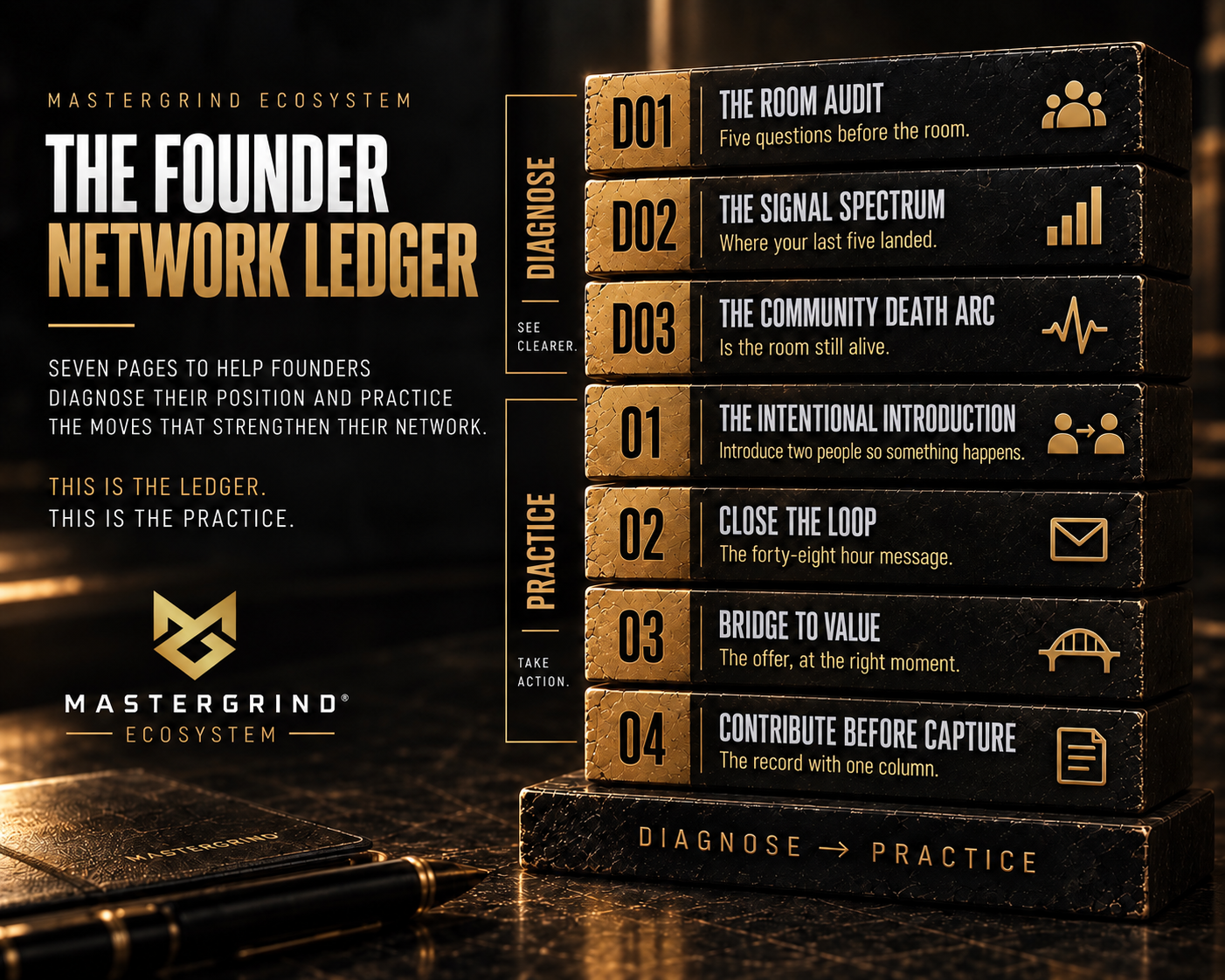
Download seven pages that help founders diagnose their position and practice the moves that activate their network.
Engage & Connect: Foundation Arc, Episode 3
A phone in a dark room, screen glow the only light.
A group thread is open. The badge shows two hundred and eleven unread. The last message in the thread was posted eleven days ago and it reads like every last message in every thread like this one: an announcement, written with effort, about something upcoming.
Below it, nothing. Not a disagreement, not a decline. Nothing.
The room that thread belongs to was, sixteen months ago, the most alive professional space its founder had ever been part of. Nothing went wrong. That is the clinical finding of this episode, and it is worse news than a failure would be.
THE OTHER OBJECT
A long dining table at eleven at night, somewhere the gathering has been happening for years.
The wood shows it. Small marks, a patina you only get from repeated use, a surface that has been wiped down a few hundred times. A candle burned well down from where it started. Glasses at different stages, some finished, some still going. Chairs at odd angles, some pulled out, one turned sideways, arranged by people who stopped thinking about the chairs a long time ago.
Two objects. One room that died and one that did not. The difference between them is not luck and it is not the founder's energy, which is what almost everyone assumes.

READING THE DEAD THREAD
Two hundred and eleven unread.
Not zero. Zero would mean people left. Two hundred and eleven means they are still in the room and have stopped opening it, which is a different condition and a worse one, because the membership number still looks healthy on a dashboard.
The last message is an announcement.
Look at who wrote it. In a room that is working, the last message is usually from a member, and it is usually a question. In a room that is dying, the last message is almost always from whoever runs it, and it is almost always an announcement.
The direction of the traffic is the diagnosis. When the person running the room is the one generating the activity, the room has already stopped being a room and become a broadcast with a member list attached.
Eleven days.
The specific number does not matter. What matters is that nobody has noticed, including the founder, who has been busy, and who will notice in about five more weeks and feel a small cold thing in the chest.
THE ARC, WHICH RARELY VARIES
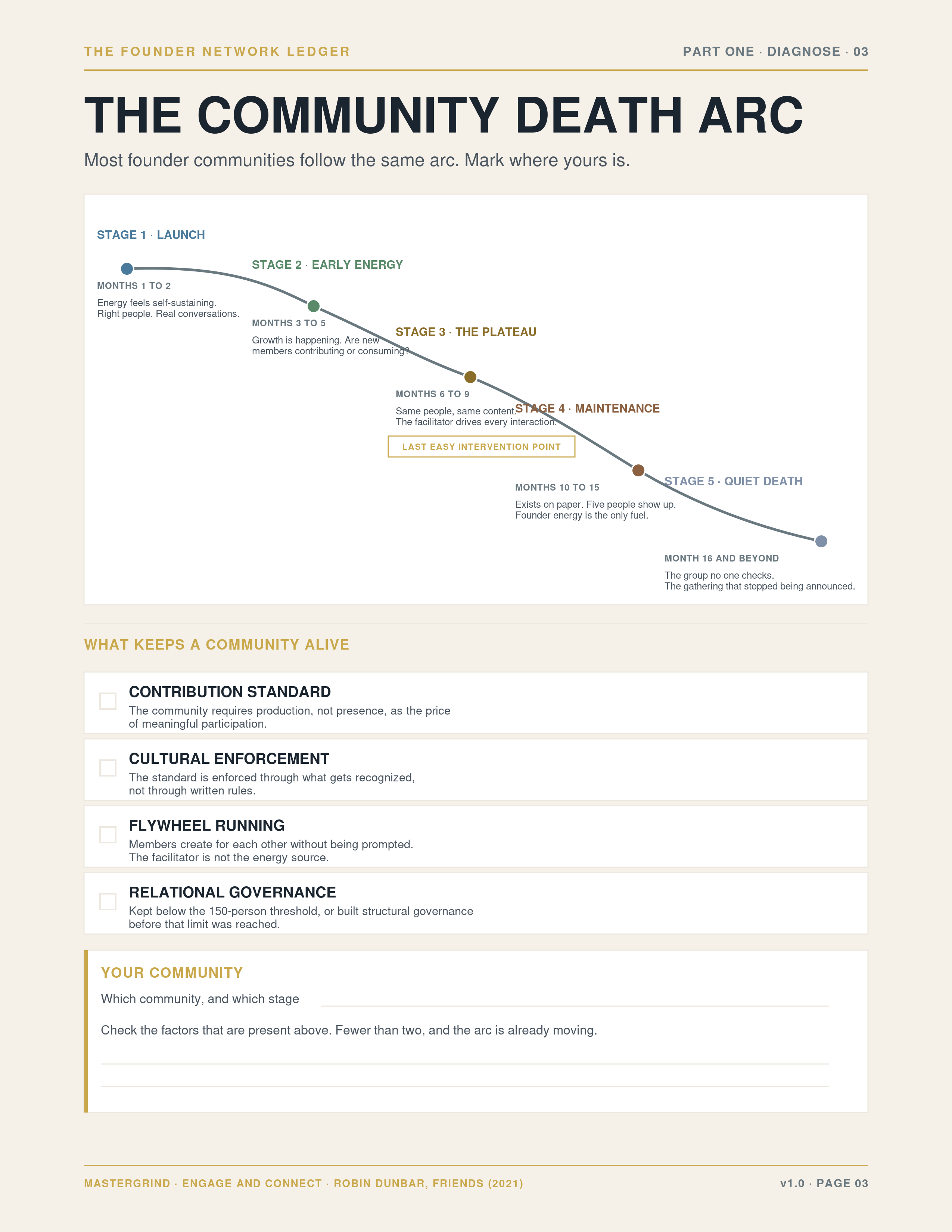
Months one and two, the energy feels self-sustaining. The right people, real conversations, and the founder thinking this is going to work.
Months three to five, growth. This is the stage that hides the problem, because the numbers are going up while the ratio of contributors to consumers is quietly going down.
Months six to nine, the plateau. Same faces, same content, and the founder is now driving every single interaction. This is the last easy intervention point, and almost nobody uses it, because from the inside it looks like a slow month rather than a structural condition.
Months ten to fifteen, maintenance. It exists on paper. Five people show up. Founder energy is the only fuel in the tank.
Month sixteen onward, the thread above.

READING THE TABLE THAT SURVIVED
The wear.
Years of it. Which means this table was not launched, it accumulated. Nobody announced it. It kept happening, and the happening is what made it real.
The candle burned down.
Somebody has been sitting here a long time. The gathering did not end when the food did.
The chairs at odd angles.
This is the detail that answers the whole episode. Those chairs were moved by people, repeatedly, over the course of an evening, as conversations formed and reformed. Nobody arranged them. Nobody is managing the seating.
Which means the energy is not coming from one end of the table. It is coming from everywhere along it, and that single fact is what separates this table from that thread.
WHAT KEEPS ONE ALIVE
Four things, and only four, and they are unglamorous.
Production rather than presence as the price of being meaningfully part of it. A standard enforced through what gets recognised rather than through written rules. People creating for each other unprompted, so that no single person is the energy source. And either staying under the threshold where everyone can plausibly know everyone, or building real structure before that limit arrives.
Rooms that have all four do not die. Rooms with fewer than two are already on the arc whether or not anyone has said so.
Open the room you are part of. Look at who wrote the last message, and when.
Download: The Founder Network Ledger
The strongest networks are built over time. Through trust. Through contribution. Through what happens after the introduction. The Founder Network Ledger gives you a way to see those relationships clearly and act on them deliberately.
Seven pages. No noise. No performance. Nothing in it works until you write on it.
mastergrind.network/network-ledger
GET ACTIVATED. STAY ACTIVATED.
Sources Referenced in This Episode
Robin Dunbar, Friends: Understanding the Power of Our Most Important Relationships. Little, Brown, 2021.
Adam Grant, Give and Take. Viking, 2013.
Download: Network Ledger
Download seven pages that help founders diagnose their position and practice the moves that activate their network.

Events:
Hosted by Mastergrind Club
Related:
Mastergrind Club


Spotlight:
The Founder Network Ledger
Stay close to what's being built!
Follow StreamsLocation:
New York City
Marketplace:
Ecosystem Activation


Explore:
Mastergrind Network
Spotlight:
The Founder Network Ledger


Stay close to what's being built.
Follow Streams

Mindset: Fear of being average
Follow & Activate


Your Club-GOLD Membership
These Club benefits are available to you during your Trial Membership until the launch of Mastergrind Club.
Your Club-Silver Membership
These Club benefits are available to you during your Trial Membership until the launch of Mastergrind Club.
Your Club-Blue Membership
These Club benefits are available to you during your until the official launch of Mastergrind Club.
Your Limited Access Account
Limited Access to Mastergrind Network & Club Events. A curated set of past Club event recordings and select resources from the Club library.
Not the full Club. A real look inside it.


