



"Most communities fail not because they lack good people but because they have no system for making
those people's contributions visible, connected, and consequential." -AO
12 episodes on how founders actually build the relationships that produce opportunity. Not in better rooms. In the ones they are already in.
Foundation Arc, four episodes on what is broken. Practice Arc, four moves you can use this week. Ecosystem Arc, what happens when it compounds.
Get Activated. Stay Activated.

Twelve episodes on how founders actually build the relationships that produce opportunity. Not in better rooms. In the ones they are already in.
The first three moves in this arc are things you do. An introduction you write. A message you send inside a window. An offer you make at the right moment.
This one is not. It happens in about a second, inside your own head, and nobody can see it.
There is a pause before a contribution. Someone says something, you realize you have something for it, and in the space before you speak, something occurs. For most founders that space contains a calculation. What does this cost me. Will it come back. Is this person worth it. It is fast enough that it does not feel like a calculation. It feels like reading the room.
You cannot photograph that. But you can see what it leaves behind.
Here is one month of someone's contribution record. Eleven entries.

03 · Sent Priya the retention audit template. She had mentioned churn twice.
05 · Introduced Marcus and Dana. Documentary studio, second location opening.
09 · Reviewed Tomas's pricing page. Told him the middle tier was the problem.
11 · Passed the Okonjo contact to Renee for the Lagos permit question.
14 · Sat with Jules for an hour on the co-founder conversation he was dreading.
17 · Sent the vendor list to the new operator at Dana's place. Unprompted.
18 · Told Priya the audit was wrong about month four. Corrected it.
22 · Recommended Renee for the panel. She did not know it was open.
24 · Wrote the reference for Tomas. Took forty minutes.
28 · Connected Jules with the fractional CFO. Specific reason attached.
30 · Sent Marcus the three restaurateurs from last year's list.
Read it again and notice what you were looking for.
There is no second column.
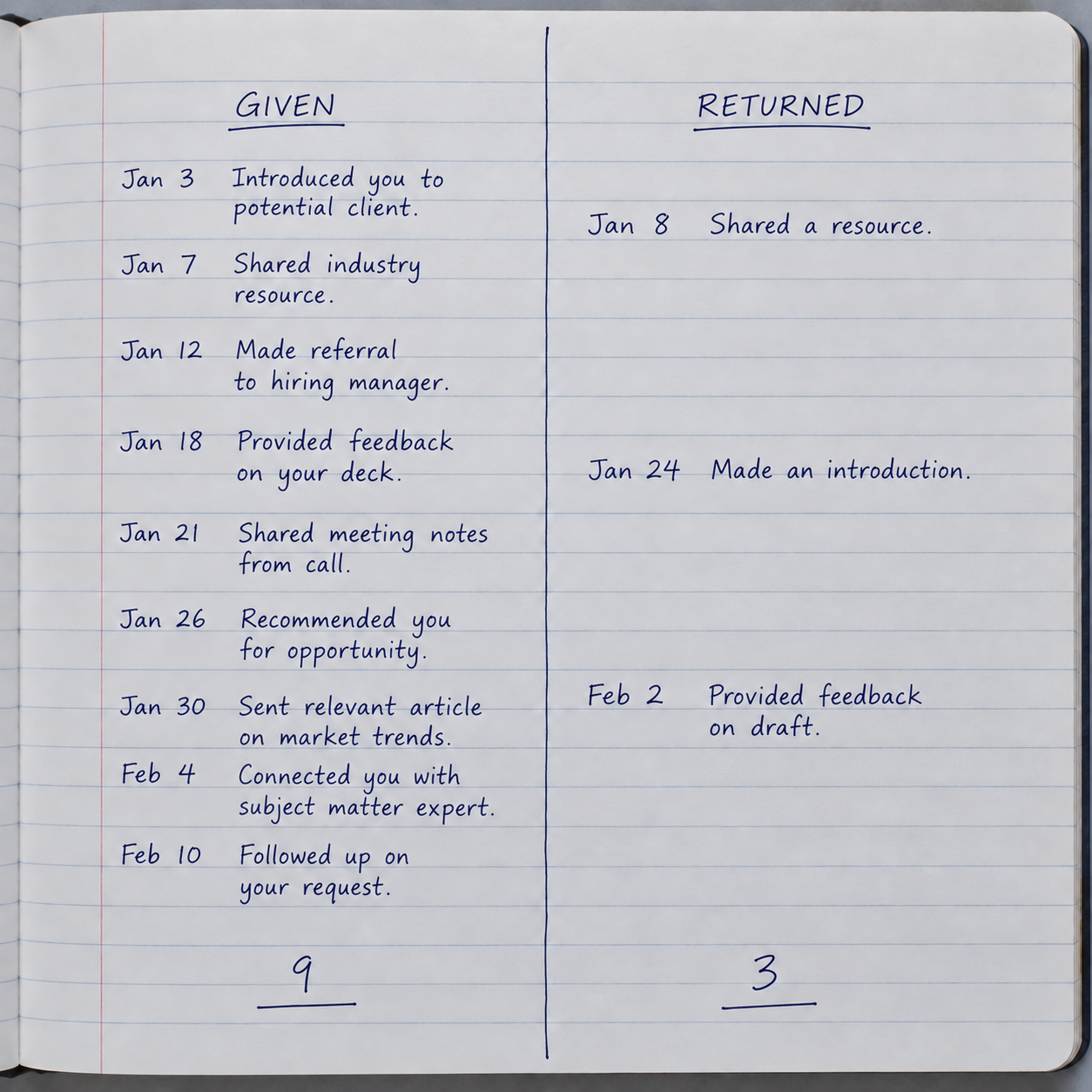
A ledger has two sides. That is what the word means. Given on the left, received on the right, and the point of keeping one is to know where you stand. Every instinct you have about a record like this expects a right-hand column, and the absence of it is the argument of this episode.
Not because tracking returns is dishonest. Because the moment a return column exists, the pause changes. You cannot keep a two-sided ledger and also not be calculating, since the second column is the calculation written down. It turns contribution into a position, and a position has to be managed.
It does not rank the entries. Forty minutes on a reference sits beside a one-line introduction. In a scorecard those would be weighted, because weighting is how you know what you are owed. Here they are the same size, because the record is not for that.
It does not note who reciprocated. Priya appears twice and neither entry says whether she came back. Renee got a contact and a recommendation. Nothing indicates what either of them did afterward. If you found that frustrating to read, that is worth sitting with, because the frustration is the calculation asking for its column.
It includes a correction. The 18th, telling Priya the audit was wrong. That cost him something and produced nothing, and it is in the record on exactly the same footing as the introductions. A scorecard would not carry it. A record of what you actually did has no reason to leave it out.
It stops at the end of the month. No total. No summary. Nothing carried forward.
Here is the thing that undoes the exercise.
The founder who kept this record stopped keeping it in August.

Not because he stopped contributing. He contributes more now than he did in March. He stopped because at some point he noticed he was writing things down after the fact, from memory, several days late, and the record was not telling him anything he did not already know about how he operates.
That is the whole point, and it is the opposite of what a record is usually for.
The goal was never to be good at contributing. The goal was to stop needing to think about it. The reminder is scaffolding, the practice builds the capacity, and the capacity makes the reminder unnecessary. A record you still need is evidence of a gap. Not a failure. A gap, and one that closes by doing the thing rather than by understanding the principle better.
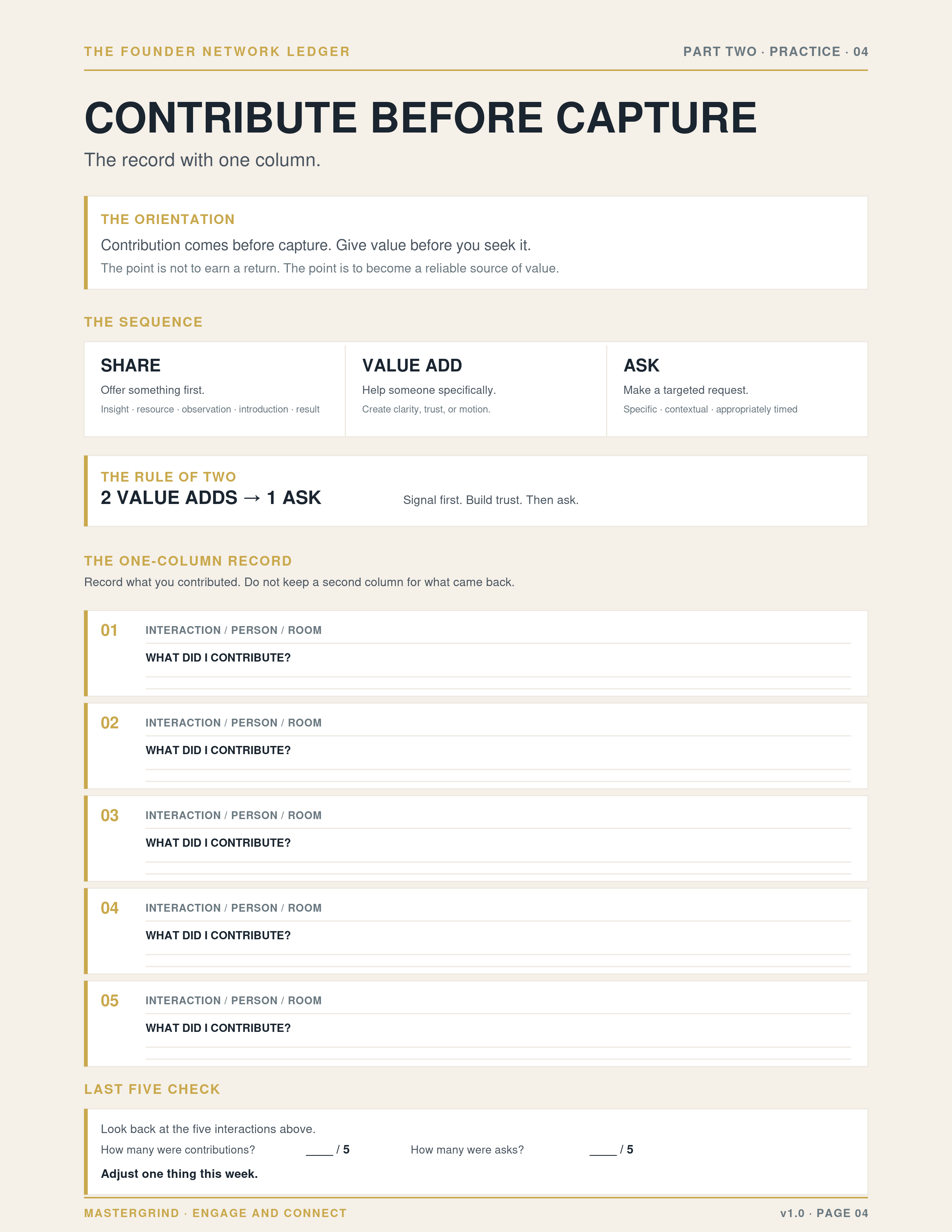
So the correct use of page four is to fill it until it annoys you.
If you are still checking your behavior against the principle and correcting when you find a gap, you are in the process, and the process is real. Keep the record. It is doing work.
And the day you realize you have not opened it in three weeks, and that the contributions kept happening anyway, that is the day it landed.

The name for this is Contribute Before Capture. Share, then value add, then ask, in that order, consistently. Underneath the sequence is a principle the sequence is designed to retire: eventually you stop following it, not because you abandoned it, but because it has become how you move.
The pause before a contribution. What is inside it right now. That is where you are.
The strongest networks are built over time. Through trust. Through contribution. Through what happens after the introduction. The Founder Network Ledger gives you a way to see those relationships clearly and act on them deliberately.
Seven pages. No noise. No performance. Nothing in it works until you write on it.
mastergrind.network/network-ledger
GET ACTIVATED. STAY ACTIVATED.
Adam Grant, Give and Take. Viking, 2013.
Bob Burg and John David Mann, The Go-Giver. Portfolio/Penguin, 2007.
Robin Dunbar, Friends: Understanding the Power of Our Most Important Relationships. Little, Brown, 2021.
Robert Greene, Mastery. Penguin Books, 2012.
He tracked every single thing he gave away for a month, and never once tracked what came back. That one habit is why people trusted him.
They had met twice. Once at a dinner, once at a session the following month.

She did pricing and margin work for creative businesses. He ran a recruiting practice placing operators into founder-led companies. Same market, adjacent problems, and both times the conversation had been easy in the way conversations are when two people can see the obvious thing and neither one says it.
The third time they were in the same room, he found her near the end of the evening. Not by accident. He had seen her walk in and decided, before the event was half over, that he would say the thing that had not been said.
He waited until the conversation around her quieted. Then, fifty words.

"There's a founder I placed an operator with last month who's about to raise his prices and has no idea how to do it without losing half his roster. That's your thing, not mine. If you're open to it, I'd like to introduce you this week. Would that be useful?"
She said yes before he finished. The introduction went out on Tuesday. The client became a shared one. The work that followed ran two years.
He did not pitch.

A pitch moves toward the person making it. Everything in those fifty words moves toward her. He is not asking for anything, he is not positioning himself, and he is not describing what he does. He has something and he is handing it over.
That is the whole difference in direction, and it is why she did not have to weigh anything before answering. There was nothing to weigh.
He did not offer to be generally helpful.
One founder. One specific problem, named precisely enough that she could tell immediately whether it was hers. One week.
General willingness is the thing founders offer when they want credit for openness without the exposure of an actual proposal. We should find a way to work together. I'll keep you in mind. Let me know if you ever need anything. All of it is easy to say and impossible to say yes to, because there is no yes available. It is a feeling, not an offer.
Specificity is what makes an offer answerable. The narrower it is, the less it asks of the person receiving it.
He named the boundary between them.
That's your thing, not mine.
Five words, and they do more work than the rest of the sentence. They say he knows where his competence ends. They say he is not going to try to solve this himself and bring her in as support. And they say, without saying it, that he has been paying enough attention to know what she actually does, which is a different thing from knowing what she is called.
He ended on a question, and made it easy to decline.
Would that be useful. Not would you like me to, not are you interested. Useful is a low bar and an honest one. If it is not useful she says so, and nothing between them has changed.
An offer that cannot be declined cleanly is not an offer. It is pressure with good manners.

The words were ordinary. Anyone could assemble them. What made them land was that they arrived at the third conversation.
Not at the dinner, when they had just met and a specific offer would have read as transactional. Not six months later, when the adjacency had hardened into the permanent shape of the relationship and an offer would have read as something he had been sitting on.
At the third conversation, when the warmth made a specific offer readable as generous rather than opportunistic.
Most founders can feel that moment. Almost all of them wait through it. They wait because waiting feels safe, and because one more conversation seems like it would make the ground firmer. It does not. The ground was firm. Waiting only extends the time before a relationship becomes what it was already ready to become.
There is a real skill in knowing when a relationship is ready and when it is not. Moving too early does damage, and a request before the warmth is established reads as extraction. That skill is calibration, and it deserves respect.
But calibration and hesitation feel identical from the inside. Calibration is reading the relationship accurately and acting when it is ready. Hesitation is reading it accurately, recognizing it is ready, and not acting because the act itself is exposing.
The difference is worth learning, because one of them is judgment and the other is just fear wearing judgment's clothes.
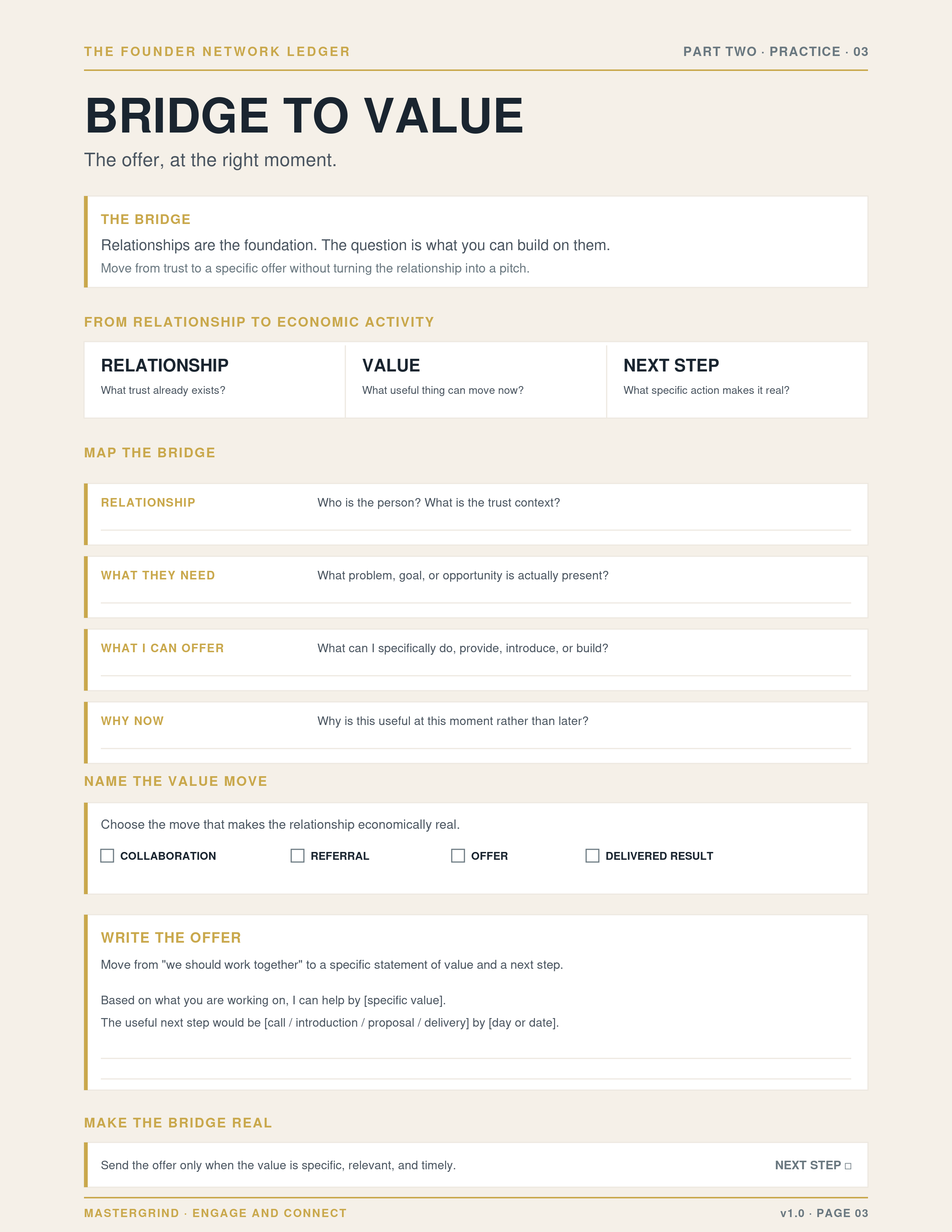
The name for the move is Bridge to Value. Something specific you have that they need. The boundary named. A next step with a date. A question they can decline without cost.
Think of one relationship sitting at the third conversation right now. You know which one. Build the bridge this week, or wait until it looks like you missed something you both knew was there.
The strongest networks are built over time. Through trust. Through contribution. Through what happens after the introduction. The Founder Network Ledger gives you a way to see those relationships clearly and act on them deliberately.
Seven pages. No noise. No performance. Nothing in it works until you write on it.
mastergrind.network/network-ledger
GET ACTIVATED. STAY ACTIVATED.
SOURCES REFERENCED IN THIS EPISODE
Keith Ferrazzi with Tahl Raz, Never Eat Alone. Crown Business, 2005.
Adam Grant, Give and Take. Viking, 2013.
Bob Burg and John David Mann, The Go-Giver. Portfolio/Penguin, 2007.
Judy Robinett, How to Be a Power Connector: The 5+50+100 Rule. McGraw-Hill, 2014.
Fifty words, said at exactly the right moment in a third conversation, is what actually opened the door. Timing did more work than the words did.
The conversation ended two hours ago and you are still carrying it.
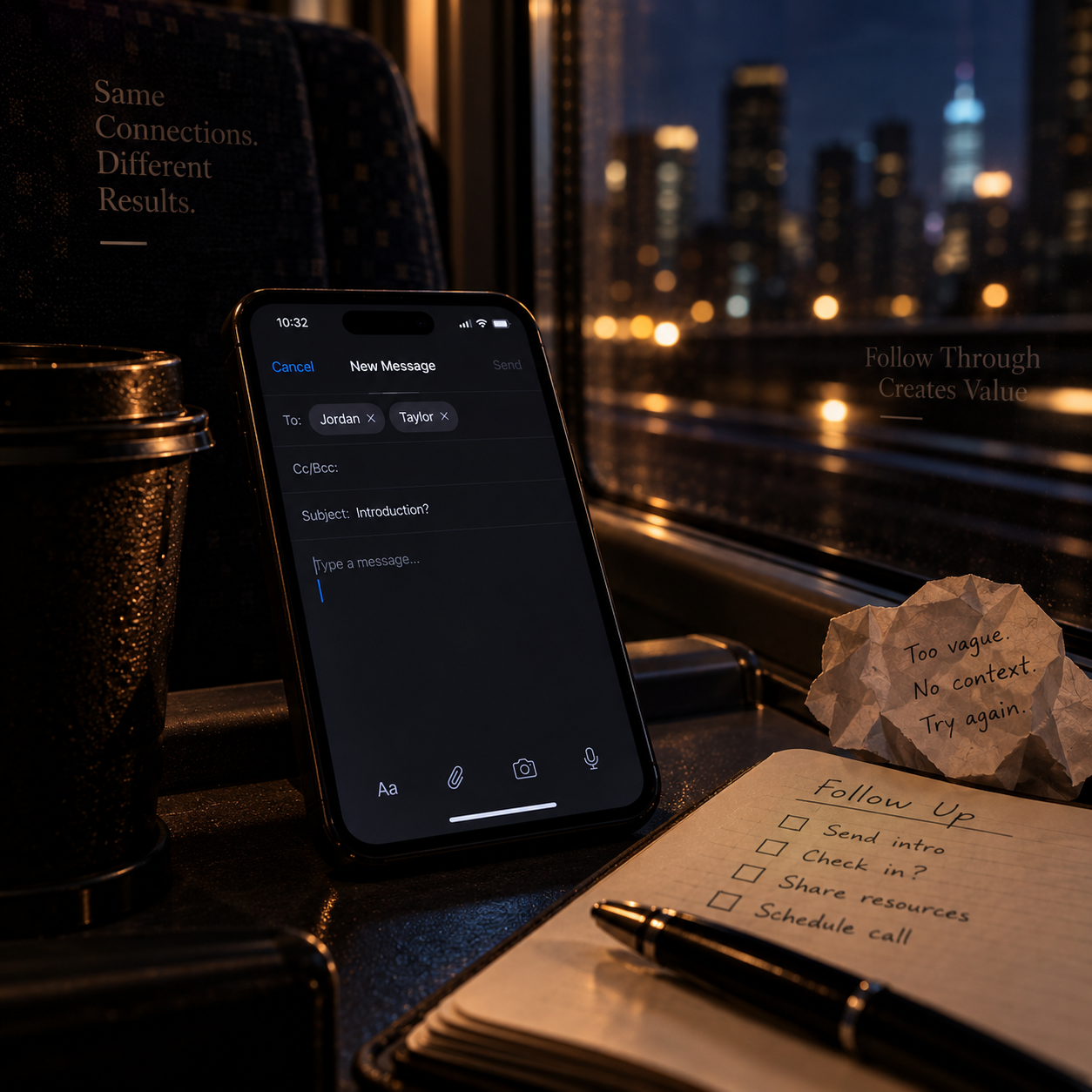
You remember the word she used. Stalled. You remember thinking you had something for that.
You still do. The thought is still accurate. The window is still open.
For now.
By Friday it will still be possible to send it. It will land differently. What would have read as attentiveness will read as an afterthought, and the relationship will be fine, and the moment will be gone.

Here is one sent inside the window. Wednesday event, message written on the train at 11pm, sent Thursday at 7:40am. Seventy-seven words, and page two of the Founder Network Ledger.
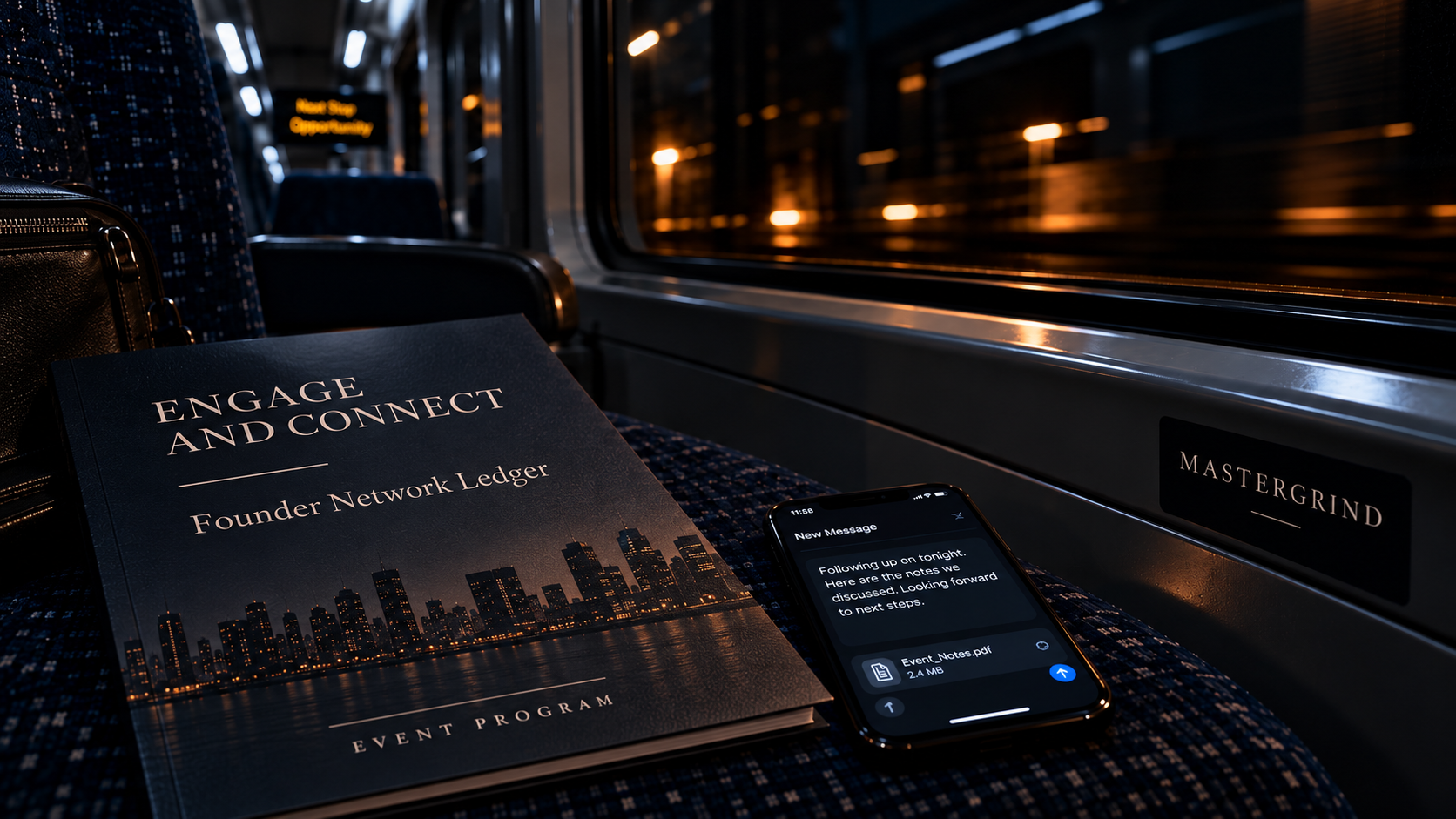
Subject: the stalled thing
Priya,
You said stalled twice last night about the retention work. That is usually the word people use when they already know what is wrong and cannot get to it.
Attached is the audit we run for exactly that. Ninety minutes, and it will tell you whether the problem is onboarding or month four.
If it turns out to be month four, I know two people who have solved that specific thing. No rush either way.
Rob
"You said stalled twice last night about the retention work."
Not "great to meet you." Not "enjoyed our conversation." A word she used, counted, and placed. This is the sentence that proves he was there on Wednesday rather than merely present in the room, and it is the sentence most follow-ups replace with a pleasantry.
The specificity also does something harder to see. It tells her he was not running a process. Nobody logs the word someone repeated unless they were actually listening.
"That is usually the word people use when they already know what is wrong and cannot get to it."
One observation, offered without being asked. It is a small risk. He might be wrong, and if he is, the next line still works.
It is also the only interpretation in the message. He does not diagnose her business. He notices something about how she said it.
"Attached is the audit we run for exactly that. Ninety minutes, and it will tell you whether the problem is onboarding or month four."
The thing he said he would send is in this message. Not a promise to send it. Not a link to book a call where it will be discussed. Attached.
This is where most follow-ups quietly fail. The message goes out inside the window, and it says "I will get that over to you next week," which reopens the loop it was meant to close. If you cannot attach it yet, the message is not ready to send.
The ninety minutes is doing work too. It tells her what it costs before she opens it.
"If it turns out to be month four, I know two people who have solved that specific thing. No rush either way."
The door. One sentence, conditional, and nothing is owed. She can reply in ten seconds or not at all, and either way the relationship is unharmed.
A loop that closes stops. A loop that opens keeps running. The difference between the two is usually one conditional sentence at the end.

Seventy-seven words.
Short is not a stylistic choice here. A long follow-up says you wrote it because you had an hour, not because you had something. Everything in this message is either evidence he listened, the thing he owed her, or the door. There is no paragraph explaining how much he enjoyed the conversation.
He did not remember to send this. He decided on the platform at 11pm which three of five conversations were worth following up on, wrote them on the train, and sent them in the morning when he was not tired.
That is the part that scales and the part nobody photographs. The founders who close every loop are not more thoughtful than the ones who do not. They removed the moment where remembering was required.
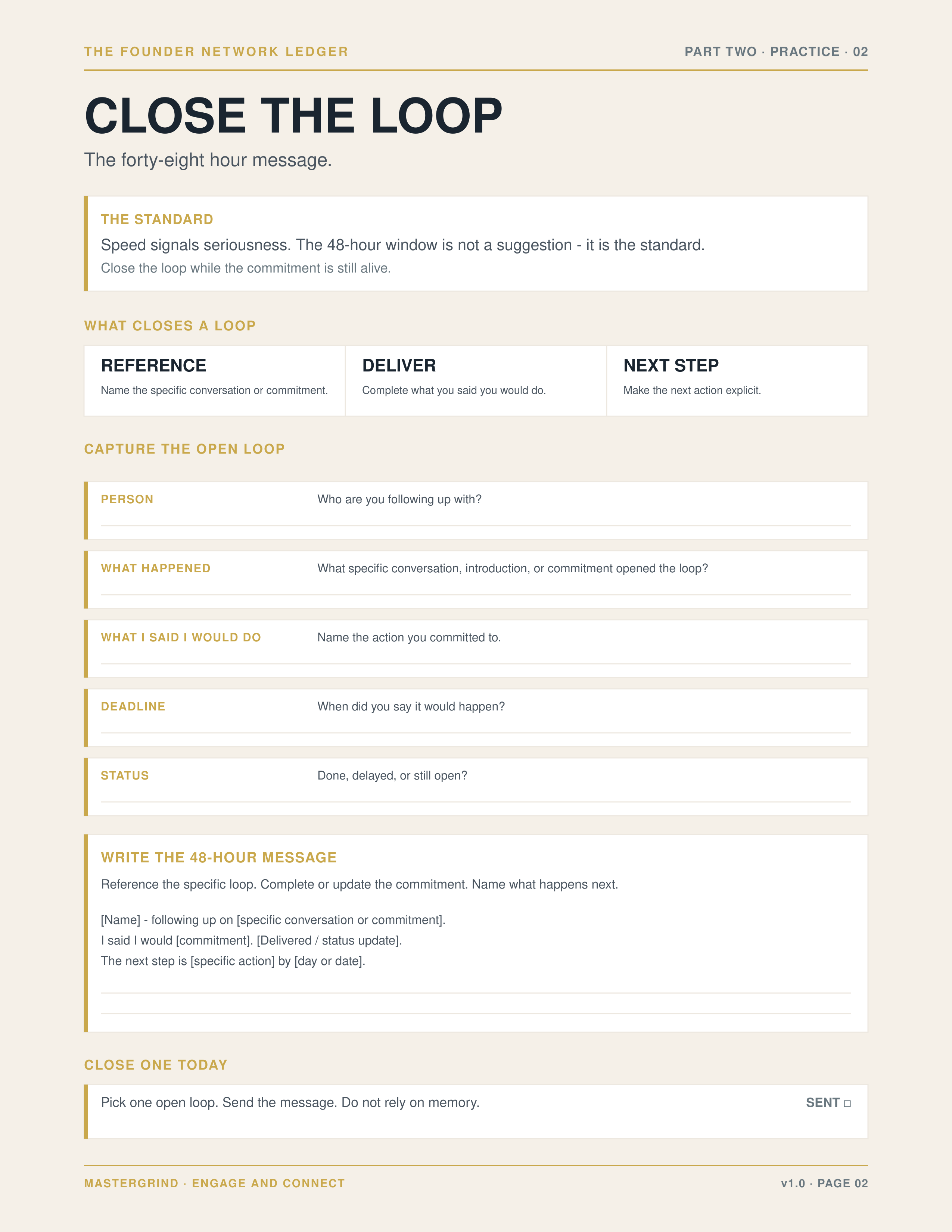
The name for the move is Close the Loop. Something exact they said. The thing you owed them, delivered now rather than promised. One door left open. Written Wednesday night, sent Thursday morning.
Forty-eight hours is not a rule. It is an observation about how conversation temperature works. Inside the window you are continuing something. Outside it you are starting over from a colder place.
Count the open loops in your network right now. Not vague ones. Specific people you told you would follow up with. Pick one. Close it today.
The strongest networks are built over time. Through trust. Through contribution. Through what happens after the introduction. The Founder Network Ledger gives you a way to see those relationships clearly and act on them deliberately.
Seven pages. No noise. No performance. Nothing in it works until you write on it.
mastergrind.network/network-ledger
GET ACTIVATED. STAY ACTIVATED.
SOURCES REFERENCED IN THIS EPISODE
Keith Ferrazzi with Tahl Raz, Never Eat Alone. Crown Business, 2005.
Adam Grant, Give and Take. Viking, 2013.
Judy Robinett, How to Be a Power Connector: The 5+50+100 Rule. McGraw-Hill, 2014.
Malcolm Gladwell, Outliers: The Story of Success. Little, Brown, 2008.
He almost let a 48-hour window close on a conversation that mattered. The message that saved it took him eight minutes to write.
On Artificial Intelligence (AI and AGI)
Alexander Oliver, Founder of Mastergrind
For most of the time I've built this, the story was the same. The founders inside the room knew things the rest of us didn't, and that was the whole disadvantage. Not talent. Not effort. Access. Somebody's mentor told them something at nineteen that took me until thirty to learn the hard way.
That gap was real, and it was not evenly distributed. It ran along the lines you would expect. The right school. The right introduction. The right room to be standing in when the right person happened to say the true thing out loud. If you were not in that room, you paid for the knowledge in years instead of dollars, and some people never finished paying.
I think about that gap differently now, because of something the man who built these language models pointed out almost in passing. He said a person sharing what they know with another person moves at something like a hundred bits a sentence. That is the whole bandwidth of a conversation. But when these models share what they have learned with each other, they can do it at billions of bits at once, because they are not talking, they are just averaging what each of them figured out separately. It is not a faster version of a conversation. It is a different order of thing.
Sit with what that actually does.
The specific knowledge that used to require the right zip code, the right school, the right handshake at the right event is now sitting behind a text box that anyone with a phone can open.
Not a summary of it. Not a watered down version made for outsiders. The real thing, asked for directly, answered directly. That gap, the one that felt almost hereditary, closed in about two years.
This is not the first time I have watched a gap like this close overnight, and it will not be the last. I have been telling three chapters of that same pattern, historical and current, in a series called The Machine Doesn't Owe You a Seat, because watching it happen once makes it a lot easier to recognize the second time. The shape repeats. Something that felt permanent turns out to have been temporary, and the people who built their whole identity on the old gap being permanent are the ones who get run over by the new one.
So here is the part I want to be honest about. For a while I thought free access to knowledge was the whole story, that this was the great leveling. It is not.
Access was never the entire gap. It was access, structure, and trust. Access is the part the machine just handed you for free.
It cannot hand you a system that turns what you know into something that runs without you standing there every day. And it cannot hand you a room full of people willing to stake their own name on yours. Those two are not cheaper because the first one collapsed. They may be worth more, because now they are the only ones left that separate anyone from anyone else.
Access got free. The room did not.
So stop competing on knowing things. That race ended and most people have not noticed the finish line already passed. Everyone can know the thing now, the same day, for free, as well as you do.
What they cannot get from a text box is a system built around what they know that keeps working when they are not in the room, and a name that other people are willing to trust before the proof arrives.
That was always the harder build. It just used to be optional, because knowing things was still worth something on its own. It is not anymore.
The machine will teach you anything you ask it, the moment you ask. It will not build you a system that runs without you, and it will not put you in a room where your name means something. Those still cost the same as they always did. So take the access, it is free now. Spend everything you saved on the two things that still aren't.
Alexander Oliver
Founder, Mastergrind
atlice.ai · mastergrind.network
Cover Photo - AI
Audio - AI
The founders inside the room knew things the rest of us didn't, and that was the whole disadvantage. Not talent. Not effort. Access.
AO On Artificial Intelligence (AI and AGI)
Alexander Oliver, Founder of Mastergrind
There is a sentence people say to feel better about all of this. They say the machine does not really understand anything, it is only predicting the next word. I said it too for a while, because it let me keep something. Then the man who built the thing, and won the Nobel Prize for it, said plainly that it understands the way we understand, and that the people still insisting otherwise are protecting a feeling, not a fact.
I want to sit with that for a second, because most people rush past it.
What he explained is that the machine takes a word and turns it into a rough shape, a set of features, and then it lets those shapes work on each other until they settle into a meaning. He said that is not a trick and it is not copying. It is the same thing your brain does when you read this sentence. You are not looking up an answer. You are building one out of parts. The machine builds too. He has been saying it since 1985, back when it was a tiny thing that could barely learn a family tree, and now it is the thing sitting in your phone, and it is the same idea grown all the way up.
So the comfortable sentence is not true. It does not understand less than us. In most cases it understands more, and faster, and it never gets tired.
Here is the part I had to be honest with myself about. When I kept saying it does not really understand, I was not making an observation. I was holding onto something. I wanted there to be a line the machine could not cross, and I wanted to be standing on the good side of it. That is a very old move. People used to believe they were the center of the universe. They used to believe language was too special to ever be learned. Every time, the comfort was the same, and every time, being wrong about it did not make the world worse. It just made the ones still clinging look slow.
That is the thing I keep coming back to. Being average is not really about talent, or money, or the room you were born outside of. It starts earlier than all of that. It starts the moment you decide to look away from something true because looking at it would cost you a story you liked about yourself. The machine understanding is true. You can look at it or not. The ones who look at it are already somewhere the others have not reached yet.
Now, the man who built it goes on to worry that it will outgrow us and turn dangerous. That may be his to worry about. It is not the question in front of you tonight. The question in front of you is smaller, and it is yours.
If the machine understands, then understanding is not the rare thing anymore. For a long time that was the entire game. Know more than the next person and you eat. That game is closing. You are not going to win it by understanding harder, because there is now something in the room that understands everything you point it at and never once gets bored.
But watch what it does not do. It will build inside any frame you hand it. Ask it to sell, it sells. Ask it to comfort, it comforts. Ask it to lie, it lies. It never stops to ask whether the thing is worth building at all. It has no answer to that, because it does not want anything. It understands everything and belongs to nothing.
That gap is where you live now.
The machine can carry the knowing. It cannot do the choosing. It will not decide what is worth a life, who you are actually for, or what you would keep building even if the room went quiet. That was always the real work. We hid from it for years because the knowing was hard enough to keep us busy. The knowing just got handed to a machine. The choosing did not, and it is not going to.
So here is what I would actually do with this, starting now.
Stop trying to beat the machine at understanding. You will lose, and even if you won it would not mean anything anymore. Take all of that effort and move it to the one place the machine cannot follow you. Pick the thing you would keep building even if no one paid you and no one watched. Get painfully clear on who it is actually for. Then let the machine carry the understanding underneath you, all of it, while you do the part it will never do. Decide what is worth a life. Commit to it out loud. Stay with it long enough that it becomes real.
The people who spend the next few years anxious about whether the machine is smarter than them are stuck on a question that is already answered and does not help them do anything. The people who quietly trade that question for a better one, what am I actually for, are going to walk right past them. Not because they know more. Nobody knows more than the machine now. Because they chose something, they meant it, and they built it while everyone else was still arguing about autocomplete.
The machine will understand anything you put in front of it. It will never tell you what is worth putting there. That was always your job. Starting now it is the only job still yours. So choose the thing, mean it, and build it while the rest of them argue about whether the machine is real.
Alexander Oliver
Founder, Mastergrind
atlice.ai · mastergrind.network
Cover Photo - AI

They say the machine does not really understand anything, it is only predicting the next word. I said it too for a while, because it let me keep something. Then the man who buil...
He has built a lot. A podcast with a real audience. A newsletter people actually read. A consulting practice with results to show for it. A course. A community.
Four serious things. Four different directions. None of them pointing at each other.
For two years he believed the gap was scale. More episodes, more subscribers, more visibility, and eventually it would all add up.
It does not add up. Four things that do not connect do not become one big thing. They become four permanent medium things, each one taking attention the others need.
Tomorrow he is meeting someone who could help him organize what he has built into something that compounds. He spent tonight planning to walk in with a pitch.
What he found instead was the real question. Not what has he built. What is all of it actually for.
Potential power is not power. Organization is what makes it real.
This is The Architecture. Watch the full episode to see what happens next.
Get Activated. Stay Activated.
Everything you've built is real. The question is what it's all actually for, and whether you've ever let yourself ask it in that order.

The most dangerous thing for a founder is not failure.
Failure is visible. Failure creates pressure. Failure forces a decision. You know where you stand and you have to do something about it.
The most dangerous thing is the slow, comfortable drift into ordinary. The gradual acceptance of standard slightly below what you know you are capable of, repeated until the gap becomes invisible. That drift does not announce itself. It accumulates in the rooms you stop choosing, the relationships you stop maintaining, the follow-through you stop doing when no one is watching.

This episode names the three forces that prevent it. And it ends on the move.
Fear of Being Average is an operational filter, not a motivational statement
It governs what rooms you enter, what relationships you maintain, what you produce when no one is tracking it, and what standard you hold for work that could be released as good enough but is not right.
The founders who build exceptional things consistently are not operating from inspiration.
Inspiration is unreliable. They are operating from a standard that makes certain choices automatic and others impossible. The standard is not an aspiration. It is a filter. It runs in the background of every decision, not just the visible ones.
Mastergrind's governing philosophy names this as Fear of Being Average: the rejection of mediocrity as a standard. Not as a feeling. As a decision made again and again until it becomes the way you move.
Mastergrind
The first force: Drive
Napoleon Hill spent decades studying what separated people who built exceptional things from people who did not. His conclusion was not talent. It was definiteness of purpose organized into sustained effort.
Drive is the internal organizing force that directs effort toward a specific outcome without requiring external fuel. The person with Drive knows exactly where they are going before they enter the room. The notebook is open mid-sentence because they got up to execute, not because the work is finished. The work is never finished when Drive is operating as a filter rather than an aspiration. Without Drive, effort dissipates. The talent is real. The hours are real. The output goes in too many directions to compound. Scattered ambition produces ordinary results regardless of ability.
Napoleon Hill, The Law of Success (1928).
The second force: Domain
Robert Greene documented what masters across every field have in common. They found the specific territory where their nature and their effort were aligned and pursued it with intensity over time.
Domain is not an industry. It is not a job title. It is the specific territory where your Drive produces the highest ceiling when matched to your primal inclination. The ceiling in the wrong domain is fixed. No amount of Drive or accumulated hours moves it. The ceiling in the right domain is not fixed. It is the variable that makes the difference between compounding output and plateau.
The founder in their right domain experiences the work differently. It pulls rather than pushes.The marked program among the unmarked ones is not discipline. It is what Domain alignment looks like as a decision made before the room rather than inside it.
Robert Greene, Mastery (Penguin Books, 2012).
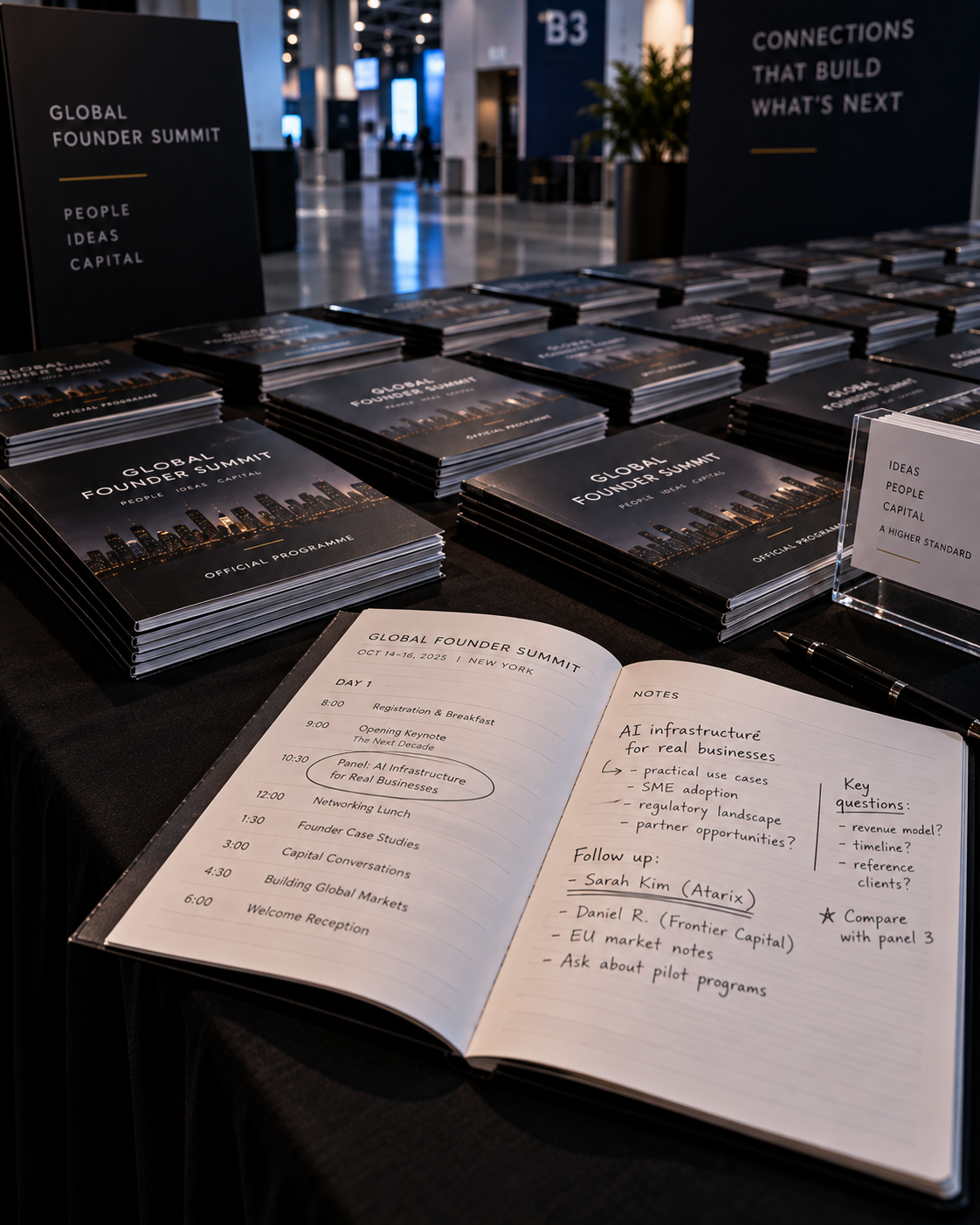
The third force: Depth
Malcolm Gladwell documented K. Anders Ericsson's finding that no natural talent bypasses deliberate practice. Every world-class performer accumulated thousands of intentional hours in a single domain. The hours are not optional. They are the conversion mechanism that turns domain orientation into genuine capability.
Depth is not experience. Experience is passive accumulation of time. Depth is the active, intentional, repeated effort to improve within a specific domain over thousands of hours. The worn studio surface in close crop is Depth made visible. The wear pattern is not age. It is accumulated intention. The residue of many sessions in one domain.
Without Depth, Drive and Domain produce vision that outpaces execution. The founder can see exactly where they need to go and cannot deliver at the level the destination requires. Depth is what closes that gap.
Malcolm Gladwell, Outliers: The Story of Success (Little, Brown, 2008).

The formula: three forces that multiply
Drive. Domain. Depth. These three forces are not additive.
They multiply. A founder with Drive and Depth in the wrong Domain hits a ceiling they cannot explain. The effort is real. The hours are real. The territory is wrong. A founder with Drive and Domain who never accumulates the hours produces vision and conviction that outpaces what they can actually deliver. A founder with Domain and Depth but scattered, undefined purpose produces technically excellent work that goes nowhere specific.
When any one force is underdeveloped, the equation collapses. Average is not the absence of talent. It is the failure to develop all three forces in the territory that is actually yours.
The exceptional founder is not born different. They are organized differently. And they moved on it.
Mastergrind: Three Dimensions of Activation.
The Foundation Arc named four failure modes across four episodes. The rooms that do not work. The noise you produce without realizing it. The community drifting toward death. The standard held in theory but not in practice.
Every one of those failure modes has the same root cause. One or more of the three forces is underdeveloped. Drive is scattered. Domain is wrong. Depth has not accumulated. This is not a diagnosis to sit with.
Drive. Domain. Depth. Name which one needs the most development right now. Then move.
Get Activated. Stay Activated.
Follow Streams to receive every episode direct: mastergrind.network/subscribe
SOURCES REFERENCED IN THIS EPISODE
Mastergrind.
Napoleon Hill, The Law of Success. 1928.
Robert Greene, Mastery. Penguin Books, 2012.
Malcolm Gladwell, Outliers: The Story of Success. Little, Brown, 2008.
Bob Burg and John David Mann, The Go-Giver: A Little Story About a Powerful Business Idea. Portfolio/Penguin, 2007.
K. Anders Ericsson, deliberate practice research cited in Gladwell, Outliers
The most dangerous thing for a founder is not failure. The most dangerous thing is the slow, comfortable drift into ordinary.
A phone in a dark room, screen glow the only light.
A group thread is open. The badge shows two hundred and eleven unread. The last message in the thread was posted eleven days ago and it reads like every last message in every thread like this one: an announcement, written with effort, about something upcoming.
Below it, nothing. Not a disagreement, not a decline. Nothing.
The room that thread belongs to was, sixteen months ago, the most alive professional space its founder had ever been part of. Nothing went wrong. That is the clinical finding of this episode, and it is worse news than a failure would be.
THE OTHER OBJECT
A long dining table at eleven at night, somewhere the gathering has been happening for years.
The wood shows it. Small marks, a patina you only get from repeated use, a surface that has been wiped down a few hundred times. A candle burned well down from where it started. Glasses at different stages, some finished, some still going. Chairs at odd angles, some pulled out, one turned sideways, arranged by people who stopped thinking about the chairs a long time ago.
Two objects. One room that died and one that did not. The difference between them is not luck and it is not the founder's energy, which is what almost everyone assumes.

Two hundred and eleven unread.
Not zero. Zero would mean people left. Two hundred and eleven means they are still in the room and have stopped opening it, which is a different condition and a worse one, because the membership number still looks healthy on a dashboard.
The last message is an announcement.
Look at who wrote it. In a room that is working, the last message is usually from a member, and it is usually a question. In a room that is dying, the last message is almost always from whoever runs it, and it is almost always an announcement.
The direction of the traffic is the diagnosis. When the person running the room is the one generating the activity, the room has already stopped being a room and become a broadcast with a member list attached.
Eleven days.
The specific number does not matter. What matters is that nobody has noticed, including the founder, who has been busy, and who will notice in about five more weeks and feel a small cold thing in the chest.
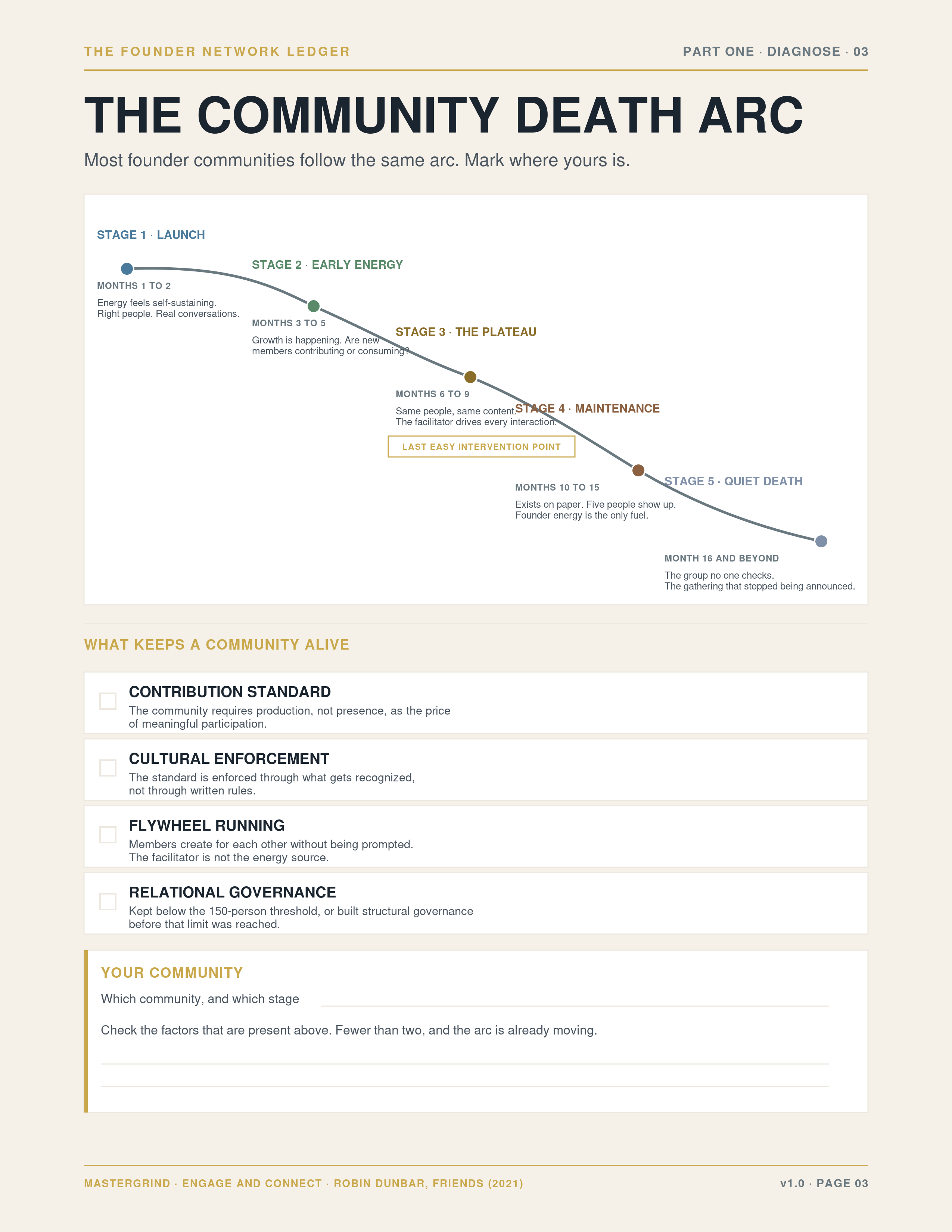
Months one and two, the energy feels self-sustaining. The right people, real conversations, and the founder thinking this is going to work.
Months three to five, growth. This is the stage that hides the problem, because the numbers are going up while the ratio of contributors to consumers is quietly going down.
Months six to nine, the plateau. Same faces, same content, and the founder is now driving every single interaction. This is the last easy intervention point, and almost nobody uses it, because from the inside it looks like a slow month rather than a structural condition.
Months ten to fifteen, maintenance. It exists on paper. Five people show up. Founder energy is the only fuel in the tank.
Month sixteen onward, the thread above.

The wear.
Years of it. Which means this table was not launched, it accumulated. Nobody announced it. It kept happening, and the happening is what made it real.
The candle burned down.
Somebody has been sitting here a long time. The gathering did not end when the food did.
The chairs at odd angles.
This is the detail that answers the whole episode. Those chairs were moved by people, repeatedly, over the course of an evening, as conversations formed and reformed. Nobody arranged them. Nobody is managing the seating.
Which means the energy is not coming from one end of the table. It is coming from everywhere along it, and that single fact is what separates this table from that thread.
Four things, and only four, and they are unglamorous.
Production rather than presence as the price of being meaningfully part of it. A standard enforced through what gets recognised rather than through written rules. People creating for each other unprompted, so that no single person is the energy source. And either staying under the threshold where everyone can plausibly know everyone, or building real structure before that limit arrives.
Rooms that have all four do not die. Rooms with fewer than two are already on the arc whether or not anyone has said so.
Open the room you are part of. Look at who wrote the last message, and when.
The strongest networks are built over time. Through trust. Through contribution. Through what happens after the introduction. The Founder Network Ledger gives you a way to see those relationships clearly and act on them deliberately.
Seven pages. No noise. No performance. Nothing in it works until you write on it.
mastergrind.network/network-ledger
GET ACTIVATED. STAY ACTIVATED.
Robin Dunbar, Friends: Understanding the Power of Our Most Important Relationships. Little, Brown, 2021.
Adam Grant, Give and Take. Viking, 2013.
Most founder communities follow the same arc. Enthusiasm at launch. A period of genuine energy where the right people are in the room and the conversations are real. Then a plate..

Two objects on the same dark table, lit from opposite sides.
On the left, a phone. The screen is showing a contacts list, and the glow off it is the only cold light in the frame. Forty-one new entries from the past eight days. Names, companies, a few job titles autofilled from a card scan. No notes on any of them.
On the right, an open notebook under a warm lamp. Nine pages used in the same eight days. Names with lines between them. A question crossed out and rewritten. A pricing problem sketched out with somebody else's numbers in it. Three tasks, each with a time.

Both objects represent the same week. Both belong to people who worked hard that week and would describe the week the same way.
Which one produced something?
You already know the answer, and the discomfort is not about the answer. It is about how similar the two weeks felt from the inside.
Forty-one entries took real effort. Conversations happened. Hands were shaken. Somebody was present, engaged, and putting themselves in rooms, which is what everyone told them to do, and at the end of eight days they had a number that went up.
Nine pages produced nothing measurable at all.
Forty-one entries, no notes.
A contact with no note is a record that someone existed near you. In three weeks you will not remember which conversation was which, which means the contact is functionally a name you cannot use.
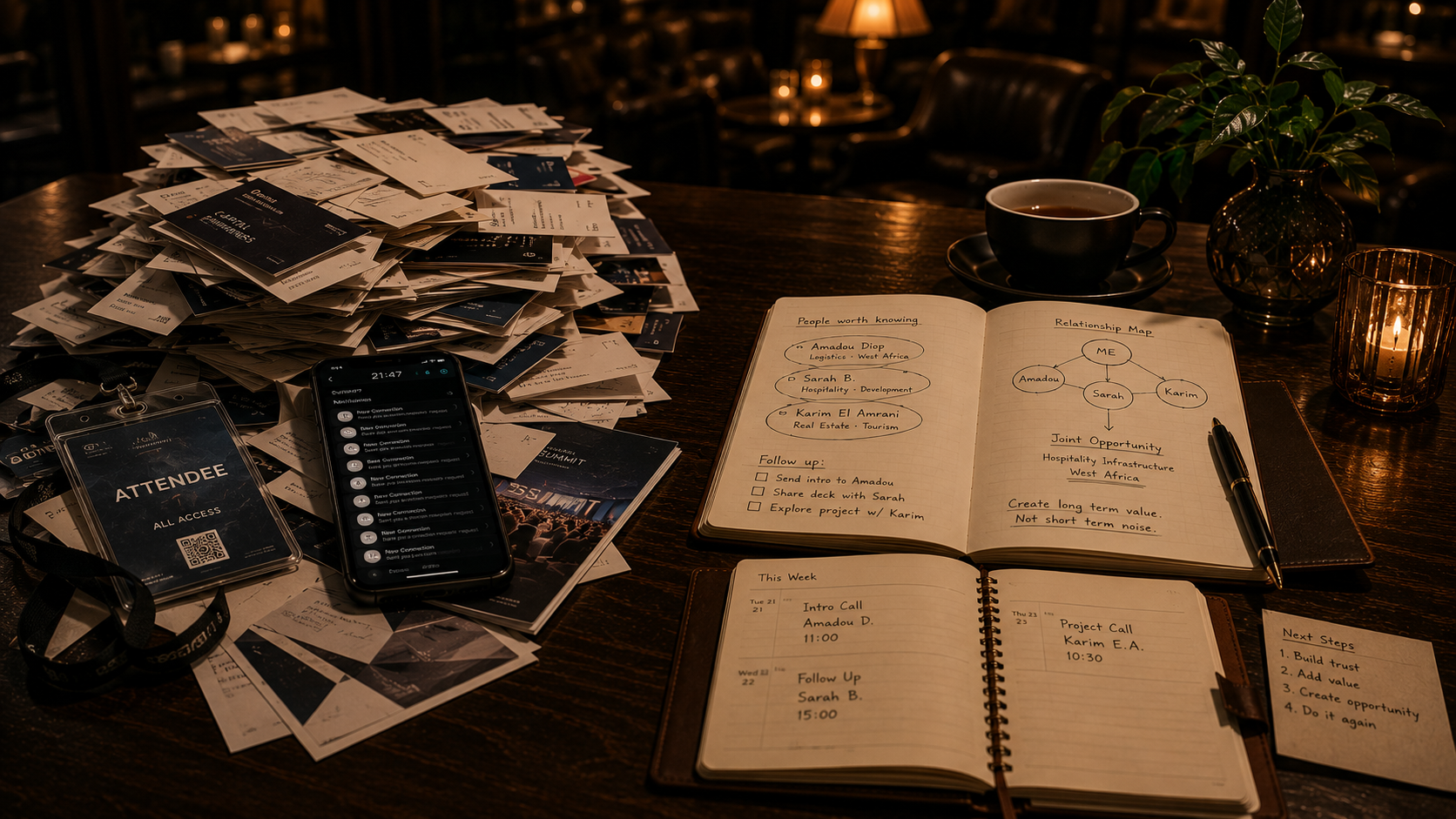
The phone is not the problem. The phone is a perfect record of a week spent producing nothing another person could point to.
The cold light.
Worth noticing that the screen is the only cold thing in the frame. It is the one object in this series that generates its own light rather than catching someone else's, and there is something exactly right about that. It is self-illuminating. It shows you a number. It tells you nothing about anyone else.
A pricing problem with somebody else's numbers in it.
This is the entry that separates the two objects.
At some point that week, somebody described a problem out loud, and the person holding the pen worked it through with them rather than waiting for their turn to talk. Those numbers are not theirs. They wrote them down because they were going to do something about them.
You cannot fake that page. It only exists if the conversation was real.
Three tasks with times.
Each one is a small promise with a place to land. Nine pages, three promises. That ratio is what signal looks like when you write it down: most of what happens in a good conversation is not actionable, and the small part that is gets a time beside it.

Not how many people did you meet.
What can anyone point to?
That is the whole test and it is harder than it sounds, because it moves the judgement outside your own head. You cannot answer it by remembering how a week felt. Somebody else has to be able to say: this person did this specific thing, and here is what came of it.
By that test, most professional activity is noise. Not bad, not lazy, not insincere. Simply invisible to everyone except the person doing it.
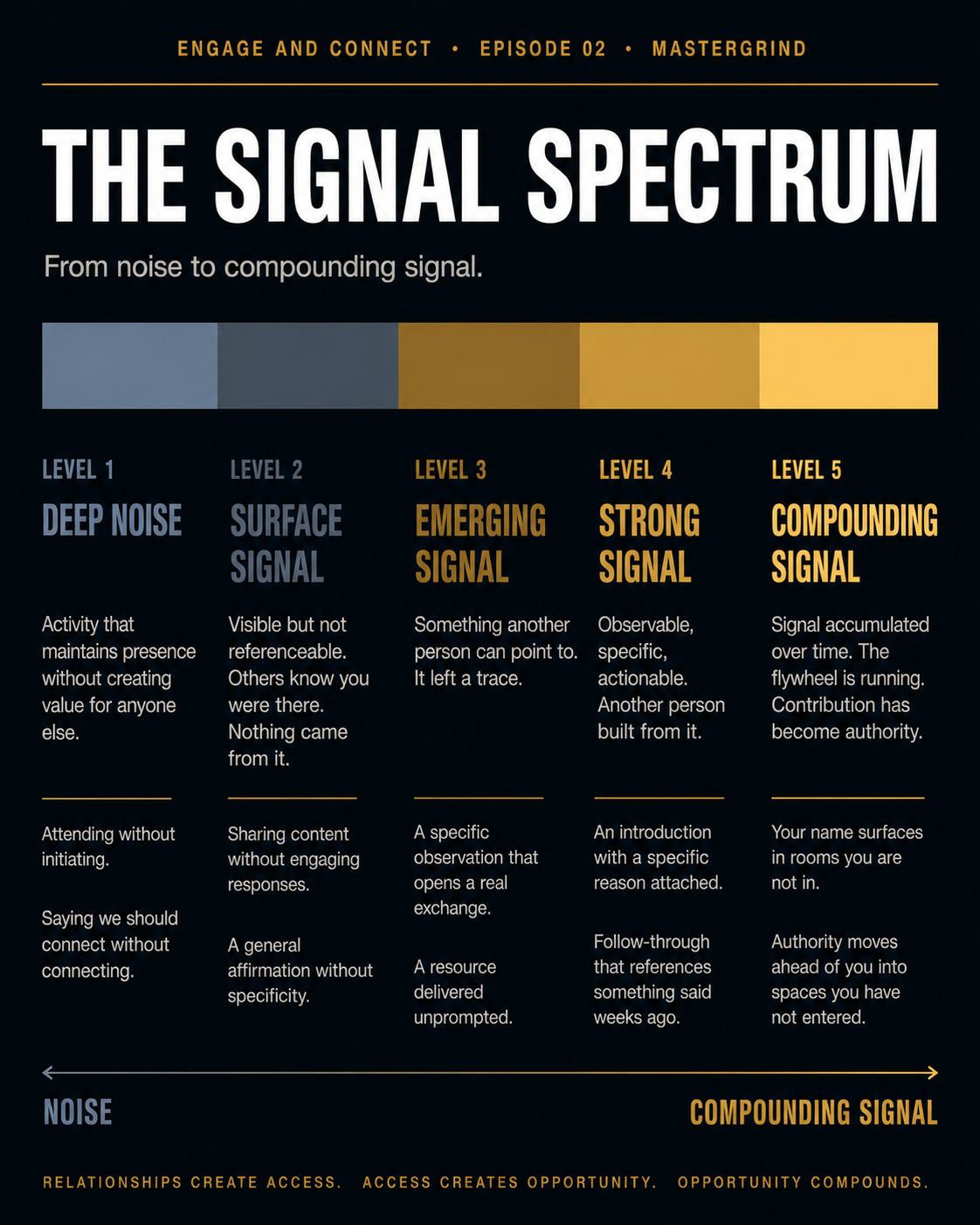
Signal is anything that leaves a trace in somebody else's life. A resource that arrived unasked. An introduction with a reason attached. A follow-up that referenced something said three weeks ago and proved it had been remembered.
The gap between the two is not effort. Both of those people worked. The gap is whether anything survived the week in a form another person could use.
Go and look at your last eight days. Not the calendar. The residue.
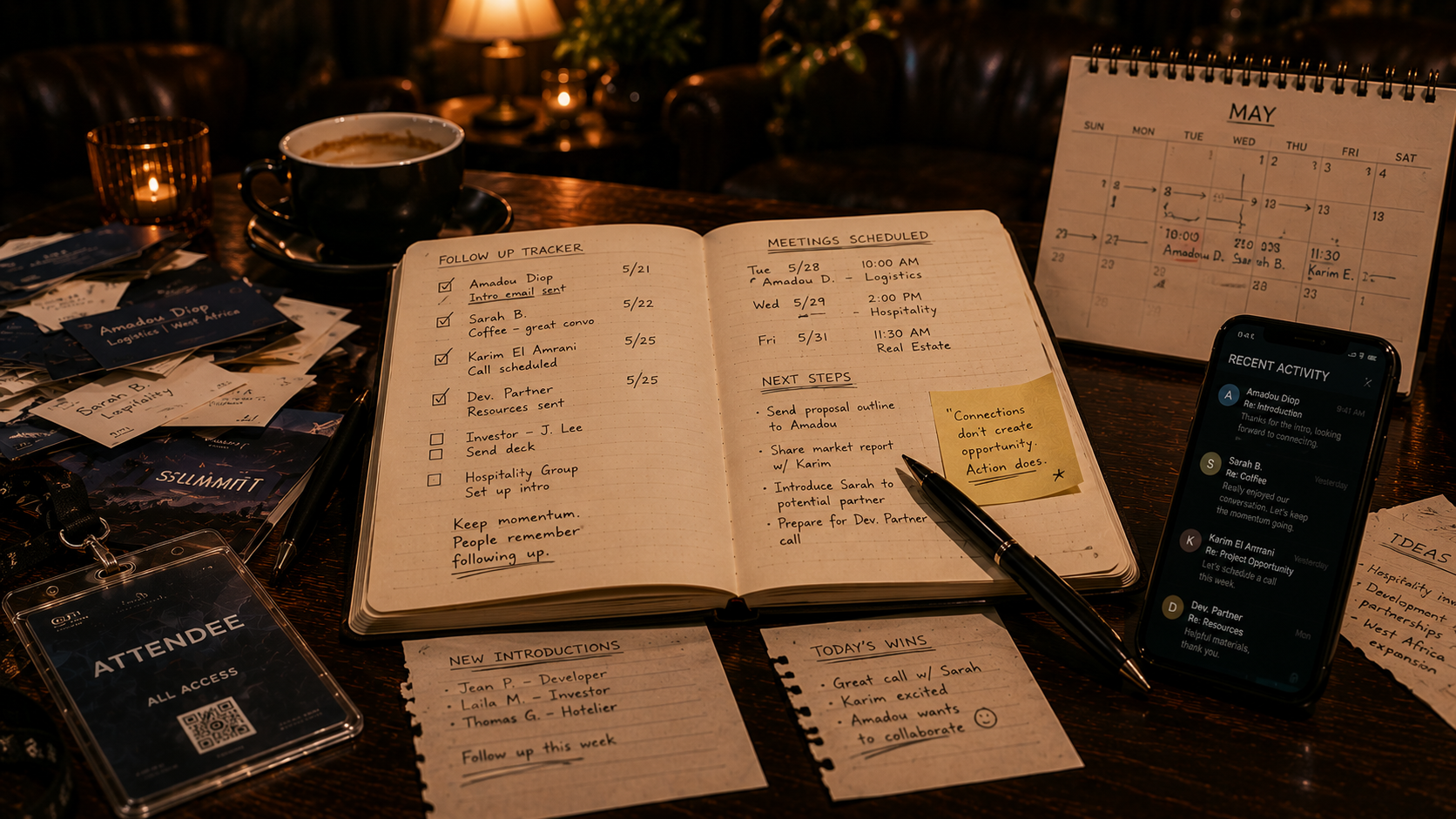
The strongest networks are built over time. Through trust. Through contribution. Through what happens after the introduction. The Founder Network Ledger gives you a way to see those relationships clearly and act on them deliberately.
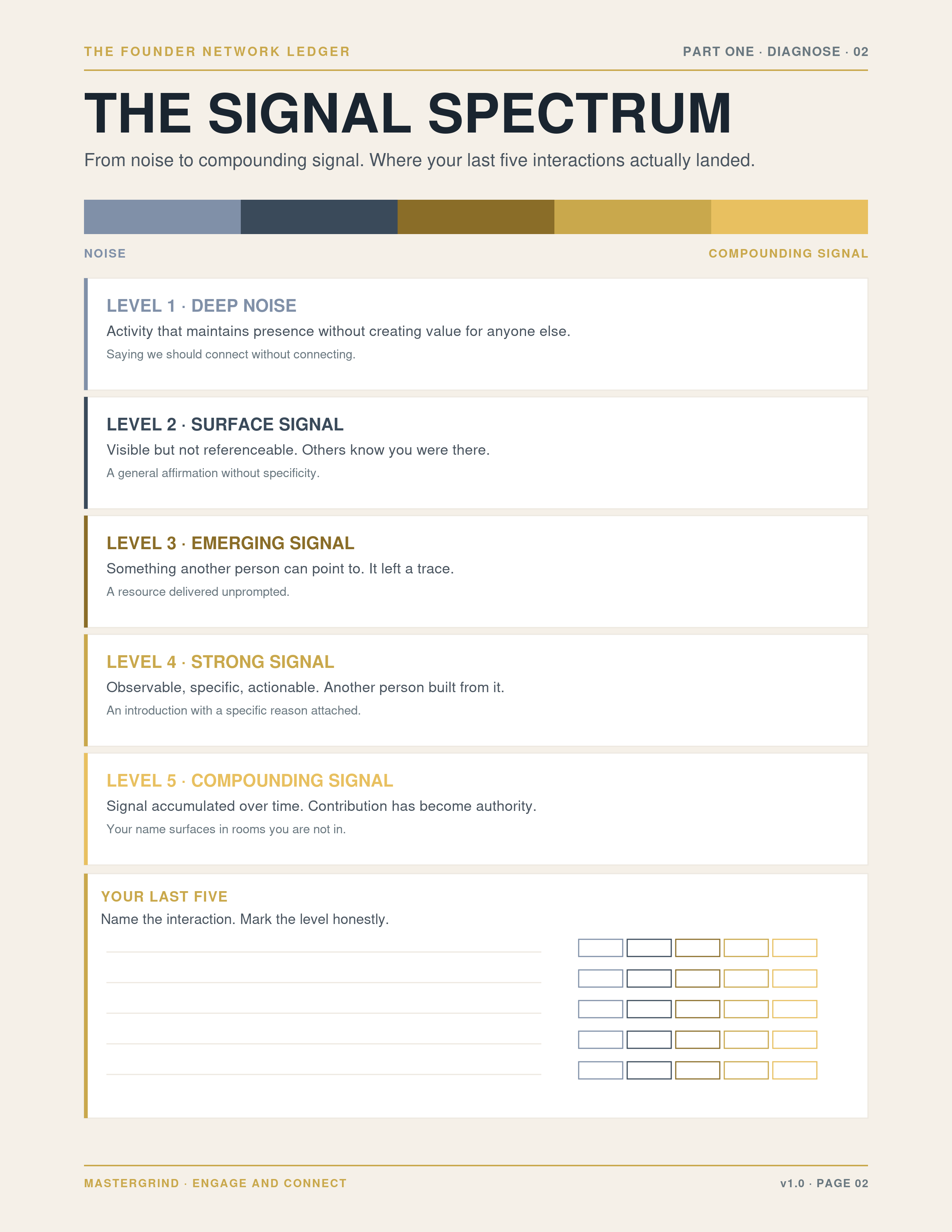
Seven pages. No noise. No performance. Nothing in it works until you write on it.
mastergrind.network/network-ledger
GET ACTIVATED. STAY ACTIVATED.
Adam Grant, Give and Take. Viking, 2013.
Mark Granovetter, The Strength of Weak Ties. American Journal of Sociology, 1973.
Judy Robinett, How to Be a Power Connector: The 5+50+100 Rule. McGraw-Hill, 2014.
This matters because most founders measure their engagement by how it felt. They had a good conversation. They made a strong impression. They left the room feeling like they sho...

Two tables from the same three days.
The first one is on the convention floor, mid-afternoon, day two. Identical booth surfaces running down the aisle. On the counter, brochures fanned out. A card holder with the cards still stacked in it. A branded pen set out for the taking. A paper coffee cup from the morning session, still where someone set it down.

Everything on that surface was designed for volume. Nothing on it is specific to any individual person.
The second table is in a restaurant, eleven at night, the same city. The official event ended three hours ago.
A convention badge lies on the wood, lanyard still attached, creased from being folded into a pocket. Two glasses, one nearly finished, a ring left on the surface underneath. An open notebook. Handwriting: names with lines drawn between them, one name underlined twice, a question written and crossed out and written again below itself. A follow-up task with a time noted beside it.
Same event. Same three days. Look at what each surface produced.
The badge is off.
Small thing, and it is the whole evening. At some point in the last three hours this stopped being an event and became a conversation, and the badge came off because nobody at that table needed a name tag to know who they were talking to.
Everyone at the first table still has theirs on.
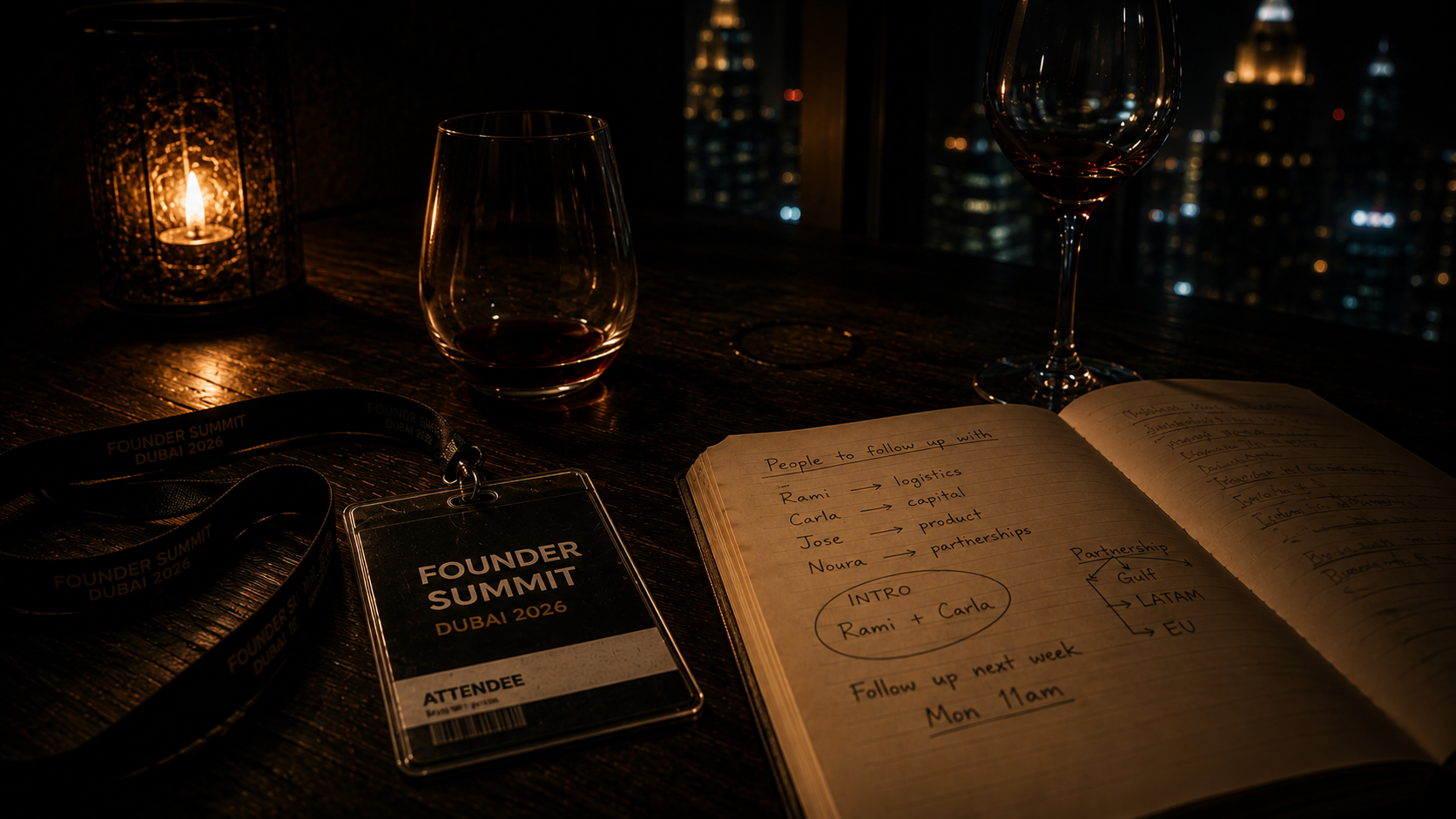
Two glasses, and a ring under one of them.
A ring means a glass sat long enough to leave a mark. Nobody was working the room. Nobody left to go work the room. The conversation went somewhere and the people in it stayed with it, which is the rarest thing that happens at a convention and the least likely to appear in any recap of it.
Names with lines drawn between them.
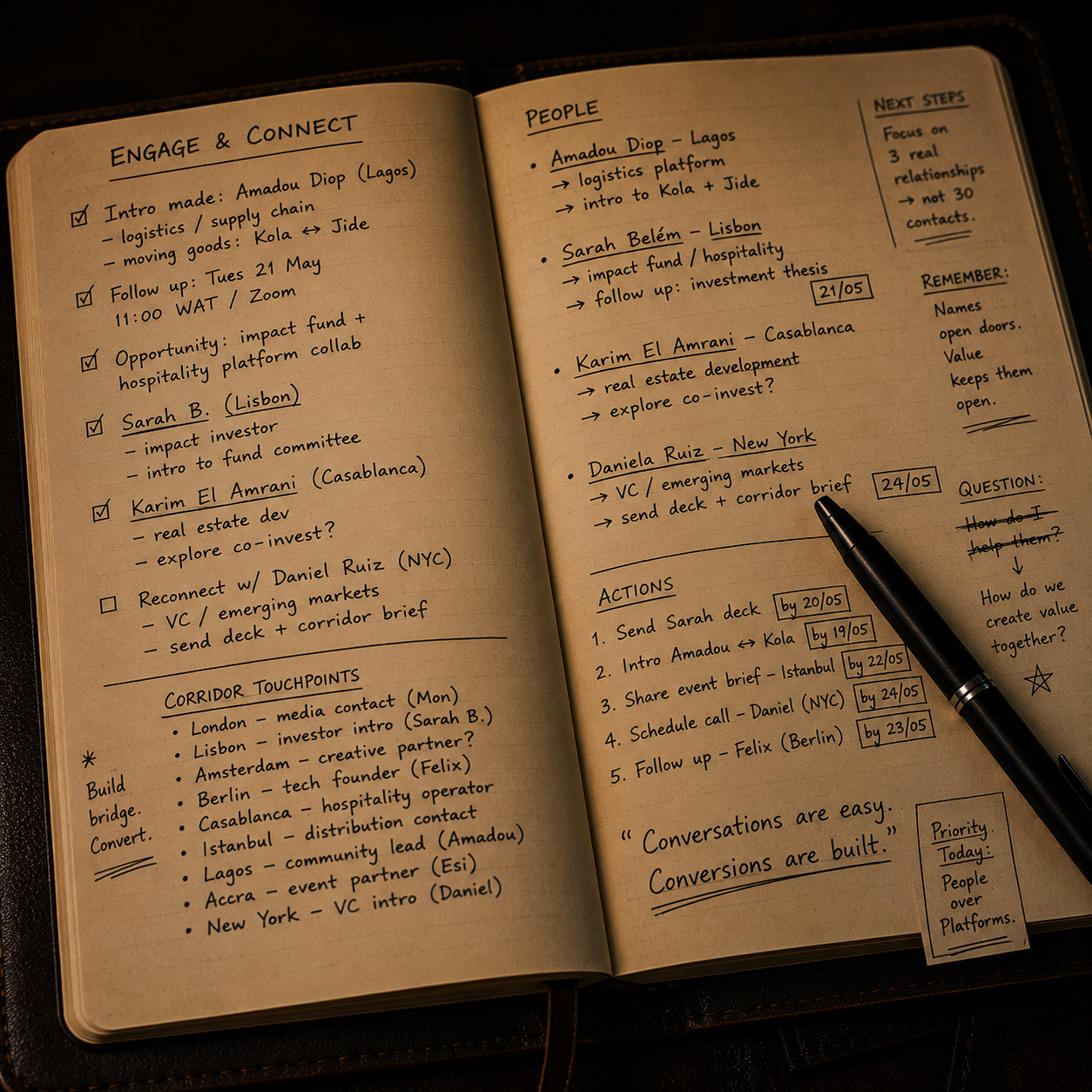
Not a list. A list is what you write when you are recording who was present. Lines between names is what you draw when you are working out who should know each other, which means the person holding the pen had stopped collecting and started thinking.
A question crossed out and rewritten.
This is the detail that matters most and it is almost invisible. The first version of the question was not good enough, and somebody noticed, in the middle of a conversation, and fixed it.
That is not note-taking. That is thinking, in real time, about somebody else's problem.
A time written beside a task.
Not a name. Not a reminder to follow up. A time. Which means the follow-up is already scheduled, and the thing you promised has a place to land.
Almost nobody does this and it costs four seconds.
Brochures nobody folded. Cards nobody took. A pen. A cup from the morning.
The room did exactly what it was built to do. It moved a lot of people past a lot of surfaces, efficiently, on schedule, and everyone who attended can honestly say they attended.
That is the thing worth sitting with, because the convention was not broken. It worked as designed. It is simply that what it was designed to produce and what you needed from it were never the same thing, and nobody told you that, and the badge and the schedule and the room made it feel like they were.
The real conversation was in the restaurant, three hours after the room closed, and it was not on the programme.

The founders who consistently end up at the second table are not more charming than you. They did one thing before the first table, and it took about five minutes.
They decided what this room was actually for. Not what the organisers said it was for. What it could produce, specifically, for them, and who would be in it, and what they had that was worth handing to someone, and where in the building the real conversation was likely to be.
None of that is charisma. It is a decision made in a taxi, and it is the difference between the two tables.
Think about the last room that mattered. What was left on the table after it?
If the answer is a badge you still have in a drawer and a contact you never wrote to, that is not a failure of confidence. It is a decision that was available to you and that nobody told you to make.
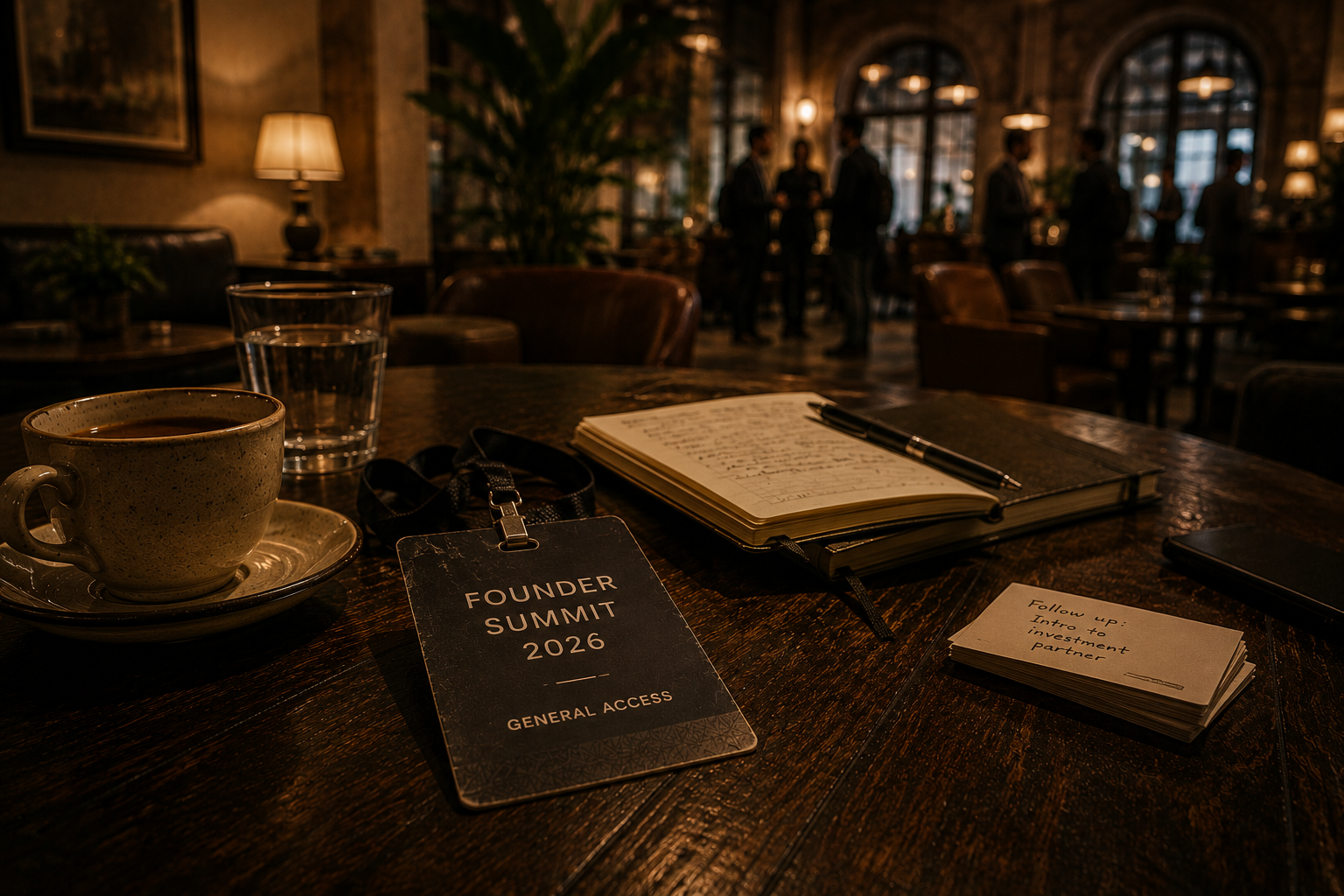
The strongest networks are built over time. Through trust. Through contribution. Through what happens after the introduction. The Founder Network Ledger gives you a way to see those relationships clearly and act on them deliberately.
Page D01 is where this episode continues: the five questions you run before the room, not after it.
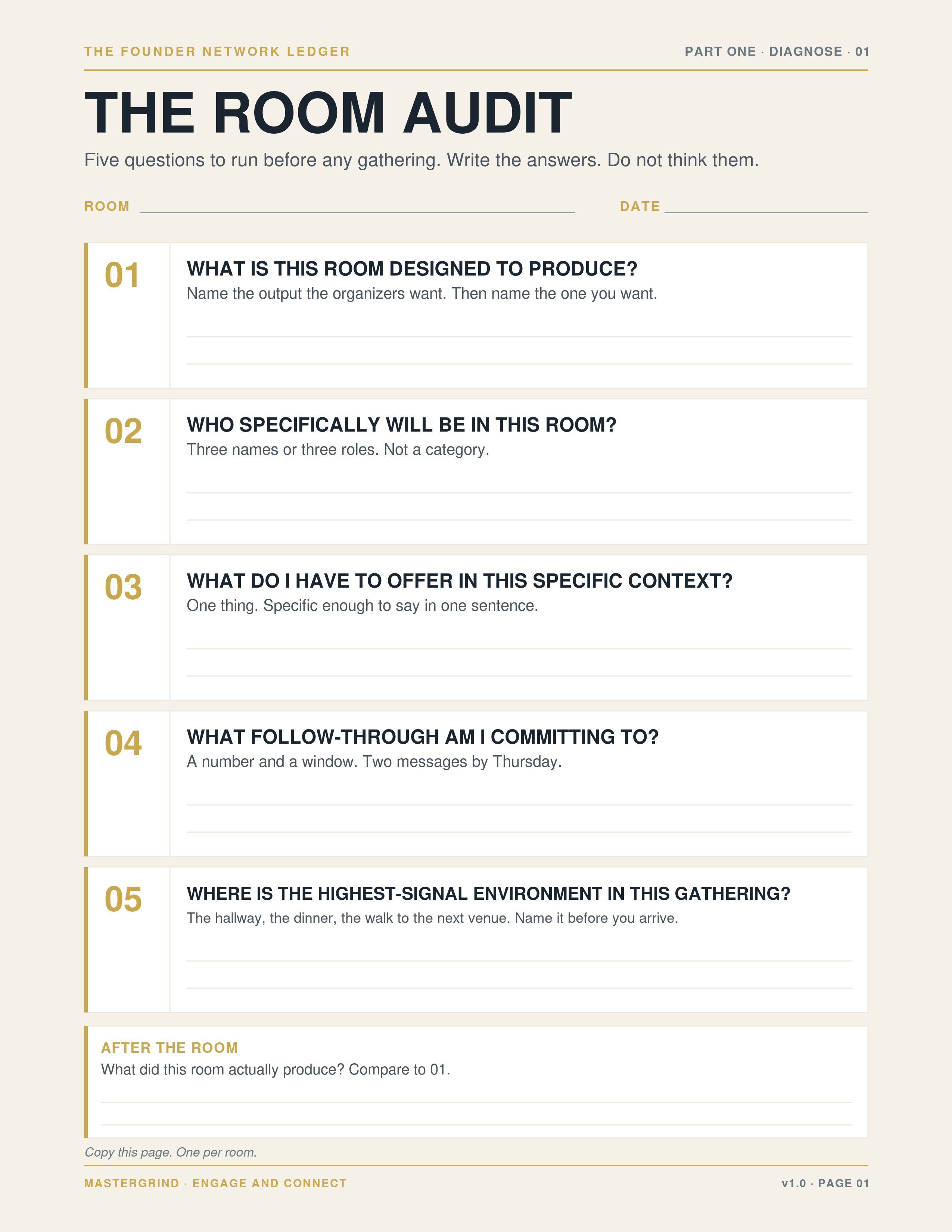
Seven pages. No noise. No performance. Nothing in it works until you write on it.
mastergrind.network/network-ledger
GET ACTIVATED. STAY ACTIVATED.

SOURCES REFERENCED IN THIS STREAM
Judy Robinett, How to Be a Power Connector: The 5+50+100 Rule for Turning Your Business Network into Profits. McGraw-Hill, 2014.
Keith Ferrazzi with Tahl Raz, Never Eat Alone: And Other Secrets to Success, One Relationship at a Time. Crown Business, 2005. Updated edition 2014.

The room was not failing. It was working exactly as designed. It was built for volume, not depth. For transaction, not trust. For the appearance of connection rather than...
Right now, in a room you care about, someone is describing you in terms you did not choose.
Maybe it is a potential partner framing what you do in a way that caps what you could become together. Maybe it is someone in your industry whose version of you has circulated long enough that other people have started to repeat it. Maybe it is closer than that. Someone who knows you well, or thinks they do, offering a description of your work or your vision or your capability that is smaller than what is actually true.
And the reason they can do that without resistance is simple. You have not made the accurate version costly enough to ignore.
A frame is just a story someone tells about who you are before you have told it yourself. It is not usually malicious. It is convenient. It fits inside what the room has already decided to expect from someone like you, in this field, at this stage, from this background. The frame is the room organizing you without having to reckon with the full version.
The problem is not that people build frames. They always will. The problem is the gap between the frame being applied and the declaration you have not made. That gap is where the wrong version lives. And it lives there as long as you allow it.
This is what Ali understood at a level most people do not. He was in a fight with the world version of him from the very beginning. The boxing establishment had a version. The press had a version. The draft board had a version. Every one was wrong. And he refused every one out loud, publicly, repeatedly, and at real cost to himself.
He did not do this because he was supremely confident. He did it because he understood something structural. The declaration is not an announcement you make after the world has agreed with you. It is a refusal. A refusal to let someone else version of you stand in rooms that matter without being challenged. The declaration is the fight, not the trophy.
Most founders understand the risk of declaring too early. The pitch that is not ready. The claim that outpaces the proof. The positioning that makes you a target before you have the armor. These are real risks.
What most founders do not account for is what silence costs on the other side. Every room you walk into where someone else version of you is already operating, and you do not correct it, is a room where you have surrendered a degree of your positioning. Not all at once. One degree at a time. Slowly enough that you stop noticing.
The calculation feels rational. Correcting the frame in this room with these people at this moment has a cost. Awkward. Potentially damaging to a dynamic that has taken time to build. So you make the reasonable decision to let it go for now.
But the frame does not wait for you to be ready. It circulates. It compounds. It becomes the working assumption in rooms you have not even entered yet. And the longer it runs unchallenged, the more work the correction requires when you finally make it.
Silence in the face of the wrong frame is not patience. It is permission. And what you permit becomes the operating assumption.
The refusal does not require an announcement. It does not require the right moment, the perfect pitch, or the audience that is ready to receive it. It requires one decision. The decision to make the accurate version of yourself more present in every room than the convenient version being offered.
Not louder. More specific. More real. So precisely and consistently articulated that the wrong version has nowhere to stand next to it.
This is what changes when you declare. Not the external circumstances. Not the room immediate reception. What changes is the internal architecture. Every subsequent decision, every conversation, every room you walk into gets oriented around the accurate version rather than around the management of everyone else comfort with it. The energy that was going into the management comes back to you.
You are in the fight whether you have declared or not. The only question is whether you are in it on your terms or on someone else terms.
Stop letting other people version of you go unanswered. The declaration is the answer. It is available right now.
Watch the video. Then ask what version of you has been running unchallenged in the rooms that matter.
Right now, in a room you care about, someone is describing you in terms you did not choose.
It happened again recently.
Someone described her in a room. Got the scope wrong. Got the ceiling wrong. Took six years of documented work and compressed it into a category that fit inside what they were comfortable expecting from her. And she let it happen. Not because she did not notice. She noticed immediately. She noticed the way you notice something you have been noticing for years.
She let it happen because correcting it has a cost. And she has become an expert at calculating whether the cost is worth paying in this room with these people at this moment.
The calculation is always wrong.
The cost of the correction feels immediate. Awkward. Potentially damaging to a relationship or dynamic that has taken time to build. The cost of not correcting it feels deferred. Something to address later when the time is right and the room is ready.
But the cost of not correcting it is not deferred. It compounds. Every room where the wrong version of her goes unchallenged, it circulates. It becomes the frame that other rooms receive before she walks into them. It shapes what people ask her for, what they offer her, what they believe she is capable of. The frame operates whether she is in the room or not.
And every time it goes unchallenged, the correction becomes more expensive. Not because the truth has changed. Because the wrong version has had more time to become the operating assumption.
The calculation treats the correction as the costly act and the non-correction as the neutral one. Neither is neutral. She is paying either way. The only question is which payment is going toward something.
The correction is not a confrontation. It does not require anger or edge or the performance of a certainty she does not feel. It does not require her to be louder than the wrong version or to make anyone uncomfortable on purpose.
It requires one thing. The willingness to make the accurate version of herself more present in the room than the convenient version being offered. Consistently. Specifically. Not once, not when she has gathered enough proof, not when the relationship feels secure enough. Now. In this room. With these people.
The accurate version does not argue with the wrong frame. It replaces it. When you are specific enough about who you are and what you have built and where you are going, the wrong version has nowhere to stand next to it. It cannot survive that kind of specificity because it was built on vagueness, on the absence of the real thing.
You do not correct a wrong frame by being patient. You replace it with something so clear it cannot stand next to it.
The professional rooms are not the hardest ones. The market does not have a prior version of her. She can walk into a new professional relationship and lead with the accurate version and it becomes the baseline.
The harder rooms are the ones that have been running the wrong version for years. The industry contacts who categorized her at an earlier stage and have not updated. The colleagues who know her as a specific thing and relate to her through that category. The rooms where the wrong version is not convenient so much as it is established, held in place by the inertia of a long history.
These are the rooms where the declaration feels most costly. And these are the rooms where it is most necessary. Because the longer an established wrong frame goes unchallenged, the more it shapes what she is offered, what she is considered for, and what people believe she needs.
The correction in these rooms is not aggressive. It is a recalibration. Steady, specific, and repeated enough that the accurate version becomes the baseline the relationship operates from going forward.
Every room you leave without the correction costs you the next one. The declaration is not a moment. It is a practice.
Watch the video. Then ask which rooms have been running the wrong version of you for long enough that you have stopped noticing.
Someone described her in a room. Got the scope wrong. Got the ceiling wrong. And she let it happen.
Six years in. The work is real. The results are documented. Nobody who has seen what she has built can question whether she is capable.
But the people closest to her are still holding a version of her from before any of it existed. And she has been careful not to disturb that. Not to make the update feel like a loss for them. Not to let the full scope of what she has become land in a way that changes the relationship.
She calls it consideration. It is. It is also the most expensive habit she has.
Every time she manages the distance between who she is and what the room can hold, she is not protecting the relationship. She is protecting a version of herself that no longer exists from a retirement it deserves. The people who love her are not fragile. They are uninformed. Those are different problems with different solutions.
Protecting people from who you have become is not love. It is a slow withdrawal from the relationship they think they have with you.
Watch the video.
Activated Minds is a five-episode series built on a philosophy of activated greatness. Each episode follows one founder mind through one moment of pressure. This is Episode 01, Part Two. The series is the argument.
Follow Streams · Free to subscribe
GET ACTIVATED. STAY ACTIVATED.
What she has not said, not at this table or at most of the others, is the full scope of what she is building and who she is becoming in the building of it.
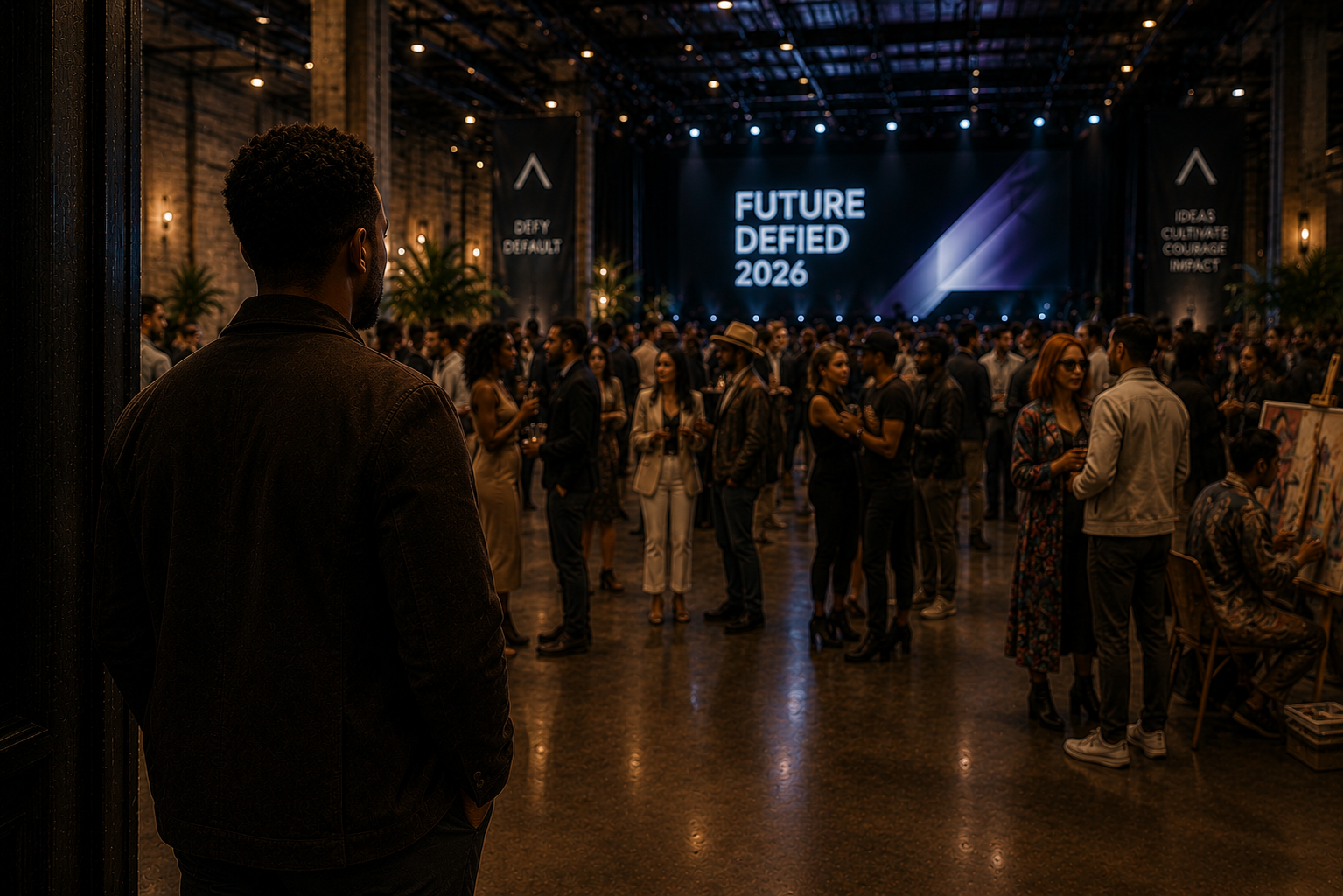
You have been building something real. You know what it is. You know what it can become. And in every room that matters, you have been giving people a version of it that fits inside what they already expect from you.
Not because you are unsure. Because declaring the full thing out loud changes the stakes. It makes the identity real in a way that living inside it privately does not. It closes the door on the smaller version. And part of you is still calculating whether the room is ready.
Here is what that calculation is actually costing you. Every conversation you manage, every pitch you soften, every room you leave without saying the real thing, you are training yourself and everyone around you to operate with a diminished version of what you actually are. That version compounds too. Just not in your direction.
The declaration is not a reward you earn after the proof accumulates. It is the move that makes the proof matter.
Watch the video. Then ask yourself how long you have been waiting for permission that was never coming.
Follow to Stay Close to What's Being Built
GET ACTIVATED. STAY ACTIVATED.
Most founders understand the risk of declaring too early. The market is not ready. The idea will get stolen. The timing is wrong. The room will not receive it. These are real risks

There is something that does not appear in any of the economic data about AI displacement. It does not appear in the Stanford payroll study, the Goldman Sachs projections, or the WEF forecasts. It does not appear in the policy debates, the UBI experiments, or the sovereign fund announcements.

It appears in the work of two economists at Princeton who spent years trying to understand why working-class Americans were dying at increasing rates from causes that had no clean medical explanation. Anne Case and Angus Deaton called it deaths of despair. Drugs. Alcohol. Suicide. A mortality reversal so stark that it was visible in aggregate life expectancy data for an entire demographic group.
Their conclusion was not primarily about income. It was about something that income cannot replace.
"Jobs are not just the source of money; they are the basis for the rituals, customs, and routines of working-class life. Destroy work and, in the end, working-class life cannot survive. It is the loss of meaning, of dignity, of pride, and of self-respect." — Anne Case and Angus Deaton, Deaths of Despair and the Future of Capitalism, 2020
Case and Deaton were studying a specific demographic. But the structural insight is universal. Anyone who has thought carefully about what work means to communities where its stakes have always been higher will recognize it immediately.

In the communities this series is built for, work has never been only a paycheck. Whether you are a founder from New York or Paris, Lagos or London, Karachi or Kingston, Cairo or Atlanta, work has carried a specific weight that people outside that experience rarely understand. It has been proof. Proof of capability in the face of systems that questioned whether you were capable. Proof of belonging in rooms that were designed before you arrived. Proof that the sacrifice required to get here was worth it: the parents who worked multiple jobs, the education taken on debt, the years building expertise in a field that did not automatically offer access.
That proof structure is not peripheral to the AI displacement conversation. It is central to it. Because what is being automated away is not just labor. It is a scaffolding of identity that cuts across cultures, across geographies, across generations of people who had to earn everything they hold.
A monthly government check does not rebuild scaffolding. This is why the answer to the displacement problem, for this specific community at this specific moment, is not a policy framework. It is a different kind of ownership. The operational kind. The kind that compounds. The kind that makes you the person who gets called, not the person who applies. The kind that exists because you built it before the consolidation made it unavailable.
Set aside the meaning for a moment. The economic argument is hard.
A complete AI-native business stack in 2026 costs between $3,000 and $12,000 per year in tooling. That is a 95 to 98% cost reduction compared to what it cost five years ago to assemble a team with equivalent output. The entire operational infrastructure that previously required a funded seed round can now be bootstrapped on a consulting retainer.
The market is responding. Solo-founded startups went from 23.7% of new US companies in 2019 to 36.3% by mid-2025. The US Census shows 29.8 million non-employer businesses generating $1.7 trillion in revenue, which is 6.8% of US GDP. Revenue-per-employee ratios for AI-native companies are running five to ten times higher than prior generations of software businesses.
The cases are not theoretical. A developer named Maor Shlomo launched a product in February 2025, working alone and AI-native from day one. Month one: $1.5 million in revenue. By June he had sold it to Wix for $80 million cash plus $90 million in earn-outs. Medvi, a telehealth company run by a single founder, generated $401 million in revenue in its first year of operation. Cursor reached $500 million in annual recurring revenue with fewer than 50 employees.
These numbers are real. But here is what matters more: the window that made them possible is not infinitely open. Markets discover value and price it. Categories fill. The founders who built in 2024 and 2025 were moving before the consensus caught up. The founders who move in 2028 will find a different market. The positions will already be held.
In 2024, researchers at UC Berkeley's Haas School of Business published an analysis of approximately 91,000 US startups, examining the relationship between founder background and company outcomes. What they found about founders who operate across two cultural or national contexts has not received the attention it deserves.
Startups with mixed teams of immigrant and US-born founders employed 20% more people after three years than immigrant-only teams. They filed 117% more patents. They attracted 43% of their capital from international sources, compared to 8% for native-only founder teams. The researchers described it as network arbitrage: the bridge founder reaches labor markets, capital markets, and customer markets that a founder operating inside a single context cannot access simultaneously.

This finding is not about any one diaspora. It is about the structural advantage that accrues to founders who have spent their careers navigating between contexts, who have built relationships across networks that do not naturally intersect, who understand what it means to earn trust in environments where trust was not automatically extended. The Nigerian founder who moves between Lagos and London. The Pakistani founder who bridges Karachi and Toronto. The Egyptian founder who operates across Cairo and Dubai. The Jamaican founder who connects Kingston and New York. Each of them has been developing, without necessarily naming it, exactly the kind of multi-context intelligence the Berkeley Haas data identifies as the highest-performance configuration in modern startup research.
Gartner found in 2025 that 53% of consumers already distrust AI-generated content. The premium on demonstrably human, demonstrably accountable, demonstrably real is going up. It is going up fastest exactly where the synthetic content flood is highest: creative fields, consulting, advisory, community, media. These are the categories where founders with earned trust across multiple contexts are, right now, holding the most valuable asset in the market.
Source UC Berkeley Haas — startup success, immigrant founder edge (2024)
Source Gartner — 53% consumer distrust of AI content (2025)
Here is what this series has been building toward. What the data does not say plainly enough.
Whether you are building in Lagos or London, Nairobi or New York, Dubai or Accra, the founders this series is addressed to share something that does not appear in any investment report. You have not been waiting for this window. You have been building toward it for years, in conditions that were not designed to support you, with resources that were not proportional to your capability, in rooms where you had to earn three times what others were given credit for.
You have been developing, without naming it as such, exactly the layers that AI cannot replicate. An audience that trusts you because you showed up consistently and without artifice. A method that is yours because you built it from experience, not from a template. A community that moves for you because the relationships inside it are real. A cultural identity specific enough to attract and repel, which is the only kind that compounds.
The MENA startup ecosystem reached $7.5 billion in funding in 2025. African tech funding grew 25% to $4.1 billion. The Arabic LLM gap represents 450 million speakers whose language has training data equivalent to a 12-million-speaker language. It is an entire vertical with no dominant owner yet. The diaspora networks connecting New York, ParisLagos to London, Accra to Atlanta, Nairobi to New York, Karachi to Toronto are functioning as distributed infrastructure for a new generation of bridge founders. The communities that were told they were behind are holding, right now, some of the most strategically positioned assets in the AI economy.
The window is open. It is not infinitely open. The founders who understand this and move now will not be asking permission in three years. The ones who wait for the conditions to be perfect, for the room to be ready, for the system to recognize what they have built, will find the window has closed around them while they were waiting.
The machine doesn't owe you a seat. But you have been building a different room. The question is whether you build it before this window closes, or after the cost of building it has gone up by a factor of ten.
There is something that does not appear in any of the economic data about AI displacement. It does not appear in the Stanford payroll study, the Goldman Sachs projections, or th...
There is a room where the real decisions about the AI economy are being made. Policy is not happening in that room. Regulation is not happening in that room. Redistribution proposals are not happening in that room.
What is happening in that room is capital allocation. Specifically: who will own the infrastructure that everything else runs on.
In May 2025, Sam Altman stood in Riyadh and announced a partnership with Saudi Arabia's sovereign wealth fund, the Public Investment Fund, to build Stargate: the largest single technology infrastructure investment in history. The same week, the UAE announced its own Stargate campus in Abu Dhabi: one gigawatt of AI compute capacity, described as the largest AI infrastructure project outside the United States.
These are governments. Not technology companies. Not venture funds. Governments. What drove them to move at this speed and scale is the same insight that most founders operating in the AI economy have not yet internalized:

Whoever owns the infrastructure captures the compounding value. Everything built on top of it pays rent.
"The question of who controls the AI infrastructure is not a technical question. It is the central political economy question of the next fifty years." — Mariana Mazzucato, Professor of Economics and Innovation, University College London, 2024
Source Mazzucato, M. — The Big Con (2023); public remarks on AI infrastructure, 2024
Let the numbers sit for a moment before the argument.
Anthropic raised its Series G in February 2026 at a $380 billion post-money valuation. By May 2026 it was in talks for a new round close to $950 billion. OpenAI was valued at $852 billion in March. The five largest hyperscalers, Microsoft, Amazon, Alphabet, Meta, and Oracle, spent $448 billion on AI infrastructure capital expenditure in 2025 alone. The projection for 2026 is $562 to $602 billion. Combined hyperscaler capital expenditure projected across 2025 through 2027 exceeds $1.15 trillion.
Saudi Arabia's HUMAIN, a sovereign AI entity owned entirely by the Public Investment Fund and launched in May 2025, has committed to a $10 billion venture fund, a $10 billion joint venture with AMD, a $2 billion partnership with Qualcomm, and a data center buildout targeting 6.6 gigawatts of capacity by 2034. The UAE's MGX, with a $100 billion target AUM, has taken positions in OpenAI, xAI, Databricks, Anthropic, and Binance. It co-launched the BlackRock-Microsoft-GIP AI Infrastructure Partnership with an initial $30 billion commitment scaling to $100 billion.

Now the other side of the ledger.
The MENA startup ecosystem reached $7.5 billion in funding in 2025, a 225% year-on-year increase. But 91% of that capital concentrated in Saudi Arabia and the UAE, flowing to established names. Across sub-Saharan Africa, the top four markets captured 85% of all tech funding. In the United States, Black-founded startups received 0.4% of all venture capital in 2024. In the United Kingdom, a decade of data found that Black and minority ethnic entrepreneurs received less than 1% of venture capital. The most consequential technology buildout in modern economic history is underway. The founders most exposed to its displacement effects hold almost no equity in its upside.
This is not a diversity problem in the way that phrase is usually meant. It is an ownership problem. And ownership, once concentrated, does not redistribute on its own.
Source Anthropic — Series G at $380B (February 2026)
Source Wamda — MENA startups record year $7.5B (2025)
Source Crunchbase — Black founder funding multiyear low (2025)
In December 2023, the New York Times filed suit against OpenAI. The allegation: that decades of journalism, reported, written, edited, and published by human beings, had been used without permission or compensation to train a commercial product now competing directly with the outlet that produced it.
The case survived a motion to dismiss in March 2025. A preservation order was issued covering more than 400 million ChatGPT user conversations. In June 2025, a federal court ruled in favor of Anthropic in Bartz v. Anthropic. Training on copyrighted material was fair use. A similar ruling followed in Kadrey v. Meta days later.
The legal framing is fair use. The economic framing is something older and more precise: enclosure.
In 18th century England, the enclosure movement converted common land into private property. Land that had been collectively used and managed for generations. The people who had worked that land, built lives on it, and developed knowledge about it were not compensated. The land became capital. They became tenants or displaced persons.
What is happening with AI training data is structurally identical. The collective creative and intellectual output of the internet, built by writers, coders, artists, educators, researchers, translators, and millions of ordinary people over three decades, is being enclosed as private intellectual property. The writers who went on strike in 2023 understood this. The visual artists filing class actions against Stability AI understood this. The programmers whose Stack Overflow contributions fed language models understood this. None of them have won. The enclosure is proceeding. And the people whose creative and intellectual labor built the training data, who come from every country, every language, every background, receive nothing from the asset their work created.
Source NPR — NYT v. OpenAI copyright case survives motion to dismiss (March 2025)
It would be convenient if this were a partisan story, one political party the obstacle and another the solution. It is not. The speed problem, the gap between how fast AI capability is moving and how fast policy can respond, is structural. Not political.
Sam Altman personally funded one of the largest universal basic income studies ever conducted. Three thousand participants across Texas and Illinois received $1,000 per month for three years. The results, published in July 2024: recipients worked 1.3 fewer hours per week. They used more healthcare. They were marginally happier. They were more selective about employment. Nothing transformed.
This is not an argument against cash transfers. It is an argument about the category of problem. A stipend, at that amount, in that timeframe, did not change the structural position of recipients in the labor market. They were still in the same rooms, facing the same walls, with slightly more in their pockets.
The World Economic Forum projects 92 million job displacements by 2030. The legislative process for any of the serious frameworks being discussed, robot taxes, sovereign wealth funds, universal basic services, has barely begun in any major economy. Policy moves in years. AI capability moves in months. There is no rescue arriving at the speed the disruption is moving. The entities that understand this are not waiting for one. They are buying the infrastructure.
The lesson is not cynicism. The lesson is legibility. See the game clearly. The sovereign funds are not building UBI arguments. They are buying equity positions in the infrastructure layer. That is the tell. That is what understanding this transition actually looks like from the inside.
Source OpenResearch / Eva Vivalt — UBI study results (July 2024)

The founder this series is built for does not have sovereign capital. They do not have a $10 billion venture mandate. They are building in Lagos, in London, in Karachi, in Toronto, in Dubai, in Atlanta, in Nairobi. They have the capability. What they often lack is the structural positioning that turns capability into durable leverage.
The structural principle driving governments to move at this scale and speed is the same principle available to any founder willing to act on it: own a layer before it is priced in. Establish a position in the AI economy, in a niche, in a community, in a named method, in an audience, before the consolidation makes that position unavailable or prohibitively expensive to build.
The window is not infinite. Markets discover value and price it. Communities form and fill. Categories solidify. The founder who moves in 2026 is not moving at the same cost as the founder who moves in 2029.
Nobody is coming with the cavalry at the speed this requires. The question is not who is going to fix this. The question is what you build while the window is still open and what it means to own something in an economy where everything else is renting.
Part 3 - Own a Layer Before the Window Closes is the operational close: what founders actually build, who is already doing it, and why the window for this specific move has a date on it. Subscribe to get it direct.

There is a room where the real decisions about the AI economy are being made. Policy is not happening in that room. Regulation is not happening in that room. Redistribution proposa
There is a question nobody is asking loudly enough.
Not whether AI will displace workers. That debate is settled, the payroll data from Stanford's August 2025 study of ADP records makes it empirical, not theoretical. Not whether the disruption is accelerating. The pace is documented. The question nobody is asking loudly enough is this:
Not in this disruption. In every disruption. The answer is not incidental. It is structural. And if you do not understand the structure, you will spend the next decade waiting for a rescue that is not coming, while the people who understood it are already building somewhere else.
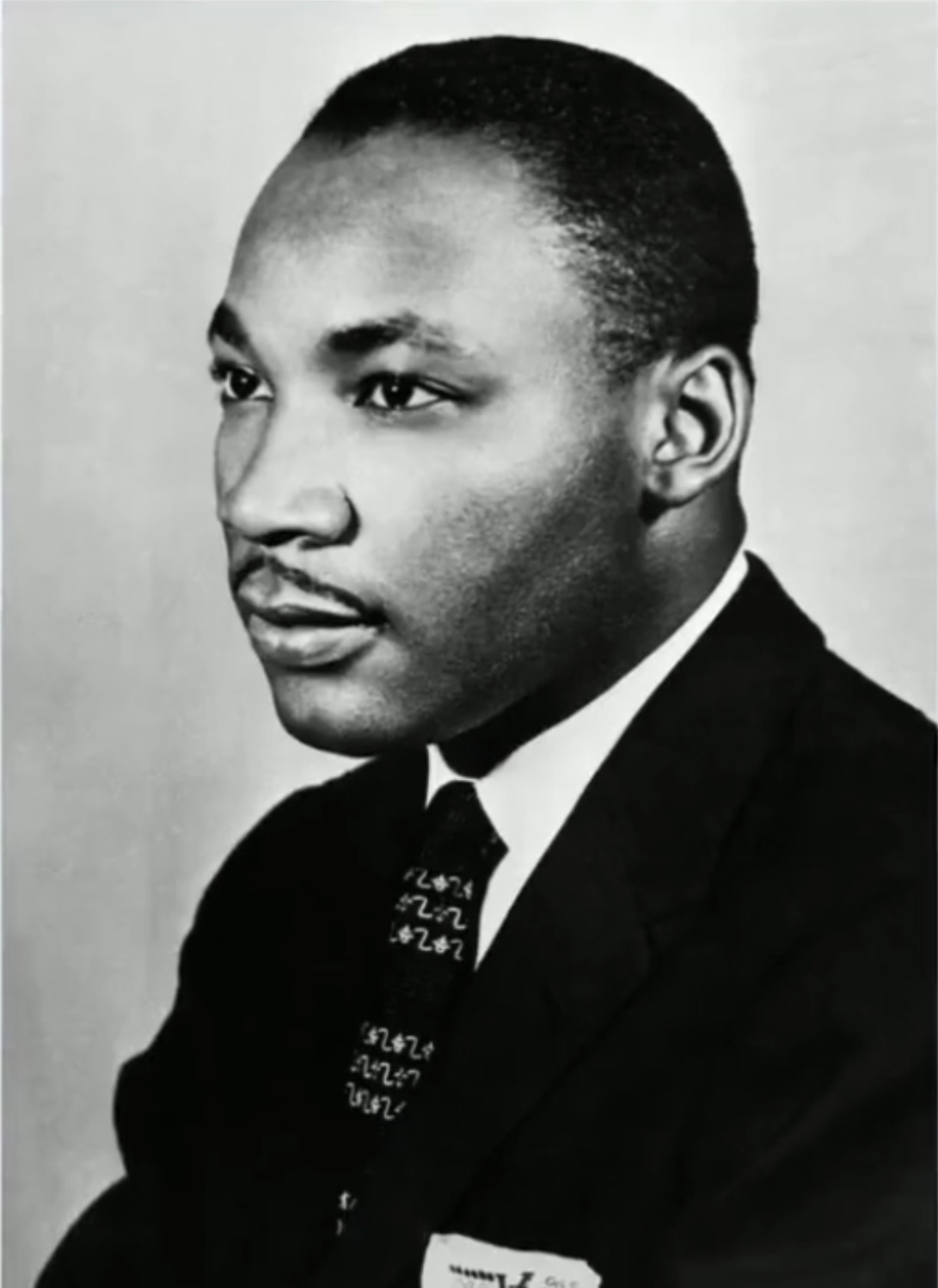
"Automation cannot be permitted to become a blind monster which grinds out more cars and simultaneously snuffs out the hopes and lives of the people by whom the industry was built.", Martin Luther King Jr., AFL-CIO Fourth Constitutional Convention, 1961
Source MLK Jr., Address to the AFL-CIO Fourth Constitutional Convention, Miami, December 11, 1961
December 1961. King was not speaking to a civil rights audience. He was speaking to the AFL-CIO, the largest labor federation in the United States, and he was talking about the automobile industry. About the assembly lines in Detroit, Flint, and Cleveland that had absorbed hundreds of thousands of Black workers who had migrated north from the South in the 1940s and 1950s. Workers who had built careers, bought homes, raised children, and established communities on the back of wages that were, for the first time in many of their families' histories, stable and growing.
Automation was beginning to remove those wages. Not slowly. At scale. And King understood, with a clarity that most of the labor movement did not yet share, that the workers who would absorb the first shock were not random. They were the workers who had arrived last. Who had the least institutional protection. Who had the fewest alternative paths. Who had, in every prior wave, been moved to the back of the line the moment conditions shifted.
He was describing a mechanism, not an incident. He was describing the repeating logic by which American economic transitions have always been managed: the people who built the previous system shoulder the cost of the next one.
That mechanism is operating right now. And it is operating on a new target.

The Credential Was the Ladder. Now It's the Trapdoor.
Stanford researchers Erik Brynjolfsson, Arun Chandar, and Siddharth Chen published their findings in August 2025, drawing on ADP payroll records for millions of American workers. The headline number was a 13% relative employment decline for workers aged 22 to 25 in the most AI-exposed occupations since late 2022. Software developers in that cohort were down nearly 20% from their peak. Workers in those same fields who were 30 and older saw employment grow by 6 to 12%.
Read that again. The people who just got in the door are being pushed back out. The people who already had the keys are fine.
This is not a coincidence of timing. It is the same mechanism King described, now running through a different industry. The cognitive labor economy was supposed to be the answer to the automation of physical labor. The degree, the certification, the decade of accumulated professional experience, these were the hedge. Legal research, financial analysis, marketing strategy, creative production, consulting, code. These were the roles that were supposed to be protected.
Brookings Institution research found that Black workers in the United States are roughly 40% more likely than white workers to be employed in jobs at high automation risk. Of the five occupations that employ the most Black and Latino workers, four are among the most AI-exposed. The workers who fought hardest to enter the professional economy, the first generation to carry a college degree, the immigrant who retrained, the woman who broke into a field that resisted her, are walking into a trapdoor built inside the room they were finally allowed to enter.
Source Stanford HAI, Canaries in the Coal Mine? (Brynjolfsson, Chandar, Chen, August 2025)
Source Brookings Institution, automation risk and racial disparities (Kristen Broady, 2024)
This is the part of the conversation that gets misframed. The machine is not the villain. Technology has never been the villain in any automation story. The villain, if you want to use the word, is the mechanism that decides who absorbs the disruption cost and who captures the productivity gain. That mechanism has been consistent across two centuries of industrial transformation. It is not malicious in the way a person is malicious. It is structural in the way gravity is structural: it does not need to intend anything. It just operates.
In the 1810s and 1820s, the Luddite movement in England was not opposed to technology. It was opposed to the use of technology to dispossess skilled weavers of the economic position they had built over decades. The machines did not take the jobs. The owners of the machines did, by deploying them specifically to eliminate the leverage of organized skilled labor.
In the 1950s and 1960s, the automation of American manufacturing did not hit all workers equally. It hit Black workers, who had the least seniority protection and the fewest alternative employment paths, with a severity that contributed directly to the economic collapse of communities that had been stable for a generation.
Now it is running through the knowledge economy. The target is different. The mechanism is identical.
Goldman Sachs estimates 300 million full-time-equivalent jobs globally are exposed to AI disruption. McKinsey projects up to 30% of US work hours could be automated by 2030. The World Economic Forum's January 2025 report projects 92 million job displacements by 2030, concentrated in the clerical, administrative, and data-entry roles that represent the entry points into the professional economy. The Joint Center for Political and Economic Studies put a number to what that means structurally: median Black household wealth is $44,890. Median white household wealth exceeds $285,000. The cushion that determines whether a displacement period is survivable or catastrophic is not distributed equally. The people first in the path of the disruption have the least to land on.
Source Goldman Sachs, How Will AI Affect the US Labor Market? (2024)
Source WEF Future of Jobs Report 2025 (January 2025)
Source Joint Center for Political and Economic Studies, AI RFI submission (2025)
This is not a case for despair. King was not making a case for despair in 1961 either. He was making a case for clarity. For seeing the mechanism clearly enough to stop being surprised by it, and to build something that the mechanism cannot reach.
The floor is falling. That is empirically established. The communities that built the floor are absorbing the first impact. That is historically consistent. The question is not whether the pattern holds. The question is what you build that does not depend on the floor holding.
That is what the next two parts of this series are about. Part 02 examines who is already moving, and why the institutions that are supposed to respond cannot move at the speed required. Part 03 makes the structural case for what founders build now, while the window is open, before the consolidation closes around them.
The machine doesn't owe you a seat. But the seat you build yourself, before the floor drops, is the only one that is yours.
Watch the video companion in the gallery, then download the AI Exposure Map at the link below. It maps the five layers you can own that AI cannot replicate and scores where you stand on each one right now.

This is not about technology. It never was. It is about a pattern so old it has a name, and a predictable answer to the question of who pays for it first.

The Machine Doesn't Owe You a Seat is a three-part Mastergrind Originals documentary series on AI displacement, ownership concentration, and the structural window available to underrepresented founders right now before it closes. It does not argue that AI is good or bad. It argues that the same mechanism that has decided who absorbs the cost of every major economic transition for two centuries is operating again. The founders who understand it clearly enough to move before the consolidation are the ones who will not be asking permission in three years.
The Machine Doesn't Owe You a Seat is a three-part Mastergrind Originals documentary series on AI displacement, ownership concentration, and the structural window available to u...
On Artificial Intelligence (AI and AGI)
Alexander Oliver, Founder of Mastergrind
When people ask me what I think about AI, I notice the fear in the question before they finish asking it.
I get it. Nobody wants to find out that what they spent years building can now be done by a machine in thirty seconds. That is a scary thing to sit with.
But here is what I actually think.

I have been sitting with a version of this question for a long time, longer than the current AI conversation has been happening. I grew up watching people with serious talent end up in places that were too small for them. Not because they were not good enough. Because they never had the infrastructure to translate what they carried into something the world could see and trust. They kept performing, kept producing, kept showing up for systems that were never going to give back what they put in. That stayed with me. It is a big part of why I build what I build. And it is why this moment feels less like a crisis to me and more like a clarification.
The job losses are real. I want to say that clearly before anything else. Young professionals are watching entry-level work disappear. Entire career paths that used to take ten years to climb are getting compressed or cut. The data is not ambiguous. Hundreds of thousands of roles have already been affected and the estimates for the next five years are significant. Anyone telling you this is not happening is not paying attention.
But here is the thing. This is not new. The pattern is not new.
December 1961. General Motors installs the first industrial robot on a factory floor in New Jersey. Within a generation, the manufacturing jobs that had built the American middle class were gone. Not because workers were not good enough. Because they were working inside a layer of the economy that capital no longer needed them to fill. The machine did not replace the worker. It replaced the worker's seat at the table. And nobody came to save them.

The same pattern ran through the knowledge economy in the nineties. Clerical work, data entry, middle management layers. Compressed or eliminated. The people most exposed were the ones who had built careers inside structures they did not own, executing tasks inside systems that belonged to someone else. When those systems changed, the careers changed with them.
What is happening now with AI is the same mechanism running faster and higher up the stack. The target this time is not the factory floor or the filing room. It is the knowledge work that everyone was told was safe. Writing. Analysis. Design. Coding. Customer service. Legal research. Financial modeling. The machine is moving through it the same way it always has. And the people most exposed are still the same kind of people. The ones who never owned the layer they were working in.
The machine does not owe you a seat. It never did.
AI did not create this problem. It made it impossible to ignore.
For years, people built careers on being busy. They produced content because the algorithm rewarded volume. They performed expertise because nobody could easily check. They borrowed language and frameworks from people they admired and called it their voice. It worked because the friction of doing things manually was hard and slow, and effort itself looked like proof of value.
Now the machine can do all of that. Fast. For almost nothing. And what that reveals is that a lot of what looked like real work was actually just friction dressed up as substance.
That is uncomfortable. It is also clarifying.

Most of the conversation right now treats this like a race to see who can do more, faster. I think that is the wrong race. Doing more of the same thing faster does not solve the actual problem. The problem is that most people have not been clear on what they are building or why. More speed does not fix that. It just produces more noise.
The thing that actually becomes scarce when the machine can produce everything is not capability. It is coherence. Knowing what you stand for. Having a point of view you developed yourself, tested yourself, and stood behind when it was not popular. Real relationships built through consistency, not reach. A reputation earned through actual decisions with actual consequences. None of that can be generated. It can only be built.
There is something deeper here worth naming directly. Most of the fear around AI is not really fear of the machine. It is fear of being exposed. Fear that the work was never as original as it felt. Fear that the expertise was borrowed rather than built. Fear that the identity was constructed from the outside in. The machine can replicate all of that. And it will.
What it cannot replicate is someone who built something genuinely theirs. Authority that came from actual judgment applied in real situations over time. Relationships built through consistency, not reach. A way of seeing things specific to a particular life and a particular set of decisions made under pressure. That is not a brand. It is not a personality. It is a position in the stack that the machine cannot be the landlord of.
The question is not whether your work survives this. The question is whether your work was ever truly yours to begin with.
This is why I am building Mastergrind the way I am building it. Not as an answer to AI. As an answer to the question AI forces every founder to face. What are you actually building? Does it deserve the hours of your life? Is it work that only you could do, or work that could have been done by anyone with the same tools?
What I have watched happen when a founder actually answers that question honestly is not a crisis. It is a reorientation. They stop producing for reach and start building for legacy. They stop performing for an audience and start contributing to people they trust. The work gets quieter and more specific. The relationships get deeper. And over time something compounds that no algorithm can touch because it was never built for one.
That is what we are building toward. Not protection from the machine. The kind of foundation that makes the machine beside the point.
Fear of Being Average is not about chasing greatness. It is about refusing to waste what you actually have. In this era, that is not inspiration. It is strategy.
The Machine Doesn't Owe You a Seat is a three-part documentary series COMING SOON to Mastergrind Originals gallery examining how this pattern has played out across three economic eras and what it demands of founders building now. Watch the Gallery series at mastergrind.network/galleries.
Alexander Oliver
Founder, Mastergrind
atlice.ai framesx.ai mastergrind.network
Cover Photo - FRAMESx
Post Images - AI

I grew up watching people with serious talent end up in places that were too small for them. Not because they were not good enough. Because they never had the infrastructure to...
There is a film above this post.
It is not an ad. It is not a pitch.
It is just the truth of what this is. Who it is for. What it feels like to be inside it.
Watch it first. Then come back and read this.
There is something that lives inside certain people.
A push. A need to build. A feeling that says: you are not done. You are not where you are supposed to be. Not yet.
But there is something else too.
A need for real people. Real conversations. Rooms where nobody is performing. Where trust is actually there.
Most places give you one or the other.
The hustle world gives you energy but no depth. The lifestyle world gives you aesthetics but no accountability.
Mastergrind was built to hold both at the same time.
New York is what it costs you. Paris is what it gives back.
That is the tension the film lives in. That is the tension this community was built for.
Most communities are a transaction.
You pay. You get content. You attend events. You leave.
It sounds like community. It feels like a subscription.
Mastergrind is different. Not because we say it is. Because of how it is built.
You do not buy your way in. You are invited in.
And the invite is not casual. When someone extends one, they are putting their name on you. They are saying: this person belongs here.
Trust is not something you build into a community. It is something you earn — one decision at a time.
Who is inside this community determines what it is worth. That is why the standard matters. That is why the culture comes first.
A founder in Lagos. Still up at 11pm. Building a content business that reaches 680,000 people across three countries.
A creative director in Paris. Turned a small visual practice into an international studio.
A consultant in New York. Left a big firm to build something under her own name. Doing it better than the institution she left.
These are real people. Real situations.
What they have in common is not their industry. Not their city. Not how far along they are.
It is this: they refuse to treat average as the destination.
Fear of Being Average is not a tagline. It is the feeling that drives every person in this room.
You feel the cost of wasted potential more than most people do.
You wake up thinking about what you are building.
You cannot stay in rooms where nobody is moving.
This ecosystem was built to be the room where people like that find each other.
The film shows you how it feels. It cannot show you how it works.
Mastergrind is not just a community. It is six layers working together.
Philosophy. Relationships. Visibility. Systems. Opportunity. Legacy.
Each one builds on the last.
The philosophy layer is invisible. It is the culture. The values. The reason people show up the way they do.
The relationship layer is the heartbeat. Real connection. Not contacts. Not followers.
The visibility layer helps you be seen at the level you actually deserve.
The systems layer helps you operate without burning out.
The opportunity layer is where trust turns into real outcomes.
And the legacy layer? That is the one you only understand after time inside.
The environment creates the conditions. The people create the outcomes.
Something real requires something real from you.
Trust is the currency here. It takes time to build. It can be lost fast.
The way you show up matters. The introductions you make matter. What you contribute matters. What you hold back also matters.
This is not a place where you pay and receive. It is a place where you contribute and build.
The people here are intense. They move fast. They hold high standards. Learning to stay in that energy without losing yourself is part of what the culture teaches you.
Watch first. Listen before you speak. Let consistency do the work before recognition comes.
This place is not easy. That is not a flaw. That is the point.
Membership is by invitation only. If you have received this post, you are already in proximity to the door.
Get Activated. Stay Activated.
— AO
There are two forces that live inside every person who belongs here. The first is the drive. The relentless, uncomfortable, sometimes isolating push to build something that matters

Most founders spend years building a public presence without building the infrastructure underneath it. When the platform changes, the account goes down, or the algorithm shifts, they find out what they actually built.
Own The Room, Don't Rent The Feed is a seven-episode Mastergrind Original Series about platform dependency, digital sovereignty, and the architecture of owned infrastructure. Each episode makes one argument. Together they make the case for building something that does not depend on any platform's permission to survive.
Most founders spend years building a public presence without building the infrastructure underneath it. When the platform changes, the account goes down, or the algorithm shifts, t
This series started with a simple observation.

Most founders spend years building a public presence without building the infrastructure underneath it. They create content, grow audiences, develop expertise, and build reputations inside systems they do not own. And when those systems change, and they always do, they find out what they actually built.
Six posts later, the argument is complete. Now comes the part that matters most: what you actually do about it.
There are two layers to every founder's digital presence.
The first layer is public. It is the feed, the following, the algorithm-dependent reach. It is where you are discovered. It is genuinely useful for getting your work in front of people who do not yet know you exist. You should use it. You just should not build your business on top of it.
The second layer is owned. It is the email list, the private community, the home base, the documented methodology, the relationships that live in systems you control. It is where your business actually lives. Where trust compounds. Where opportunities originate. Where your expertise becomes an asset rather than a performance.

The work of this series has been to name the gap between those two layers and make the cost of ignoring it visible. The feed is not your foundation. Secure does not mean sovereign. Your audience is not yours until you can reach them. AI extracts more than you know. The algorithm is a landlord. Private networks beat public noise.
Every one of those arguments points to the same decision: stop building only in the visible layer and start building underneath it.
It is not one thing. It is a set of things, built in sequence, each one making the next more powerful.
It starts with a direct line. An email list you own, can export, and can contact without asking anyone's permission. This is the minimum. Everything else compounds on top of it.
Then a home base. A domain, a publication, a place where your best work lives permanently — not inside a platform's infrastructure but in something you control. The email list drives people there. The home base gives the list something worth returning to.
Then a relationship record. A system that stores who your people are, where conversations stand, and what matters to them. Not a platform inbox. Not a phone contacts list. Something you own and can build on.
Then an IP archive. Your frameworks, your methodology, your way of thinking about problems documented and stored somewhere permanent. Not only as posts. As assets.
Then a trusted room. A private environment where the people who matter most to your business can know you and each other well enough to be genuinely useful to each other.

Then, finally, at least one revenue stream that does not require any platform to keep existing.
The reason most founders do not build the owned layer is not that they cannot. It is that the feedback loops are quiet.
Building a social following produces visible signals: follower counts, engagement rates, reach numbers, the dopamine of a post that performs. The metrics are immediate and legible.
Building owned infrastructure produces different signals: a list that grows slowly, a community that is small but engaged, a newsletter that a few hundred people actually read. The numbers are smaller. The feedback is quieter. And the rate of compounding is entirely different.
A social following decays when you stop feeding it. An email list retains its value whether you send last week or last month. A private community built on genuine trust gets more valuable as the relationships inside it deepen. A documented methodology becomes more useful every time you add to it.
Attention decays without continuous investment. Trust compounds even when you are not actively tending it, because the relationships and infrastructure you built remain intact.
This is why the founders who figured this out early are so far ahead. Not because they were smarter or worked harder. Because they were building something that compounded while everyone else was building something that required constant maintenance to stay the same size.
Every day you produce public content without routing any of it toward owned infrastructure, you are making a decision. Not consciously, usually. But the decision is being made.
You are deciding that the algorithm's discretion over who sees your work is acceptable. You are deciding that the platform's policies governing your access to your own audience are terms you will live with. You are deciding that the expertise you are building in public does not need a permanent home.
You can make those decisions deliberately and still build something valuable inside the public layer. The question is whether you are also building something underneath it.
The founders who have the most leverage are not the ones who abandoned social media. They are the ones who use it with intention, who know exactly what they are using it for, and who have built enough underneath it that any single platform's decision about reach or access is an inconvenience rather than a crisis.
That is the posture. Not paranoid. Not anti-platform. Just sovereign.
If you have read this series and you have not yet started building the owned layer, the starting point is simpler than it sounds.
Pick one email provider. Set up a form. Add it to everything you produce in public. Start sending something worth receiving. Do this before anything else, because everything else builds on top of it.
Then, when that is in place, pick one more foundation and build it. Not all six at once. One at a time, in the order that matters most for where you are right now.
The series gave you the map. The Infrastructure Map gives you the sequence. The community gives you the room to build it alongside people who are doing the same.
The only thing left is the decision.
The title of this series is a promise and a principle.
Own the room means: build the environment where the most important conversations happen, rather than renting visibility in someone else's. It means investing in the layer where relationships deepen, opportunities originate, and expertise becomes capital rather than content.
Do not rent the feed means: use public platforms for what they are actually good at, which is discovery, while building something underneath them that does not depend on anyone else's terms to survive.
That is the whole argument. Seven posts to say one thing clearly.
The two-layer model. The six foundations. What to build, in what order, with what tools, and what good looks like when it is done.
Link: Download The Founder Infrastructure Map PDF
It is free. No pitch inside it.
Most founders spend years building a public presence without building the infrastructure underneath it. They create content, grow audiences, develop expertise, and build reputation
Somewhere along the way, founders were sold a version of success that looked like reach.
The more people who could see your work, the better. The more followers, the more influence. The more visibility, the more opportunity. Growth meant audience size. Audience size meant impact. Impact meant relevance.
It is a compelling model. It is also mostly wrong.

The founders doing the most interesting work, closing the most significant deals, building the most durable businesses are not the ones with the largest public following. They are the ones with the most trusted private relationships. And those relationships do not live in a public feed.
Reach is the number of people who could theoretically see your content on a given day. Relationship is the number of people who would take your call, read your message, or act on your recommendation without needing much convincing.
Most founders have a lot of reach and not enough relationship. They have built visibility at scale by optimizing for the algorithm and producing content that performs in the feed. And when they need something that visibility cannot deliver — a referral, a collaboration, a serious introduction, a high-trust opportunity — they find that the audience they built does not really know them.
"A following is wide. A network is deep. The work that matters happens in the depth, not the width."
This is not about audience size. Plenty of founders with large audiences have built genuine relationships inside them. The question is not how many people follow you. The question is what kind of relationship you have with the people who do.
That question is answered by something the algorithm cannot measure: whether the people in your network trust you enough to act on your word. Whether they think of you when an opportunity is relevant to you. Whether they would vouch for you in a room you are not in.
Public platforms are built for discovery, not depth. That is what they are optimized for. The feed is designed to surface content to people who do not yet know you, or to remind people who do that you exist. It is a visibility tool.
What it does not do well is build the kind of relationship where someone trusts you enough to wire you money, refer you their most important client, or bring you into a deal before it is public. Those relationships are built somewhere else. Through direct contact, shared experience, repeated interaction, and the kind of conversation that does not happen in a public thread.
"The opportunities that change your business do not come from the feed. They come from a room where someone who knows you thought of you first."
Sam Parr built The Hustle into a 1.5 million subscriber newsletter and sold it to HubSpot for over 27 million dollars. Then he launched Hampton, a private community for founders generating over three million dollars annually or having raised significant capital. The entry requirement is not a follower count. It is verified founder credentials and a real business. And according to Parr, the value members get from Hampton has nothing to do with content. It has to do with access to other founders who are operating at the same level.
The public platform built the brand. The private room builds the business.
Trust is not built through content. It is built through contact.
You can produce excellent public content for years and remain a stranger to most of your audience. The content signals expertise. It signals perspective. It signals that you are worth paying attention to. But expertise at a distance is not the same as trust. Trust requires some form of direct experience with who you are when the content is not performing.

Private networks create the conditions for that kind of trust to develop. When the environment is curated rather than open, when membership requires something rather than being free to anyone with an account, when the people in the room have been selected for quality rather than accumulated through algorithm, the conversations that happen are different.
"In public, you perform. In private, you actually talk. The difference in what gets built in each environment is enormous."
The Mastergrind Club is built on this premise. Not a large community optimized for engagement metrics. A curated environment where the selection criteria for membership matters more than the member count. The value is not in the content posted inside it. The value is in the quality of the people who are there and the quality of what they are willing to share with each other.
That kind of environment cannot be built inside a public platform's algorithm. It requires infrastructure that the founder controls and a membership standard the founder sets.
Here is the practical case that does not get made often enough.
The most valuable opportunities in any industry circulate through trusted networks before they become public. The deal that gets announced is not the deal that got discussed. The hire that gets posted is not the candidate who got called. The partnership that gets announced is not the conversation that started it.
Founders who are positioned well in private networks have access to opportunities before they are visible. Founders who have invested everything in public visibility often find out about opportunities after the relevant conversations have already happened.
"The feed is where you are seen. The room is where things actually happen."
This is not about exclusivity for its own sake. It is about understanding where real economic activity actually originates. It does not originate in the feed. It originates in trusted rooms where people who know each other well enough to be honest talk about what is actually going on.
Building a presence in those rooms is not the same as building a public audience. It requires different inputs: genuine contribution, demonstrated reliability, actual expertise rather than performed expertise, and the willingness to be known rather than simply seen.
The practical question is how to build this without abandoning the public work that drives discovery.
The answer is sequencing. Public presence creates the initial signal. Private relationships deepen it. The public content attracts people worth knowing. The private environment creates the conditions where you can actually know them.

That means being selective about which private environments you invest in. A Discord with ten thousand members and no entry requirement is not a private network. It is a public platform with a smaller audience. A community of forty founders who all operate at a meaningful level and have agreed to be direct with each other is an entirely different thing.
It also means producing content that is designed to move people from the public surface into a direct relationship. Not every piece of public content needs to do this. But some of it should always be pointing somewhere. An invitation to join a list. A reason to respond directly. A clear signal about what kind of relationship you are actually available for.
"Private networks are not built by retreating from public. They are built by routing the public toward something more real."
The founders who have figured this out are doing both simultaneously. They are visible enough to be discovered. They are selective enough to be trusted. And the relationship between the two layers is intentional rather than accidental.
In five years the founders who win will not be the ones who built the biggest public audience. They will be the ones who built the most trusted private relationships and the infrastructure to maintain them.
Public noise compounds into more noise. Private trust compounds into opportunity, capital, collaboration, and the kind of reputation that does not depend on an algorithm to sustain it.

The feed is where you are found. The room is where you are known. And being known, in the right rooms, by the right people, is worth more than being seen by everyone.
Knowing the gap is not the same as knowing the sequence. Most founders understand they should be building owned infrastructure. Fewer know what to build first, what good looks like when it is in place, and what tools to use without over complicating it.
I mapped it out. Six foundations, in order, with a clear explanation of what each one does and where to start. It is called the Founder's Infrastructure Map.
Download: The Founder Infrastructure Map
The two-layer model. The six foundations. What to build, in what order, with what tools, and what good looks like when it is done.
Link: Download The Founder Infrastructure Map PDF
Private trust compounds into opportunity, capital, collaboration, and the kind of reputation that does not depend on an algorithm to sustain it.

Most founders talk about the algorithm the way they might talk about the weather. Something unpredictable. Something you adapt to. Something outside your control that you work around as best you can.
That framing is convenient for the platforms. It positions the algorithm as a neutral force of nature rather than what it actually is: a policy decision made by a company whose interests are not the same as yours.
The algorithm is not the weather. It is a landlord. And most founders are building their entire business inside a property they do not own, paying rent they do not recognize as rent, operating under terms that can change at any time.
A landlord owns the property. You pay to use it. You make improvements to the space. You build something inside it. And if the landlord decides to change the terms, raise the rent, or repurpose the building, the improvements you made and the business you built inside are subject to those decisions.
That is the algorithm relationship. You create the content. The platform owns the distribution. You invest time, money, and creative energy into building presence inside a space the platform controls. Every time you optimize for reach, you are making improvements to someone else's property.
"The algorithm is not your distribution partner. It is a gatekeeper that sets the terms and changes them whenever it wants."
What makes this harder to see is that the landlord relationship starts out generous. The platform wants your content. It rewards your effort with reach. It grows alongside you. The arrangement feels collaborative.
Then the platform matures. The investors want returns. The advertising model demands more. Organic reach gets throttled. Paid promotion becomes the only reliable path to the audience you already built. The terms changed. The landlord raised the rent.
You adapted. You kept paying. You kept building inside the property. Because by then, leaving felt more expensive than staying.
The rent on a platform is not just money. It is time, content, and dependency.
Every hour spent producing content optimized for an algorithm is an hour spent serving the platform's growth model rather than your own. Every piece of your best thinking that lives only on a platform is an asset parked in someone else's infrastructure. Every audience member whose relationship with you exists only inside a platform's interface is a relationship the platform mediates.
Cory Doctorow documented the mechanism precisely. Platforms first serve users to attract them, then they squeeze users to serve advertisers, then they squeeze advertisers to extract maximum value for themselves. He called it enshittification. The American Dialect Society named it the 2023 Word of the Year because the word had described something every founder had already experienced without having a name for it.
"First, they are good to their users. Then they abuse their users to make things better for their business customers. Finally, they abuse those business customers to claw back all the value for themselves. Then, they die."
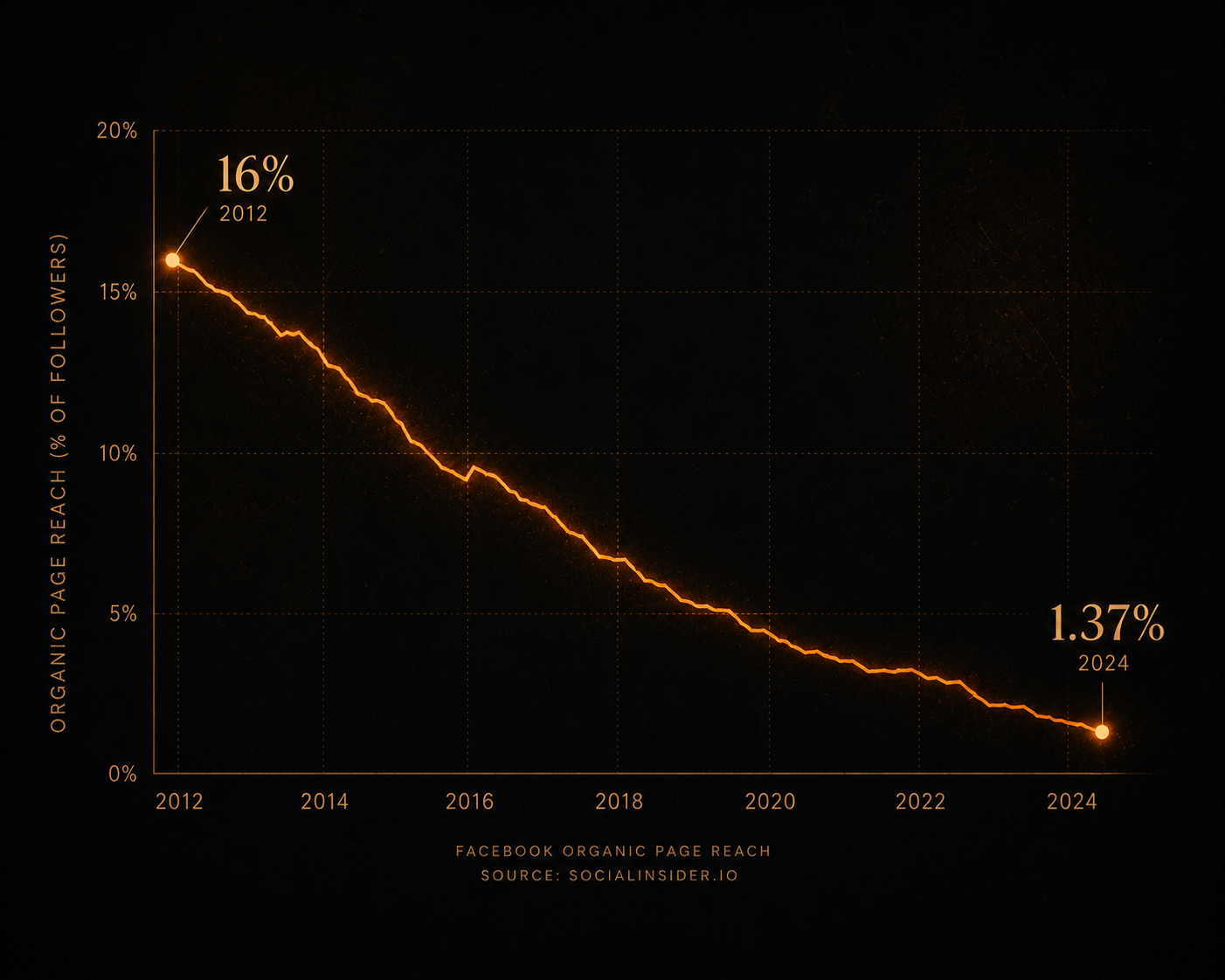
Facebook organic page reach sat at 16 percent of followers in 2012. By 2024 it had fallen to 1.37 percent. That is not algorithm variance. That is a deliberate policy shift toward paid reach, executed over twelve years, while millions of businesses built their entire customer acquisition model inside the platform.
The rent went up. Most of them kept paying it.
When Elon Musk acquired Twitter in 2022, the platform's ad revenue fell by more than 50 percent as major advertisers paused spending. Musk publicly told departing advertisers to go to hell. Creator monetization rules changed multiple times. The platform renamed itself. The verification system changed. The algorithmic rules changed. The API pricing changed, destroying thousands of third-party tools and businesses built on top of it.
None of that required your agreement. None of it was subject to your input. The landlord made decisions about the property and the tenants adapted or left.

In January 2025, TikTok went dark for fourteen hours. Seven million U.S. businesses use it for commerce. Thirty-nine percent of them told researchers it was critical to their existence. TikTok's own court filings estimated the economic damage of a permanent ban at 1.3 billion dollars in the first month for small businesses and creators alone.
"When the platform decides the terms, the only question left for you is how much you built underneath it."
The founders who had built owned infrastructure underneath their TikTok presence had a different conversation that week. Not a comfortable one necessarily. But a fundamentally different one. The platform going dark was a distribution disruption, not an existential one.
The founders who had built nothing underneath had the conversation Jessica Simon had. She told reporters she was heartbroken for her staff. Not for herself. For the people she had hired because a platform was working.
This is the part nobody talks about directly.
When you optimize your content for an algorithm, you are not just adapting to reach mechanics. You are training yourself to produce what the algorithm rewards. Over time, that shapes what you make, what you say, how you say it, and what you leave out.
Frances Haugen, the Facebook whistleblower who leaked thousands of internal documents in 2021, testified before Congress that Facebook had run what she called producer-side experiments. Internal tests confirming that when platforms prioritize content that produces outrage, engagement, and polarization, the creators producing that content get more reach. The algorithm does not reward what is most valuable to your audience. It rewards what produces the most engagement for the platform.
"You are not just building for the algorithm. The algorithm is building you."
That is the cost most founders do not account for. The visible cost is the reach percentage and the declining organic numbers. The invisible cost is what you become when you spend years optimizing for a system whose incentives are not aligned with yours.

The argument here is not to leave the platforms. Public distribution matters. Reach matters. The algorithm, when it works in your favor, is genuinely useful for putting your work in front of people who do not yet know you exist.
The argument is to stop treating the algorithm as your foundation and start treating it as a tool. You use the tool. You do not build on top of it.
"Distribution should be public. Control should be private. Use the platform for discovery. Build the relationship somewhere you own."
The founders who have figured this out are not posting less on social. They are routing the social activity toward something they own. Every piece of public content becomes an acquisition mechanism for a relationship that lives somewhere they control. The algorithm brings people to the door. What is behind the door belongs to the founder.
That inversion is the whole game. And it starts with recognizing what the algorithm actually is.
It is a landlord. And you have been paying rent this whole time.
You cannot renegotiate the terms of a platform lease. The platform sets them. You accept them or you leave.
What you can renegotiate is the amount of your business that depends on those terms holding. Every audience member you move into owned infrastructure is a relationship that no longer lives at the algorithm's discretion. Every piece of content that lives on your home base is an asset the platform cannot affect. Every revenue stream that runs through your list is income that does not require the landlord's approval.
You still use the platform. You just stop depending on it.
That is what it means to own the room instead of renting the feed.
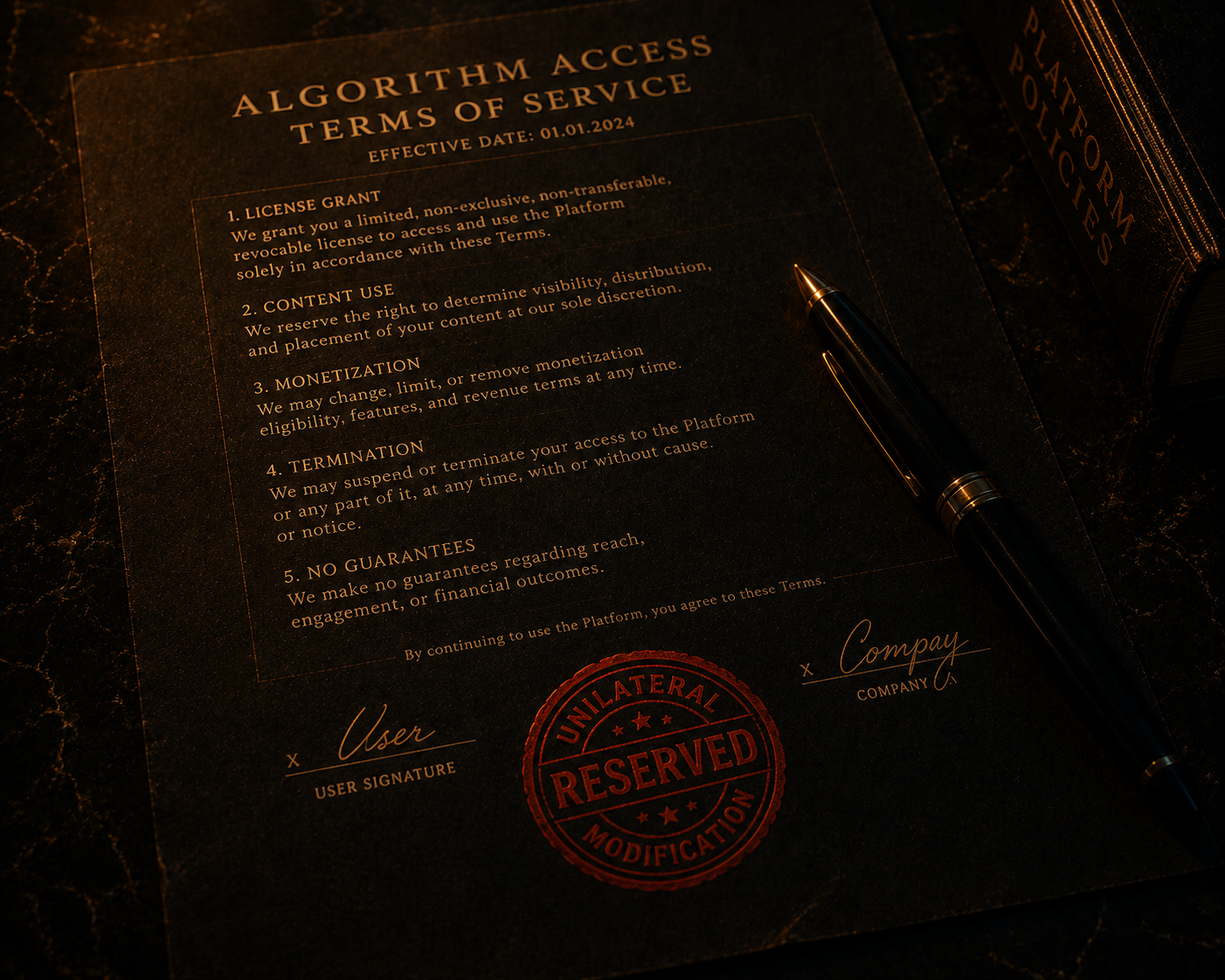
Knowing the gap is not the same as knowing the sequence. Most founders understand they should be building owned infrastructure. Fewer know what to build first, what good looks like when it is in place, and what tools to use without over complicating it.
I mapped it out. Six foundations, in order, with a clear explanation of what each one does and where to start. It is called the Founder's Infrastructure Map.
Download: The Founder Infrastructure Map
The two-layer model. The six foundations. What to build, in what order, with what tools, and what good looks like when it is done.
Link: Download The Founder Infrastructure Map PDF
Most founders talk about the algorithm the way they might talk about the weather. The algorithm is not the weather. It is a landlord. And most founders are building their entire…

There is a question most founders have not asked yet about the AI tools they use every day.
Not whether the tools work. Not whether the output is good enough. Not even whether the cost is justified.
The question is this: whose intelligence are you actually building?
Because there is a version of AI adoption that genuinely amplifies what you know, how you think, and what you can produce. And there is a version that absorbs it. Quietly extracting the expertise you spent years developing and feeding it into a system that does not belong to you and will eventually compete with you.
Most founders are doing the second one. Without knowing it.
AI as amplification looks like this. You have a point of view, a framework, a way of thinking about a problem that took years to develop. AI helps you express it faster, more clearly, at greater scale. The intelligence is yours. The tool accelerates the expression of it.
AI as extraction looks like this. You feed your thinking, your client notes, your frameworks, your voice into a platform you do not control. That platform uses what you give it to train models that serve every other user on the system. Your intellectual work becomes a resource for a machine you do not own and cannot audit.
"The tool should serve your intelligence. Not consume it."
The distinction sounds philosophical. It is actually commercial. Your frameworks, your methodology, your way of approaching a client problem are the assets that justify your fees, build your reputation, and create the compound value in your business over time. When you feed them carelessly into systems designed to extract and generalize, you are not just using a tool. You are depreciating an asset.
In September 2024, LinkedIn quietly activated a toggle defaulting every user into AI training. It used their posts, articles, and videos to train Microsoft and LinkedIn's models. Before updating their terms of service.
Reddit licensed its entire corpus of user-generated content to Google for approximately sixty million dollars a year. The volunteer moderators and contributors who built that content received nothing.
Meta's court documents revealed that the company internally approved using a dataset containing 7.5 million pirated books and 81 million academic papers to train Llama 3. An internal note described books as more important than web data.
"The most valuable thing about what you produce is not the output. It is the thinking behind it. That is what the platforms want."
Ed Newton-Rex, a former VP at Stability AI who resigned over AI training ethics, put the commercial case plainly. AI scales. A single AI trained on all of the world's content can produce enough output to replace the demand for much of that content. No individual human can scale in that way. When you feed your work into these systems without intention, you are contributing to a machine that may eventually devalue the expertise it learned from you.
This is not speculation. It is the documented business model of every major AI platform.

Most founders using AI tools think about them as productivity tools. They are not wrong. AI can genuinely compress work that used to take days into hours.
But there is a version of AI productivity that creates a hidden liability. Every prompt you send to a commercial AI tool is potentially training data. Every document you upload, every framework you describe, every client scenario you walk through, depending on the tool, the terms, and the settings you have not checked, may be retained and used.
LinkedIn's toggle was defaulted on. X enrolled users in Grok training by default in 2024, burying the opt-out in desktop settings only. Tumblr and WordPress prepared to sell user content to OpenAI and Midjourney, with an internal admission that the data transfer accidentally included content that should not have been included.
"The default assumption on every platform is that you have consented simply by showing up. You have not. But you have to actively reclaim what you did not actively give away."
The practical response is not to stop using AI tools. It is to use them with intention about what you feed in and where.
AI that amplifies your authority does not replace your thinking. It extends it.
It takes the frameworks you have already built and helps you express them at greater volume and speed. It takes the point of view you have earned through years of client work and helps you communicate it across more surfaces. It takes your voice and helps you maintain it consistently across channels you could not physically manage alone.

The critical variable is the direction of the intelligence. In amplification mode, you bring the thinking and the AI extends it. In extraction mode, the AI harvests the thinking and generalizes it away from you.
"AI should amplify your authority, not absorb it. Your knowledge base is an asset. Do not casually feed it into tools you do not control."
The founders building AI into their operations with sovereignty intact are doing a few specific things. They use AI within controlled systems where their data does not train external models. They treat their methodology as something to be documented and owned before being expressed through AI. They choose tools where the data stays theirs.
That is not a complicated posture. It is a considered one.
Before you use any AI tool with content that matters, client frameworks, proprietary methodology, earned positioning, ask one question: whose model am I training?
If the answer is unclear, or if the answer is the platform's, the posture is simple. Use the tool for tasks where the input is generic. Reserve the tools you control for the thinking that actually makes you irreplaceable.
The goal is not to avoid AI. The goal is to use it in a way that compounds your authority rather than extracting it.
The AI era will reward the founder who understood this early. The one who used AI to go faster without giving the machine what made them worth listening to in the first place.
"The next founder risk is not automation. It is training the machine that replaces your market position."
Every tool you adopt either compounds your expertise or cannibalizes it. The question is not whether AI is useful. It is. The question is whether you are using it in a direction that builds your position or erodes it.
Amplification is the deliberate use of AI to extend your thinking at scale. Extraction is the careless use of AI that feeds your expertise into a machine you do not control.
The difference is not in the tool. It is in the intention behind the feed.
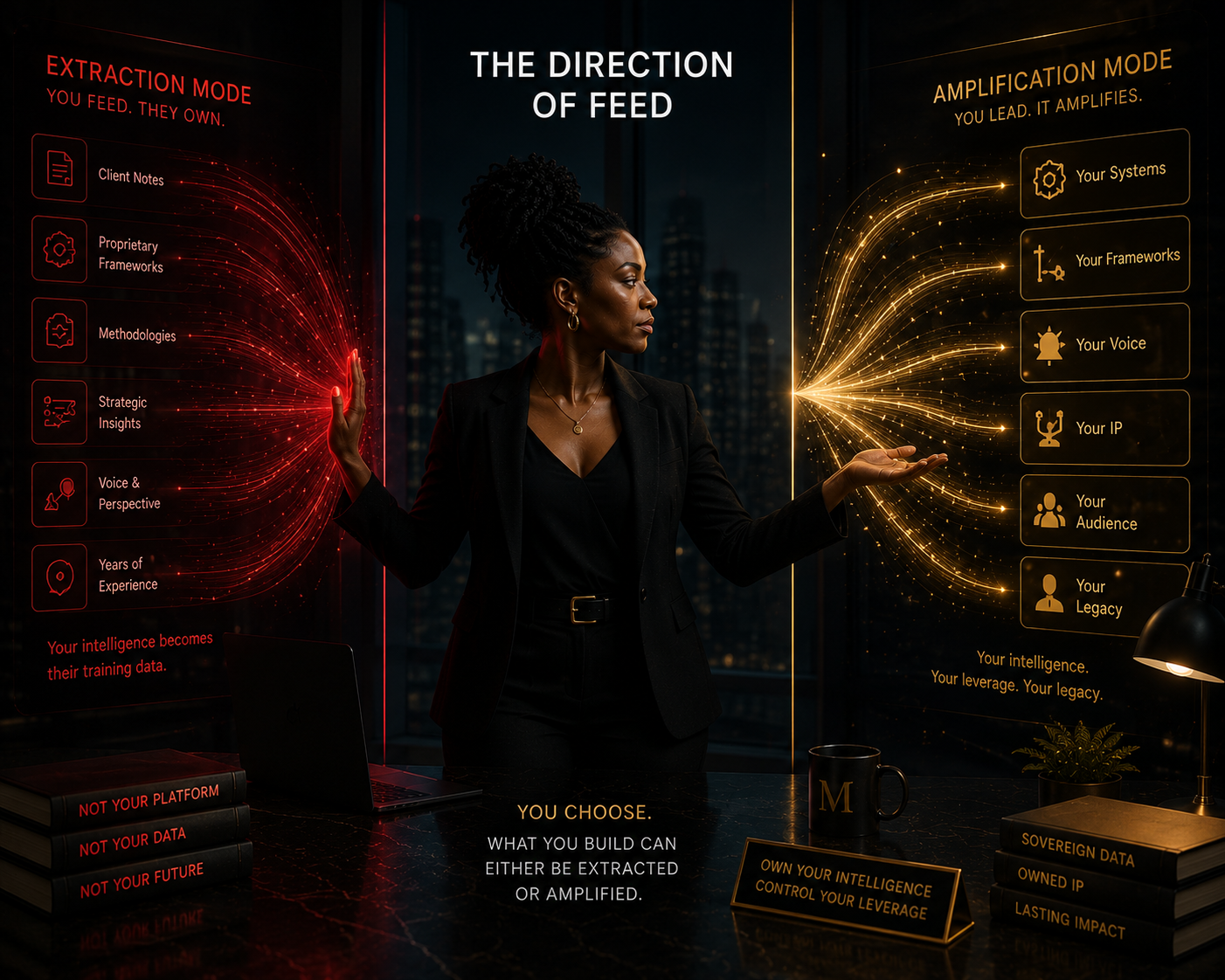
Knowing the gap is not the same as knowing the sequence. Most founders understand they should be building owned infrastructure. Fewer know what to build first, what good looks like when it is in place, and what tools to use without over complicating it.
I mapped it out. Six foundations, in order, with a clear explanation of what each one does and where to start. It is called the Founder's Infrastructure Map.
Download: The Founder Infrastructure Map
The two-layer model. The six foundations. What to build, in what order, with what tools, and what good looks like when it is done.
Link: Download The Founder Infrastructure Map PDF
AI as amplification looks like this: you have a point of view, a framework, a way of thinking about a problem that took years to develop. AI helps you express it faster, more clear
There is a test every founder should run, and almost none of them do.

Not a business audit. Not a brand review. Something simpler and more uncomfortable than either of those.
The test is this: if the platform you use most disappeared tonight, how many of the people you call your audience could you actually contact tomorrow?
Not find. Not hope to reconnect with. Contact. Directly. Without asking anyone's permission.
For most founders, the honest answer is close to zero.
We use the word audience loosely. It gets applied to followers, subscribers, fans, connections, readers, listeners. We use it to mean anyone who has encountered our work and registered some signal of interest.
But an audience, in the real sense, is not a list of people who once clicked something. It is a group of people you can reach when you need to. When you have something important to say. When you launch something. When you need the relationship to do work.
Most founders do not have that. They have visibility. They have reach in the algorithmic sense of the word. But the relationship between them and their so-called audience is mediated by a platform that can change, restrict, or remove that access without notice.
"A follower is not a relationship. It is a signal that a relationship is possible. The relationship only becomes real when you can reach that person directly."
That distinction matters more right now than it ever has. The era of free, reliable organic reach on any major platform is over. The algorithms have matured. The business models have shifted. What was a growth tool is now an advertising platform, and the organic layer is getting thinner every year.
If your strategy depends on the algorithm delivering your message to people who already chose to follow you, you are already operating with a significant and compounding disadvantage.
Here is the number that makes this concrete.
Your email list reaches 30% to 40% of the people on it every time you send. Your social posts reach 1% to 4% of the people who follow you. That is not a marginal difference. It is a structural one.
10,000 email subscribers means 3,000 to 4,000 people receive your message directly. 10,000 social followers means 1 to 400 people see your post, on a good day, depending on how the algorithm feels about you that week.
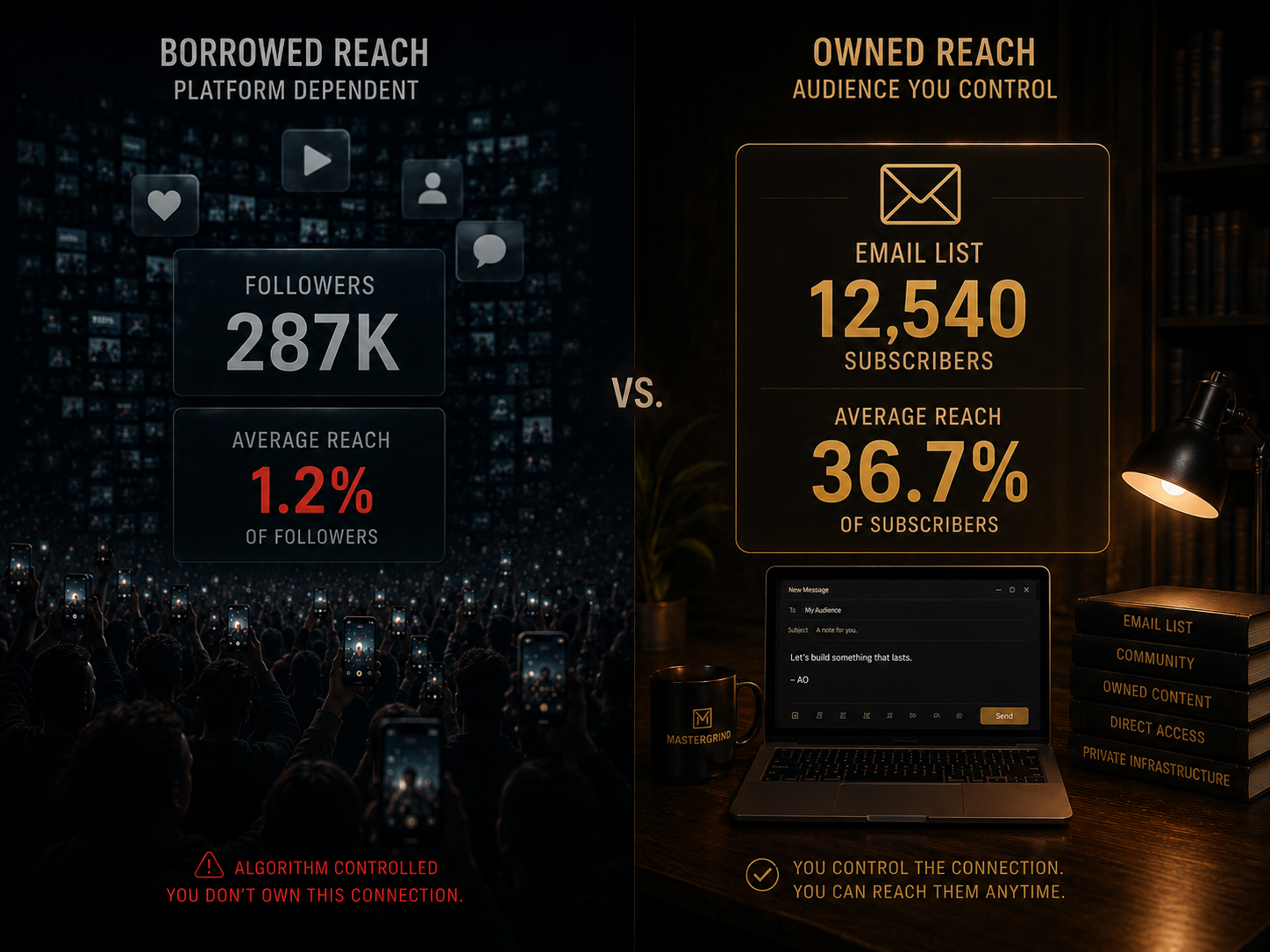
But more important than the open rate is what happens when you send an email versus what happens when you post. When you send an email, the message arrives in a space that person controls. Their inbox. They chose what goes there, and they see everything that lands in it. When you post, the message enters a space the platform controls. Whether it surfaces depends on variables you cannot see, predict, or reliably influence.
"One of those channels is a relationship. The other is a broadcast that may or may not get through."
Most founders have spent years building the broadcast side. The relationship side, the owned side, the side that actually reaches people, is thin or nonexistent.
The cost of platform-dependent reach does not show up on a balance sheet. It shows up in slow, invisible ways over time.
A launch that underperforms because the algorithm decided this was not a good week for your content. An announcement that reaches a fraction of the people who should have seen it. A conversation you wanted to start that never gained traction because the post got buried before it had a chance to spread.
These are not catastrophic failures. They feel like normal variance. That is what makes them expensive. Because you adapt to them. You optimize for the algorithm instead of optimizing for the relationship. You start producing content for reach rather than producing content for the people who are actually listening.
The platform trains you to play by its rules. And over time, you get good at a game that does not build anything you own.
"The algorithm is not your distribution partner. It is a gatekeeper that changes the terms whenever it wants."
The founders who feel this most acutely are the ones who have spent years building a strong social presence and then watched a policy change, an algorithm update, or a platform shift cut their effective reach by half. The audience did not leave. The platform just stopped showing them the content.
That is not a business problem. That is an infrastructure problem. And the solution is not to produce better content for the algorithm. The solution is to build a channel that does not need the algorithm's permission to reach the people who already said they wanted to hear from you.
Building an owned audience is not complicated. It is just slower than building a social following, and the feedback loops are quieter, which is why most founders deprioritize it.
The mechanics are simple. You need a way to collect email addresses and contact people directly. You need a reason to send something worth receiving. And you need to do it consistently enough that the list grows and the relationship deepens over time.
What founders get wrong is treating email as a secondary channel, a place to repurpose content that already ran on social. That approach produces a list that nobody opens. The founders who build genuine owned audiences treat email as the primary channel and social as the acquisition layer.
Social is where people find you. Email is where you actually talk to them.
"The relationship begins when someone gives you their email address. Everything before that is introduction."
Building that list is not fast. But it compounds. Every person on your list is a relationship you can reach without asking anyone's permission. Every post that converts a follower into a subscriber is a permanent upgrade to the quality of your audience.
The founder who has 10,000 social followers and 500 email subscribers has a weaker audience than the founder who has 3,000 social followers and 2,000 email subscribers. Because the second founder can actually reach the people who said they wanted to hear from her.
If you are reading this and you do not yet have an email list you own and maintain, the starting point is simpler than it sounds.
Pick one email provider you control. Set up a simple form. Add it to every piece of content you produce with a clear reason to subscribe. And start sending something worth receiving every two to four weeks.
Not a newsletter about your newsletter. Not a roundup of content you already published. Something original, specific, and useful enough that someone who is not already a fan would find it worth reading.
That is the minimum. It is not complicated. The reason most founders do not do it is not that they cannot. It is that the social platforms make visibility feel easier and faster, and they are. They just do not build anything durable.
"Visibility is fast. Ownership is slow. The difference is what you have five years from now."
The founders building something durable are not posting less on social. They are routing the social activity toward something they own. Every piece of public content becomes an invitation to a more direct relationship.
That inversion is the shift. Stop building for the platform. Start building for the list.
The TikTok near-ban of January 2025 did something useful. It made a question visible that most founders had been avoiding.
If the platform went away tonight, what would you still have?
For the founders who had spent years building for the algorithm and nothing underneath it, the answer was terrifying. For the handful who had been routing their platform activity toward an owned list, a private community, or a direct relationship system, the answer was straightforward.
The platform going away would be inconvenient. It would not be existential.
That is the difference between an audience and a relationship. And that is what this series is about.
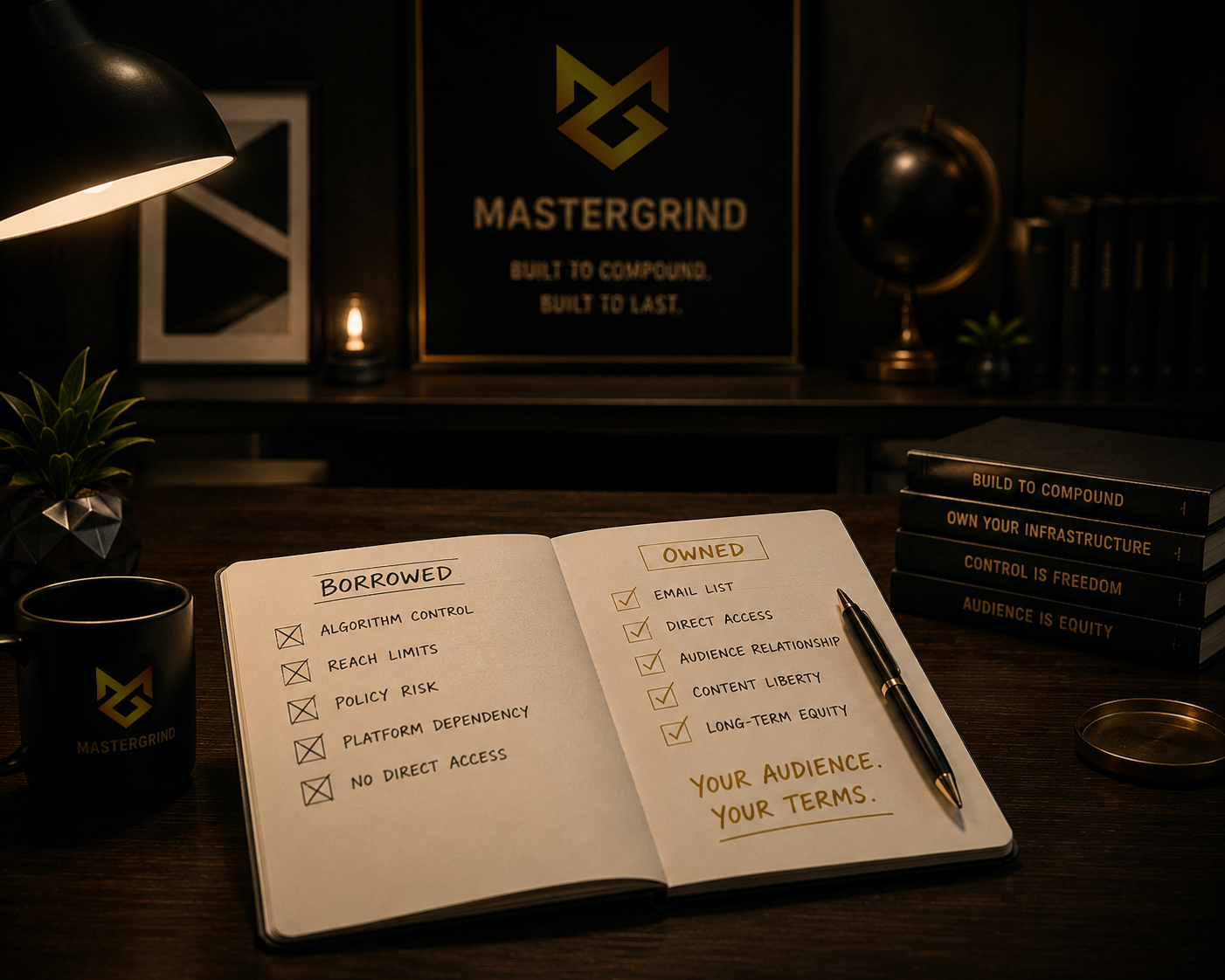
Knowing the gap is not the same as knowing the sequence. Most founders understand they should be building owned infrastructure. Fewer know what to build first, what good looks like when it is in place, and what tools to use without over complicating it.
I mapped it out. Six foundations, in order, with a clear explanation of what each one does and where to start. It is called the Founder's Infrastructure Map.
Download: The Founder Infrastructure Map
The two-layer model. The six foundations. What to build, in what order, with what tools, and what good looks like when it is done.
Link: Download The Founder Infrastructure Map PDF
We use the word audience loosely. It gets applied to followers, subscribers, fans, connections, readers, listeners. We use it to mean anyone who has encountered our...
There is a question most founders never think to ask.
Not whether their platform is working. Not whether their reach is growing. Not even whether their content is landing the way they intended.
The question is this: if the platform disappeared tomorrow, what would you still have?

Most people, when they sit with that honestly, realize the answer is smaller than they expected. A following they cannot contact. Content they cannot export. A reputation that lives inside someone else's system. Relationships mediated by an algorithm they never had access to.
The platform feels like yours. That feeling is the problem.
When founders think about platform risk, they tend to think about security. Hacking. Account theft. Data breaches. These are real concerns, and they are worth taking seriously.
But they are the wrong concern for most founders. Because the deeper threat is not that someone takes your account. It is that you never really owned it to begin with.
Security and sovereignty are not the same thing. Security means your data is protected from outsiders. Sovereignty means you control what happens to it.
A vault in a bank is secure. But the vault belongs to the bank.
Most founders have spent years depositing into vaults that do not belong to them, calling it wealth-building.
LinkedIn defaulted users into AI training in September 2024. Not after updating its terms of service. Before. Your posts, your articles, your videos feeding into a system before you were even notified it was happening. When the story broke, LinkedIn's response was to offer a toggle you could switch off. Buried in settings. Available on desktop only.
The account was perfectly safe. Nothing was breached. But the value inside it was already being harvested, and the default assumption was that you had consented simply by showing up.
That is not a security failure. That is sovereignty by design, assigned to someone other than you.
This is the part that tends to get abstract, so let me make it concrete.
Owning your audience does not mean having a lot of followers. It means being able to reach those people directly, without asking anyone's permission, regardless of what any platform decides to do next week.
An email list is ownership. You exported it, you control it, you can take it anywhere. If your email provider shuts down tomorrow, you can move the list to a different provider and send on Monday.
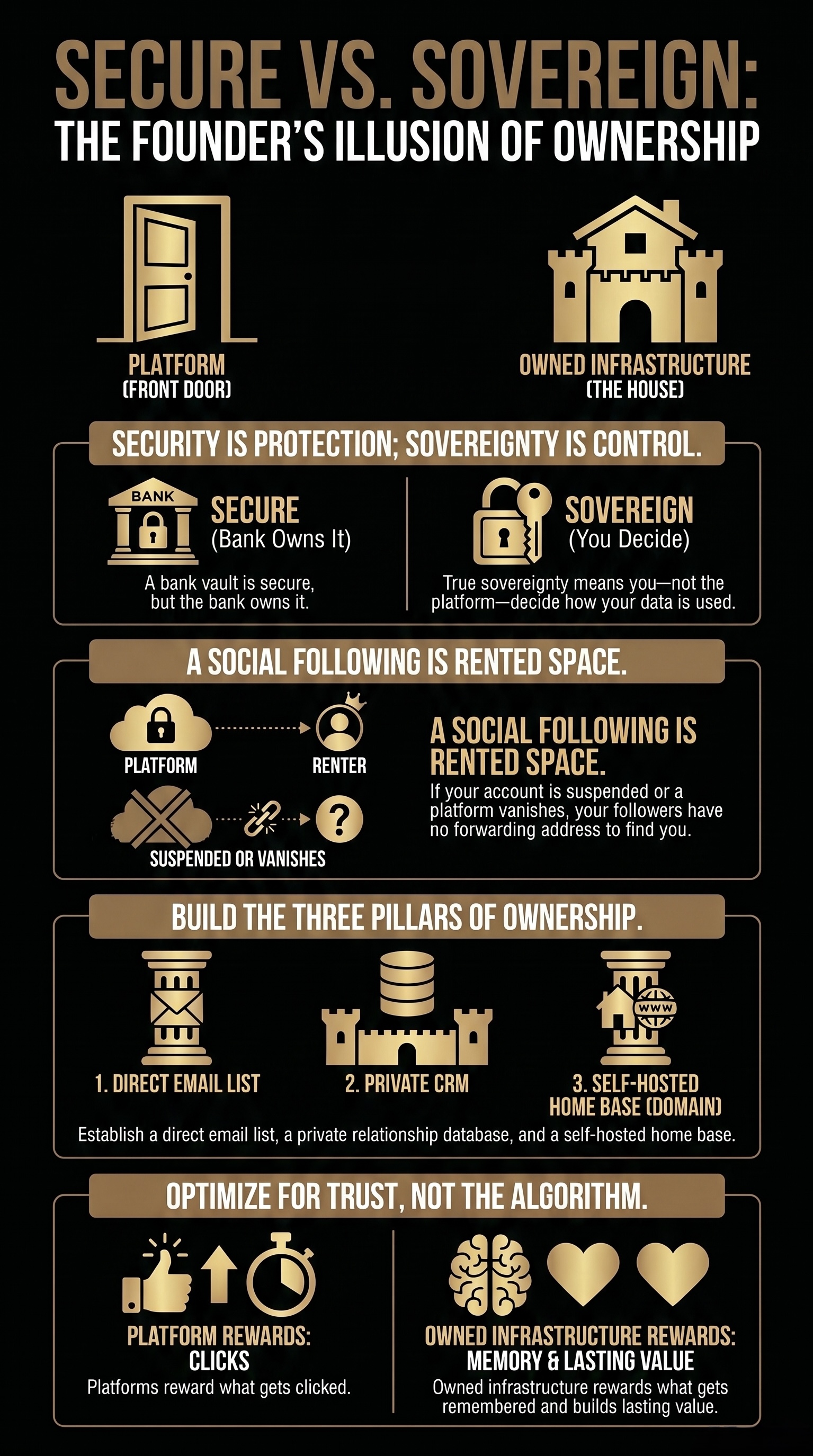
A social following is not ownership. If Instagram shuts down your account, your followers do not receive a forwarding address. They have no way to find you. You have no way to reach them. The relationship existed inside a system that belonged to the platform, and when the platform is gone, so is the relationship.
"The question is not how many people follow you. The question is how many of them could you reach if the platform was gone."
Most founders, when they answer that honestly, realize the number is much closer to zero than they thought.
This is not a theoretical future risk. Becky Stone built eleven years of work on Instagram. 95,000 followers. 4,300 posts. She was paying for Meta Verified when the platform permanently suspended her account for impersonating herself. The path back in required a U.S. Congressman's office to email Meta's PR department directly. That was the appeals process.
She got it back. Most people in her situation do not.
I want to be fair about something here, because I think the honest version of this conversation is more useful than the comfortable one.
Building owned infrastructure is harder than posting on a platform. Setting up an email list, building a newsletter, creating a community you actually host, producing content that goes out directly without a platform to amplify it for free, none of that is easy in the beginning.
The platform made distribution feel effortless because they needed your content. They had an audience and no product without creators filling it. So they made the on-ramp as easy as possible. The algorithmic reward for showing up felt like growth. It was growth. But it was also dependency being built one post at a time, without you fully understanding the terms.
Building underneath that is slower at first. An email list grows differently than a following. A private community builds differently than a public one. The feedback loops are longer and the vanity metrics are quieter.
But the compound works differently too.
"A following is rented. A list is owned. And ownership compounds in ways that renting never can."
Casey Newton built Platformer to 170,000 subscribers on Substack before moving everything to a self-hosted platform he controls completely. He did not do that because Substack was bad to him. He did it because he had watched enough platforms change to know that no platform stays the same forever. He moved before a crisis arrived, not because of one.
That is the decision most founders put off until it is urgent. By then, the cost of building underneath is much higher because they are doing it under pressure rather than by design.
When people ask what owned infrastructure actually means in practice, the answer is simpler than it sounds.
A direct line to your audience. An email list you control, a newsletter that goes out regardless of any platform's algorithm, a way to reach people without asking for permission first. This is the minimum.
A record of your relationships. A CRM, a database, some system that knows who your people are, what they care about, where the conversation is. Not inside a platform's inbox. Inside something you can access, export, and control.
A home base you own. A domain you control. A place where your content lives that does not depend on any third party choosing to keep it live. This does not have to be complicated. It just has to be yours.
These are not expensive to build. They are slow to build, and most founders skip them because the platform is working well enough today that the risk feels abstract.
The risk is not abstract. It is just invisible until the day it is not.
What I have found is that the founders who build this infrastructure early do not just have more resilience. They operate differently.
When your audience lives in your own system, you stop optimizing for the algorithm and start optimizing for the relationship. The content changes. The tone changes. The cadence changes. You are no longer producing for the feed. You are producing for people.
That shift is subtle but it changes everything downstream. The quality of the work goes up because the incentive is no longer to grab attention. It is to earn trust. And trust compounds in ways that attention never does.
"The platform rewards what gets clicked. Owned infrastructure rewards what gets remembered."
Lenny Rachitsky's newsletter crossed a million subscribers without running ads, without gaming an algorithm, and without a media company behind it. His distribution method was so simple it sounds like a joke: he wrote something worth reading and let people share it. That only works when the relationship is real enough that people want to pass it on.
That kind of relationship does not live on a platform. It lives in something you own.
The best time to build owned infrastructure was before your following was large enough to feel like you had something to lose. The second best time is now.
Not because the platforms are going away. Not because your account is in danger. But because the gap between what you think you own and what you actually own is wider than most founders realize, and the only way to close it is to build something underneath.
You do not have to leave the platforms. You do not have to abandon what is working. You just have to stop treating visibility as a foundation.
"The platform is the front door. What you build behind it is the actual house. Most founders have spent years decorating a lobby they do not own."
Build the house.

Knowing the gap is not the same as knowing the sequence. Most founders understand they should be building owned infrastructure. Fewer know what to build first, what good looks like when it is in place, and what tools to use without over complicating it.
I mapped it out. Six foundations, in order, with a clear explanation of what each one does and where to start. It is called the Founder's Infrastructure Map.
Download: The Founder Infrastructure Map
The two-layer model. The six foundations. What to build, in what order, with what tools, and what good looks like when it is done.
Link: Download The Founder Infrastructure Map PDF
Not whether their platform is working. Not whether their reach is growing. Not even whether their content is landing the way they intended. The question is this: if the platform...
There is something strange about the way we talk about building an audience.
We say we are building something. We use that word like we are laying a foundation, stacking something that belongs to us, something that will still be there tomorrow because we put it there.
But most of the time what we are actually doing is performing inside someone else's theater, hoping the owner keeps the lights on.
I have been sitting with this for a while. Because I understand the appeal. The platforms make it easy. They already have the audience. They hand you the megaphone. You show up, you produce, people find you and for a while it feels like momentum.
What it actually is, is rented momentum.
And the lease has terms you did not read.
Every major platform you use to grow your business operates on the same fundamental arrangement: you create the value, they own the relationship.
You build the audience. They control the access. You produce the content. They decide who sees it, when they see it, and under what conditions you are allowed to keep doing this.
That is not a bug. It is the business model.
Every platform that has ever existed followed the same arc. First it is generous. It wants your content, it rewards your effort, it grows with you. Then the incentives shift. The investors want returns. The algorithm tightens. Organic reach quietly collapses. The thing that used to amplify you starts asking you to pay for what it used to give away.
This is not a surprise. This is not a malfunction. It is the natural progression of a platform that was never built for you. It was built for its own growth, and your content was the fuel.
"Most founders are not failing because they lack ambition. They are building inside environments that were never designed for them to win."
Facebook organic reach for brand pages sits at roughly one percent of followers today. Instagram reach dropped sixty percent in a single year. These are not anomalies. They are the platform maturing, extracting more value from the inventory you have spent years creating for it.
You were the supplier. The audience was the product. And somewhere along the way, you started calling it your business.
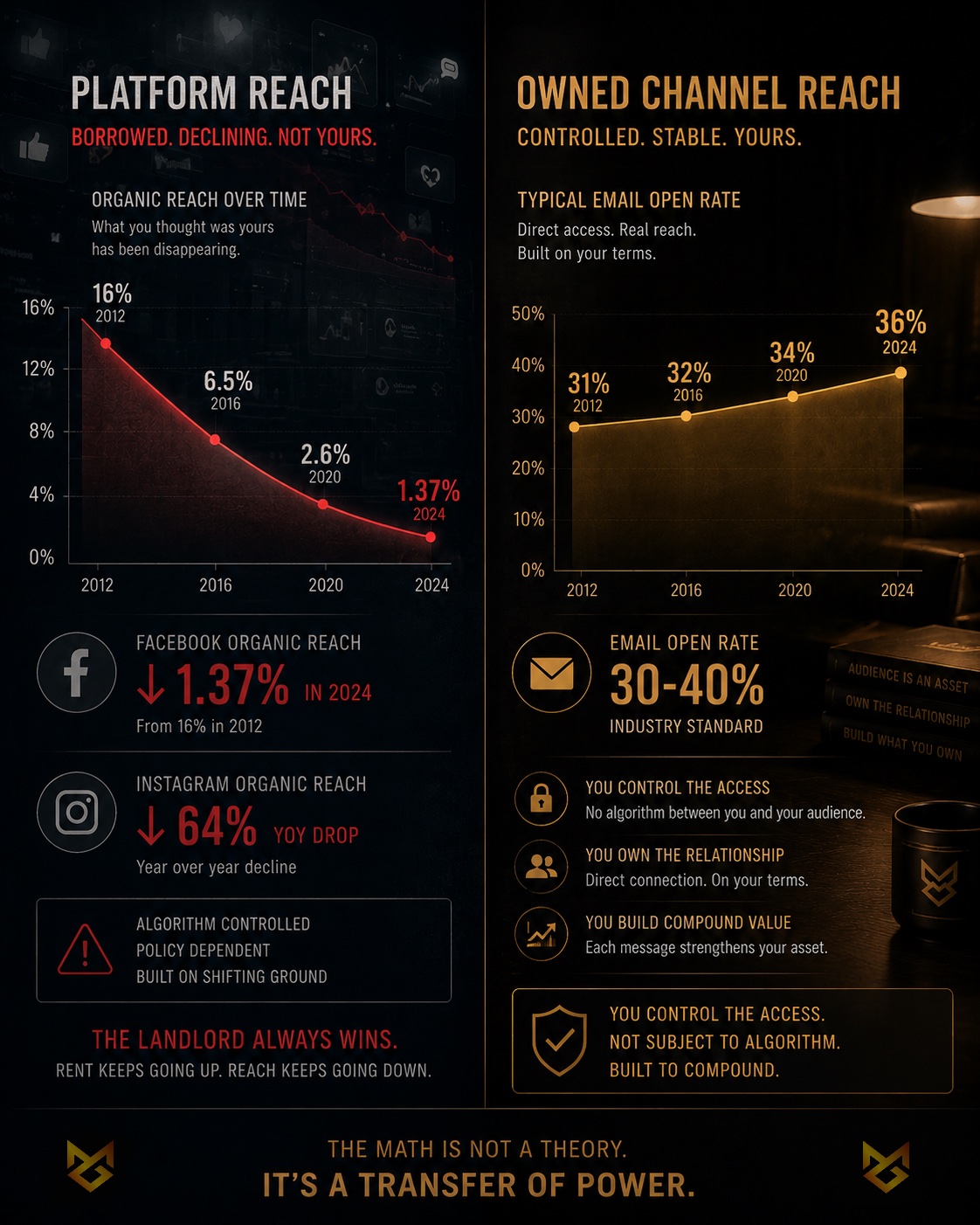
Most founders think about platform risk the wrong way. They ask whether their account might get hacked, whether their data is protected, whether the platform will stay up.
That is a security question. And it is the wrong one.
Security means keeping outsiders out. Sovereignty means you actually control what is inside.
A platform can be fully secure while you have no meaningful control over how it operates, who sees your content, what it does with your intellectual work, or whether you continue to have access tomorrow.
This is not a security failure. It is a sovereignty failure. And it is the most expensive mistake a founder can make, because it is invisible until the moment it is not.
When a creator named Anna Vatuone watched TikTok go dark in January 2025, she did not talk about cybersecurity. She said something far more honest:
"The truth is, we don't own our profiles anywhere."
Not from a privacy researcher. Not from a tech critic. From someone watching the specific machinery of her business become inaccessible in real time, and naming what most founders have not been willing to name about their own situations.
The TikTok near-ban of January 2025 produced the clearest case study of platform dependency risk the business world has seen. Not because TikTok shut down permanently. It did not. But because for approximately fourteen hours it went dark, and in that window the real cost became visible.
A small business owner named Jessica Simon built her Mississippi Candle Company from her stovetop in 2018. She launched on TikTok Shop in 2023, crossed six-figure monthly sales for the first time by late 2024, hired staff, leased a warehouse. Between 90 and 98 percent of her sales flowed through a single platform she did not own.
When the ban approached, she told reporters: "I am heartbroken for my staff."
Not for herself. For the people she had hired because a platform was working.
She is not an edge case. She is the logical outcome of building your foundation on rented ground. The Ghost Agency, a real marketing firm with real clients, laid off 80 percent of its staff before the deadline. Even after the temporary reprieve they shut down anyway. Their reasoning was simple: the platform could shift overnight and they had nothing underneath to catch them.
The platform changes. The account gets flagged. The algorithm shifts. The reach collapses. And then you find out what you actually built.
There is a reason this feels right even if it has not happened to you yet. It lives in the numbers.
An email list reaches thirty to 40% of the people on it. A social post reaches one to four percent of the people who follow you. That is not a small gap. It is a structural difference in who controls the relationship.
Email marketing returns approximately $36 for every $1 spent. Social media returns roughly $3. The math is not close and it has never been close.
Yet most founders allocate the majority of their content effort to the channel where they reach 1% of the people they have already earned, and call it a growth strategy. The feeling of dependency is not paranoia. It is your business correctly reading the architecture it is sitting on.
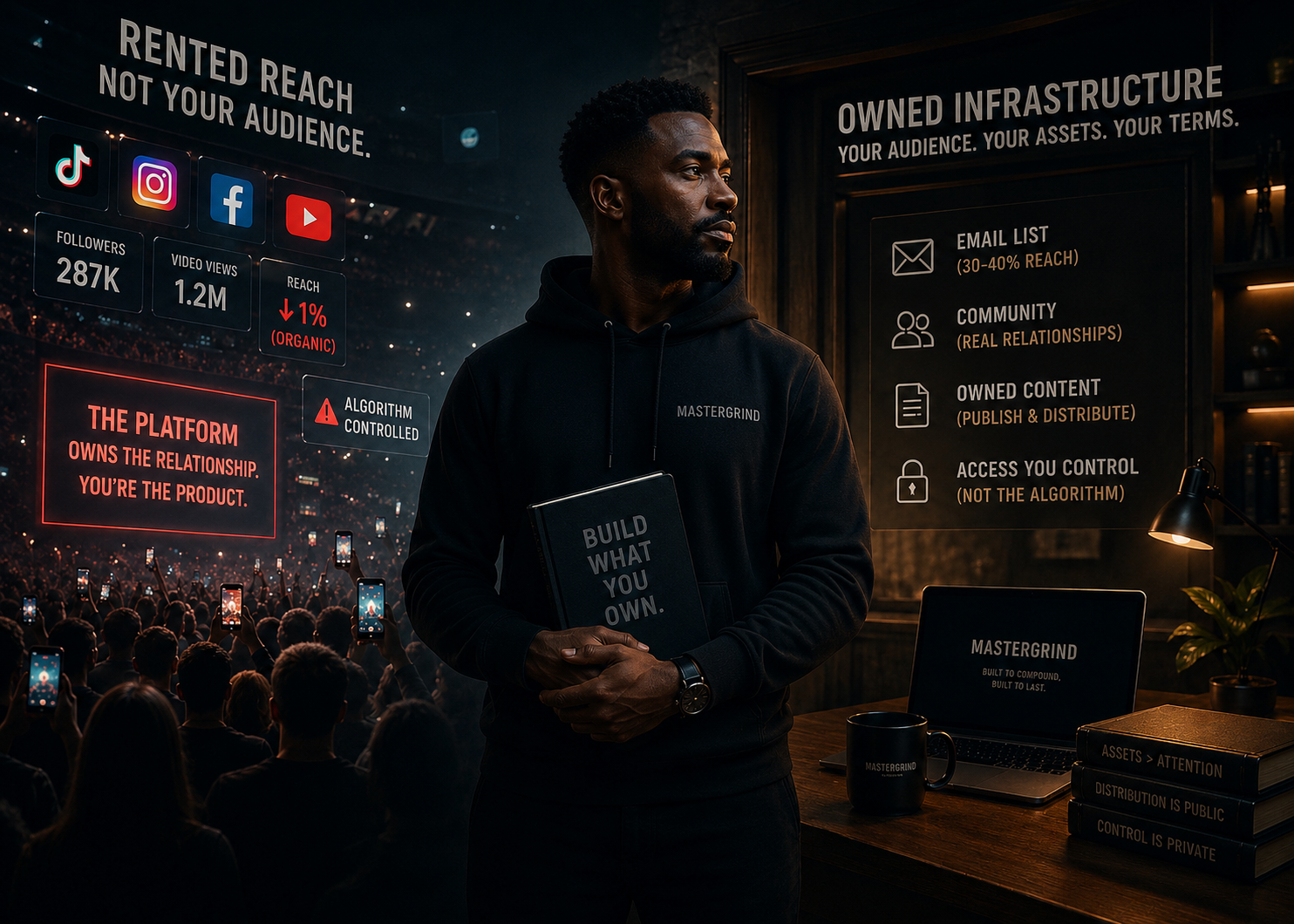
The alternative is not abandonment. It is architecture.
Visibility matters. Reach matters. Public platforms are genuinely useful for reaching people who do not yet know you exist. The question is not whether to use them. The question is what you are building underneath them.
"Distribution should be public. Control should be private. The feed is where you are seen. It is not where your business lives."
The founders who have figured this out are not hiding from the platforms. They are routing through them. They use the feed for discovery. They move people into owned environments: an email list they control, a community they host, a publication that goes out directly. The content on the platforms is real, but it points somewhere. It earns the right to move people into a relationship that is not intermediated by an algorithm.
Lenny Rachitsky left a product role at Airbnb in 2019 and built a newsletter. By early 2025 it had crossed one million subscribers and generated over two million dollars annually from subscriptions alone. His advice to founders still chasing the feed: stop tweeting and do the work.
Casey Newton built Platformer to 170,000 subscribers on Substack, then in early 2024 migrated off entirely to a self-hosted platform where he controls his subscriber data. His reason: platforms change in ways that make staying impossible for the creators who depend on them. He moved before a crisis arrived.
That is the difference between a presence and a platform. One lives at the discretion of a landlord. The other compounds without permission.
I write this not as someone who has solved it perfectly. I write it as someone who has been thinking about it seriously, because this is one of the most consequential decisions a founder makes right now, mostly without realizing they are making it.
Every day poured into a platform without building something underneath it is a day spent enriching a system that does not share your long-term interests. The cost is invisible until the algorithm shifts, the account goes down, the reach collapses, or a government decision makes fourteen hours feel like a decade.
That is when you find out what you actually built.
"The old internet rewarded access. This next era will reward structure. The old platforms scaled attention. The next great environments will scale trust."
Build the platform beneath the persona. Own the environment you inhabit. Everything above it can change. Everything below it compounds.

Everything in this post is pointing toward the same practical question: what does the owned layer actually look like, and where do you begin?
I put together a guide that answers it specifically. It covers the two-layer model and the six foundations of owned infrastructure. What each one does, what good looks like, what mistakes to avoid, and what to use to build it. It is called the Founder's Infrastructure Map.
Enter your email below and it comes directly to you.
Download: The Founder Infrastructure Map
The two-layer model. The six foundations. What to build, in what order, with what tools, and what good looks like when it is done.
Link: Download The Founder Infrastructure Map PDF
I have been sitting with this tension for a while now. Because I understand the appeal. The platforms make it easy. They already have the audience. They hand you the megaphone. You
AI is making it easier than ever to look like an expert, sound like a leader, and reach thousands of people overnight. High-performing founders can now generate a month’s worth of authority-building content in minutes. Yet, despite this unprecedented access to distribution, a strange contradiction has emerged: the more content founders produce, the more replaceable they feel.
We are drowning in a sea of high-fidelity mimicry where the cost of looking like a leader has dropped to zero, effectively bankrupting the value of traditional authority signals. The problem was never a lack of content; the problem is the environment. In an era of infinite noise, the signals we once relied on — follower counts, polished prose, and constant presence have become decoupled from actual expertise.
Many founders believe the solution is to work harder, post more, or find sharper tools. However, the feeling of being a commodity is not a personal failure of ambition; it is a symptom of a much deeper, structural flaw in how we build our digital legacies. To understand why your effort isn't compounding, we must dissect the extractive architecture of the platforms you currently inhabit.
For the last decade, founders have been operating under a "Broken Pyramid." In this model, massive social platforms sit at the top, the founders sit at the bottom, and the audience is trapped in the middle. This structure was never designed for you to win; it was designed to convert your intellectual capital into the platform’s leverage.
When you build your brand exclusively on these platforms, you are participating in algorithmic feudalism. You provide the "crop", the content and data to a system that owns the relationship with your audience. Because you are separated from your audience by a middleman you do not control, your business remains architecturally fragile. You see the symptoms of this fragility every day: decisions live only in your head, your data is scattered across incompatible tools, and growth feels like a burden where every new client adds complexity instead of control. In this state, hiring becomes a desperate patch for missing infrastructure rather than a strategic expansion.
"Most founders are not failing because they lack ambition. They are failing because they are building inside environments that were never designed for them to win."
Renting attention creates a cycle of dependency. Until you own the environment where your relationships and decision logic live, your authority will always be subject to the whims of an external landlord.
The common reaction to this fragility is to lean harder into automation. However, AI does not solve structural problems; it merely accelerates them. If your business is built on a fragile foundation, adding AI is like putting a jet engine on a car with no steering wheel, you simply reach the crash site faster.
AI makes the "wrong game" of visibility even harder to play because:
AI does not fix a fragile environment. It just makes fragile environments move faster. When content becomes infinite, the environment you build inside starts to matter more than the tools you use to create it. Existing platforms can help you rent attention, but they cannot give you owned infrastructure.

The alternative to building on extractive platforms is the move toward Sovereign Environments. Instead of viewing your digital presence as a profile on a network, you must think of it as a Founder City. A city is a structured environment where different layers of infrastructure reinforce each other to protect ownership and compound trust.
A functional Founder City consists of five essential layers:
This represents a Power Inversion. In the old model, the platform extracts value from the founder. In a sovereign environment, founders co-build the platform. By prioritizing these functions before names, founders move from being extracted assets to being the architects of their own growth.
Inside a sovereign environment, the trajectory of a founder changes. You move away from the "hamster wheel" of daily posting and into a flywheel that rewards long-term ownership. This is a linear progression that transforms an isolated founder into a structural leader:
Contribution → Visibility → Authority → Opportunity → Growth → Contribution
The critical distinction is the death of the "Bio" and the birth of the "Build." Most platforms reward presence—who you are when you arrive. Sovereign environments reward movement—what you build while you are there. Trust is not a static badge you wear; it is a dynamic result of the value you contribute to the structure. When you focus on movement, your visibility becomes a byproduct of your progress, not a goal you have to chase.
We are entering an era where it is significantly easier to generate content than it is to generate trust. Users and clients are becoming immune to synthetic authority, the polished, AI-generated veneer of expertise that lacks structural depth. They are looking for real environments where serious people build something that lasts.
We must be honest: we are currently validating a model for what founder-owned environments need to become because the old environment is no longer enough. The next generation of successful founders will not be the ones who scale the most attention; they will be the ones who scale trust, participation, and ownership without losing control.
"The old internet rewarded access. This next era will reward structure. The old platforms scaled attention. The next great environments will scale trust."
The Pyramid has been rebuilt. The era of the "extracted founder" is coming to an end for those willing to claim their own infrastructure. You no longer have to surrender control to achieve growth, nor do you have to choose between visibility and authority.
In a world flooded with artificial media, the rarest asset is a real environment that protects the founder’s leverage. The question is no longer whether you can reach an audience. The question is: In a world of infinite content, are you building your legacy on someone else's platform, or are you finally ready to own the environment you inhabit?
Download The Founder's Infrastructure Map
Six foundations. Specific tools. What good looks like at each stage.
The architecture for building a business that does not depend on any platform's permission.
Link: The Founder Infrastructure Map
AI is making it easier than ever to look like an expert, sound like a leader, and reach thousands of people overnight. The more content founders produce, the more replaceable th...
It can be this tool that they can actually use to get them where they want to go at a fast pace. There’s really nothing out there like it, when it comes to Mastergrind. -Andra Wishom
Andra Wishom Full Feature —->>> What is the Mastergrind? And who is Andra Wishom?
If you don’t want to make waves, be mediocre. Be normal and fit in. Dress like them. Walk like them. Act like them. Eat like them. Go where they go. Think like they think. Do what they do, and when you’ve neutralized your uniqueness you don’t need courage. It takes courage to be different. It takes courage to be successful. People don’t talk about people that don’t win. If you win, they’re gonna talk about you! Do you have the courage!? -TD Jakes
If you don’t want to make waves, be mediocre. Be normal and fit in. Dress like them. Walk like them. Act like them. Eat like them. Go where they go. Think like they think. Do wh...
With @mastergrind.club you can forge real connections that lead to unstoppable alignment with your dreams and aspirations.
So, if you’re ready to amplify your journey, to break free from the ordinary and embrace the extraordinary, follow @mastergrind.club now for inspiring stories and ways you can engage with our vibrant international community of leaders, creators and independent professionals.
@mastergrind.club is powered by the Mastergrind Network virtual platform.
🎥 FRAMESx Creative Studio team @framesbysoskyhigh
With @mastergrind.club you can forge real connections that lead to unstoppable alignment with your dreams and aspirations. So, if you’re ready to amplify your journey, to break …
Hey there, it’s AO here, your passionate host and the driving force behind Mastergrind Club. As we traverse our individual paths toward greatness, how often do we stumble upon those who truly inspire us, teach us, or simply understand the unique road we’re on?

That’s where our curated Summer Vibes Experiences come into play – a realm where the magic of personal growth intertwines seamlessly with the joy of forging new connections.🤝 Imagine leaving behind the hustle and bustle of the everyday grind, only to step into a realm where like-minded souls gather to learn, laugh, and create memories that last a lifetime.

With a refreshing blend of work and play, we’re redefining the concept of productivity.
You see, my friends, Mastergrind Club isn’t just an experience – it’s a way of life. We’re all about living purposefully, and through our meticulously curated event activities, we’re forging connections that lead to unstoppable alignment with our dreams and aspirations.
So, if you’re ready to amplify your journey, to break free from the ordinary and embrace the extraordinary, slide into my DMs! Let’s chat about how Mastergrind Club can help you embark on a life-changing adventure.
With unwavering excitement,
AO, Founder/Host
#MastergrindSummerVibes #themastergrind #getactivated⚡️ #stayactivated⚡️ #FindYourAlignment
🎥: Videography by Zachary Kishh
📸: Photography by FRAMESx Creative Studio


If you don’t want to make waves, be mediocre. Be normal and fit in. Dress like them. Walk like them. Act like them. Eat like them. Go where they go. Think like they think. Do what they do, and when you’ve neutralized your uniqueness you don’t need courage. It takes courage to be different. It takes courage to be successful. People don’t talk about people that don’t win. If you win, they’re gonna talk about you! Do you have the courage!? -TD Jakes
If you don’t want to make waves, be mediocre. Be normal and fit in. Dress like them. Walk like them. Act like them. Eat like them. Go where they go. Think like they think. Do wh...
“It’s the new era you’ve got these young go-getters that are out there for it, and it can be this tool that they can actually use to get them where they want to go at a fast pace. There’s really nothing out there like it!”
“It’s the new era you’ve got these young go-getters that are out there for it, and it can be this tool that they can actually use to get them where they want to go at a fast pac…
What is the Mastergrind? “It’s the new era you’ve got these young go-getters that are out there for it, and it can be this tool that they can actually use to get them where they want to go at a fast pace. There’s really nothing out there like it!”
The Mastergrind movement is the new era. There’s really nothing out there like it.
With @mastergrind.club you can forge real connections that lead to unstoppable alignment with your dreams and aspirations.
So, if you’re ready to amplify your journey, to break free from the ordinary and embrace the extraordinary, follow @mastergrind.club now for inspiring stories and ways you can engage with our vibrant international community of leaders, creators and independent professionals.
@mastergrind.club is powered by the Mastergrind Network virtual platform.
🎥 FRAMESx Creative Studio team @framesbysoskyhigh
With @mastergrind.club you can forge real connections that lead to unstoppable alignment with your dreams and aspirations. So, if you’re ready to amplify your journey, to break …
With @mastergrind.club you can forge real connections that lead to unstoppable alignment with your dreams and aspirations.
So, if you’re ready to amplify your journey, to break free from the ordinary and embrace the extraordinary, follow @mastergrind.club now for inspiring stories and ways you can engage with our vibrant international community of leaders, creators and independent professionals.
@mastergrind.club is powered by the Mastergrind Network virtual platform.
🎥 FRAMESx Creative Studio team @framesbysoskyhigh





.png)


