




Contribute Before Capture
Module 8/12: The Record with Only One Column
From
Alexander D. L. Oliver
The first three moves in this arc are things you do. An introduction you write. A message you send inside a window. An offer you make at the right moment.
This one is not. It happens in about a second, inside your own head, and nobody can see it.
There is a pause before a contribution. Someone says something, you realize you have something for it, and in the space before you speak, something occurs. For most founders that space contains a calculation. What does this cost me. Will it come back. Is this person worth it. It is fast enough that it does not feel like a calculation. It feels like reading the room.
You cannot photograph that. But you can see what it leaves behind.
Here is one month of someone's contribution record. Eleven entries.

MARCH
03 · Sent Priya the retention audit template. She had mentioned churn twice.
05 · Introduced Marcus and Dana. Documentary studio, second location opening.
09 · Reviewed Tomas's pricing page. Told him the middle tier was the problem.
11 · Passed the Okonjo contact to Renee for the Lagos permit question.
14 · Sat with Jules for an hour on the co-founder conversation he was dreading.
17 · Sent the vendor list to the new operator at Dana's place. Unprompted.
18 · Told Priya the audit was wrong about month four. Corrected it.
22 · Recommended Renee for the panel. She did not know it was open.
24 · Wrote the reference for Tomas. Took forty minutes.
28 · Connected Jules with the fractional CFO. Specific reason attached.
30 · Sent Marcus the three restaurateurs from last year's list.
WHAT IS MISSING
Read it again and notice what you were looking for.
There is no second column.
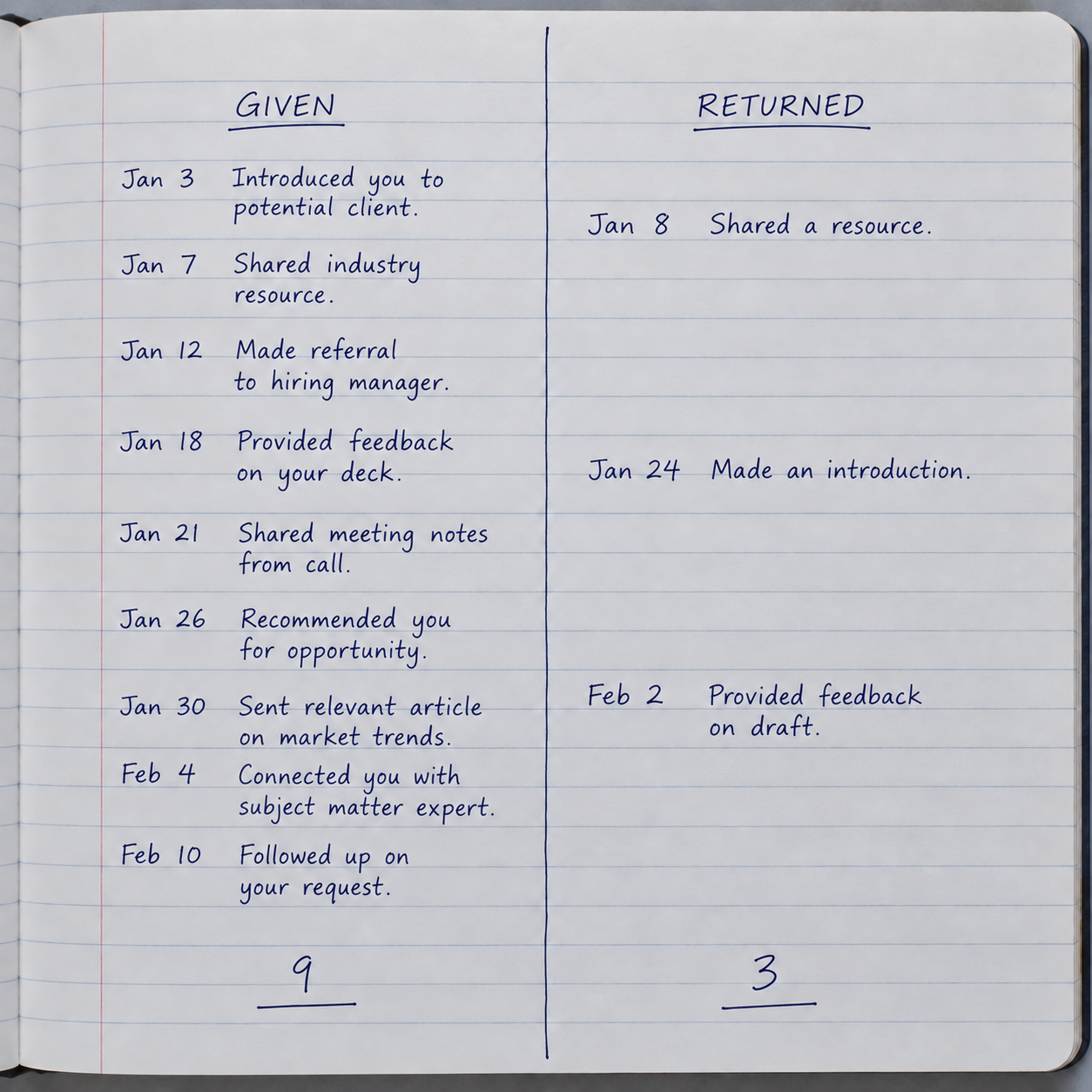
A ledger has two sides. That is what the word means. Given on the left, received on the right, and the point of keeping one is to know where you stand. Every instinct you have about a record like this expects a right-hand column, and the absence of it is the argument of this episode.
Not because tracking returns is dishonest. Because the moment a return column exists, the pause changes. You cannot keep a two-sided ledger and also not be calculating, since the second column is the calculation written down. It turns contribution into a position, and a position has to be managed.
THE THINGS THIS RECORD DOES NOT DO
It does not rank the entries. Forty minutes on a reference sits beside a one-line introduction. In a scorecard those would be weighted, because weighting is how you know what you are owed. Here they are the same size, because the record is not for that.
It does not note who reciprocated. Priya appears twice and neither entry says whether she came back. Renee got a contact and a recommendation. Nothing indicates what either of them did afterward. If you found that frustrating to read, that is worth sitting with, because the frustration is the calculation asking for its column.
It includes a correction. The 18th, telling Priya the audit was wrong. That cost him something and produced nothing, and it is in the record on exactly the same footing as the introductions. A scorecard would not carry it. A record of what you actually did has no reason to leave it out.
It stops at the end of the month. No total. No summary. Nothing carried forward.
THE REVERSAL
Here is the thing that undoes the exercise.
The founder who kept this record stopped keeping it in August.

Not because he stopped contributing. He contributes more now than he did in March. He stopped because at some point he noticed he was writing things down after the fact, from memory, several days late, and the record was not telling him anything he did not already know about how he operates.
That is the whole point, and it is the opposite of what a record is usually for.
The goal was never to be good at contributing. The goal was to stop needing to think about it. The reminder is scaffolding, the practice builds the capacity, and the capacity makes the reminder unnecessary. A record you still need is evidence of a gap. Not a failure. A gap, and one that closes by doing the thing rather than by understanding the principle better.
So the correct use of page four is to fill it until it annoys you.
If you are still checking your behavior against the principle and correcting when you find a gap, you are in the process, and the process is real. Keep the record. It is doing work.
And the day you realize you have not opened it in three weeks, and that the contributions kept happening anyway, that is the day it landed.

The name for this is Contribute Before Capture. Share, then value add, then ask, in that order, consistently. Underneath the sequence is a principle the sequence is designed to retire: eventually you stop following it, not because you abandoned it, but because it has become how you move.
The pause before a contribution. What is inside it right now. That is where you are.
SOURCES REFERENCED IN THIS EPISODE
Adam Grant, Give and Take. Viking, 2013.
Bob Burg and John David Mann, The Go-Giver. Portfolio/Penguin, 2007.
Robin Dunbar, Friends: Understanding the Power of Our Most Important Relationships. Little, Brown, 2021.
Robert Greene, Mastery. Penguin Books, 2012.


Events:
Hosted by Mastergrind Club
Related:
Mastergrind Club


Spotlight:
Founder Infrastructure Map
Stay close to what's being built!
Follow StreamsLocation:
New York City
Location Spotlight:
Go Back Home (Single)
Marketplace:
Ecosystem Activation


Explore:
Mastergrind Network
Spotlight:
Founder Infrastructure Map


Stay close to what's being built.
Follow Streams

Mindset: Fear of being average
Follow & Activate


Your Club-GOLD Membership
These Club benefits are available to you during your Trial Membership until the launch of Mastergrind Club.
Your Club-Silver Membership
These Club benefits are available to you during your Trial Membership until the launch of Mastergrind Club.
Your Club-Blue Membership
These Club benefits are available to you during your until the official launch of Mastergrind Club.
Your Limited Access Account
Limited Access to Mastergrind Network & Club Events. A curated set of past Club event recordings and select resources from the Club library.
Not the full Club. A real look inside it.


