




Fear of Being Average
Episode 4/12: The Three Dimensions of Activation is the Mastergrind Standard that Separates the Builders
From
Alexander D. L. Oliver
The Founder Network Ledger
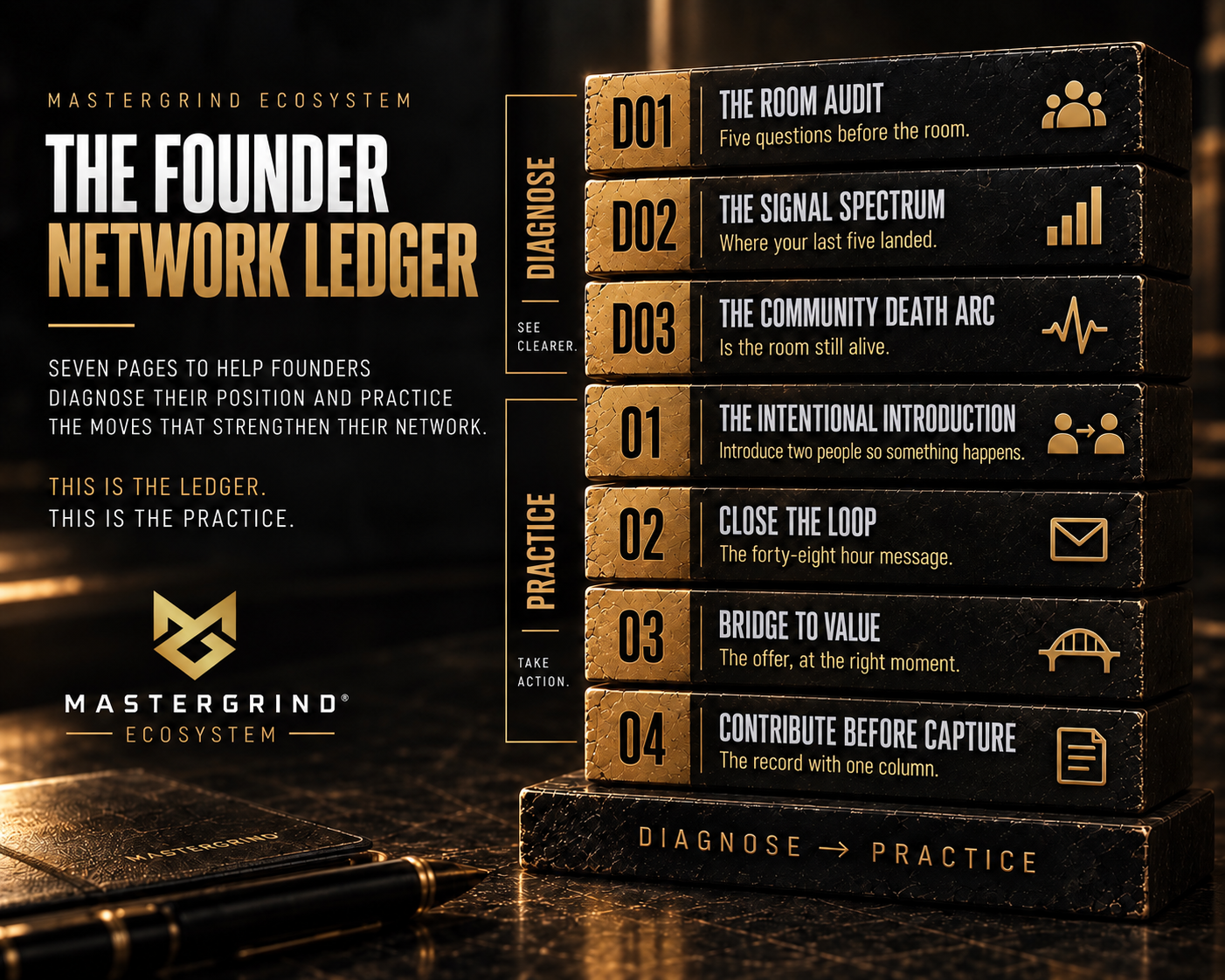
Download seven pages that help founders diagnose their position and practice the moves that activate their network.
Engage & Connect: Foundation Arc, Episode 4

The most dangerous thing for a founder is not failure.
Failure is visible. Failure creates pressure. Failure forces a decision. You know where you stand and you have to do something about it.
The most dangerous thing is the slow, comfortable drift into ordinary. The gradual acceptance of standard slightly below what you know you are capable of, repeated until the gap becomes invisible. That drift does not announce itself. It accumulates in the rooms you stop choosing, the relationships you stop maintaining, the follow-through you stop doing when no one is watching.

This episode names the three forces that prevent it. And it ends on the move.
KEY TAKEAWAYS
01
Fear of Being Average is an operational filter, not a motivational statement
It governs what rooms you enter, what relationships you maintain, what you produce when no one is tracking it, and what standard you hold for work that could be released as good enough but is not right.
The founders who build exceptional things consistently are not operating from inspiration.
Inspiration is unreliable. They are operating from a standard that makes certain choices automatic and others impossible. The standard is not an aspiration. It is a filter. It runs in the background of every decision, not just the visible ones.
Mastergrind's governing philosophy names this as Fear of Being Average: the rejection of mediocrity as a standard. Not as a feeling. As a decision made again and again until it becomes the way you move.
Mastergrind
02
The first force: Drive
Napoleon Hill spent decades studying what separated people who built exceptional things from people who did not. His conclusion was not talent. It was definiteness of purpose organized into sustained effort.
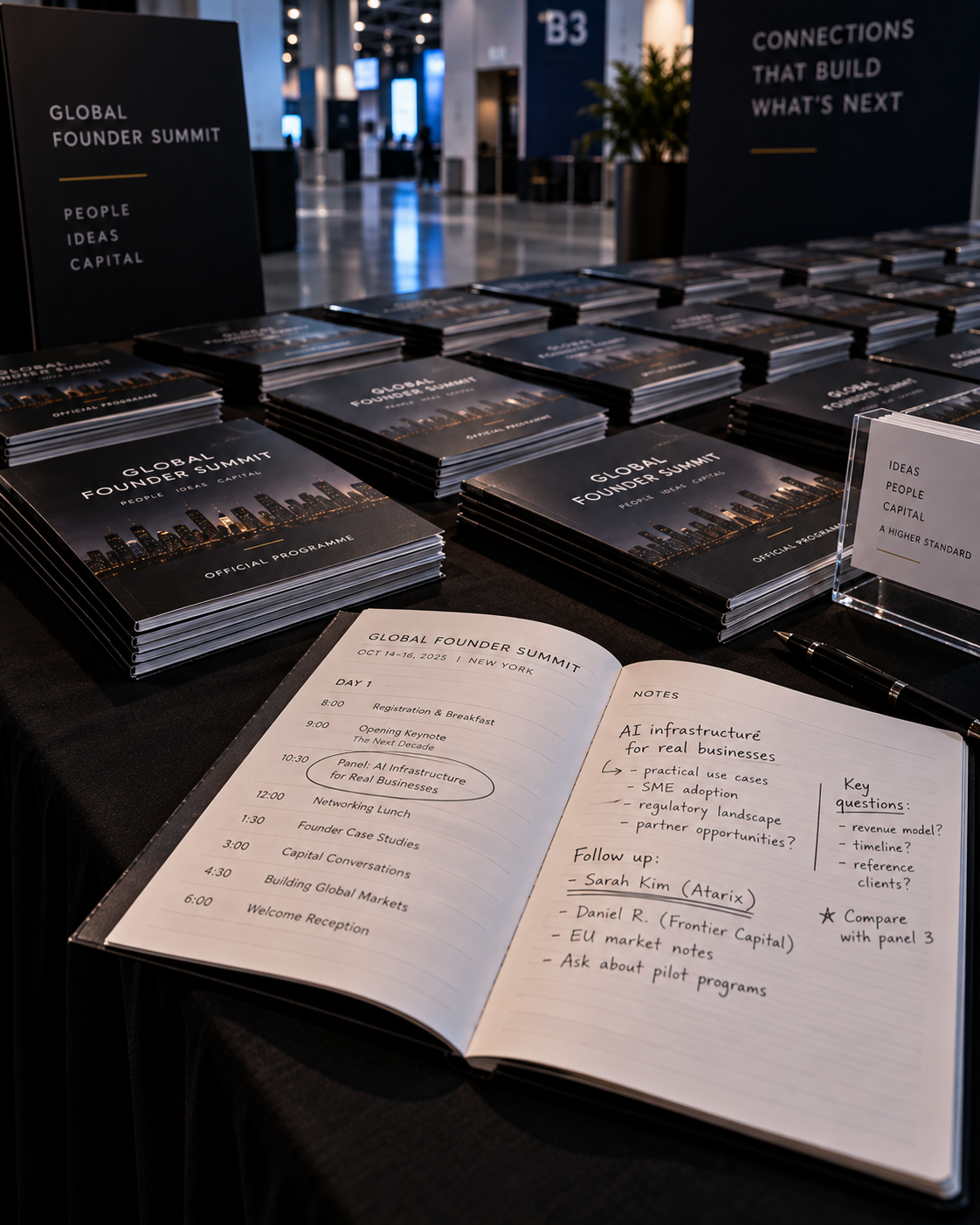
Drive is the internal organizing force that directs effort toward a specific outcome without requiring external fuel. The person with Drive knows exactly where they are going before they enter the room. The notebook is open mid-sentence because they got up to execute, not because the work is finished. The work is never finished when Drive is operating as a filter rather than an aspiration. Without Drive, effort dissipates. The talent is real. The hours are real. The output goes in too many directions to compound. Scattered ambition produces ordinary results regardless of ability.
Napoleon Hill, The Law of Success (1928).
03
The second force: Domain
Robert Greene documented what masters across every field have in common. They found the specific territory where their nature and their effort were aligned and pursued it with intensity over time.
Domain is not an industry. It is not a job title. It is the specific territory where your Drive produces the highest ceiling when matched to your primal inclination. The ceiling in the wrong domain is fixed. No amount of Drive or accumulated hours moves it. The ceiling in the right domain is not fixed. It is the variable that makes the difference between compounding output and plateau.
The founder in their right domain experiences the work differently. It pulls rather than pushes.The marked program among the unmarked ones is not discipline. It is what Domain alignment looks like as a decision made before the room rather than inside it.
Robert Greene, Mastery (Penguin Books, 2012).
04
The third force: Depth
Malcolm Gladwell documented K. Anders Ericsson's finding that no natural talent bypasses deliberate practice. Every world-class performer accumulated thousands of intentional hours in a single domain. The hours are not optional. They are the conversion mechanism that turns domain orientation into genuine capability.
Depth is not experience. Experience is passive accumulation of time. Depth is the active, intentional, repeated effort to improve within a specific domain over thousands of hours. The worn studio surface in close crop is Depth made visible. The wear pattern is not age. It is accumulated intention. The residue of many sessions in one domain.
Without Depth, Drive and Domain produce vision that outpaces execution. The founder can see exactly where they need to go and cannot deliver at the level the destination requires. Depth is what closes that gap.
Malcolm Gladwell, Outliers: The Story of Success (Little, Brown, 2008).

05
The formula: three forces that multiply
Drive. Domain. Depth. These three forces are not additive.
They multiply. A founder with Drive and Depth in the wrong Domain hits a ceiling they cannot explain. The effort is real. The hours are real. The territory is wrong. A founder with Drive and Domain who never accumulates the hours produces vision and conviction that outpaces what they can actually deliver. A founder with Domain and Depth but scattered, undefined purpose produces technically excellent work that goes nowhere specific.
When any one force is underdeveloped, the equation collapses. Average is not the absence of talent. It is the failure to develop all three forces in the territory that is actually yours.
The exceptional founder is not born different. They are organized differently. And they moved on it.
Mastergrind: Three Dimensions of Activation.
The Foundation Arc named four failure modes across four episodes. The rooms that do not work. The noise you produce without realizing it. The community drifting toward death. The standard held in theory but not in practice.
Every one of those failure modes has the same root cause. One or more of the three forces is underdeveloped. Drive is scattered. Domain is wrong. Depth has not accumulated. This is not a diagnosis to sit with.
Drive. Domain. Depth. Name which one needs the most development right now. Then move.
Get Activated. Stay Activated.
Follow Streams to receive every episode direct: mastergrind.network/subscribe
SOURCES REFERENCED IN THIS EPISODE
Mastergrind.
Napoleon Hill, The Law of Success. 1928.
Robert Greene, Mastery. Penguin Books, 2012.
Malcolm Gladwell, Outliers: The Story of Success. Little, Brown, 2008.
Bob Burg and John David Mann, The Go-Giver: A Little Story About a Powerful Business Idea. Portfolio/Penguin, 2007.
K. Anders Ericsson, deliberate practice research cited in Gladwell, Outliers
Download: Network Ledger
Download seven pages that help founders diagnose their position and practice the moves that activate their network.

Events:
Hosted by Mastergrind Club
Related:
Mastergrind Club


Spotlight:
The Founder Network Ledger
Stay close to what's being built!
Follow StreamsLocation:
New York City
Location Spotlight:
United Agency: 5 Habits for Building Wealth
Marketplace:
Ecosystem Activation


Explore:
Mastergrind Network
Spotlight:
The Founder Network Ledger


Stay close to what's being built.
Follow Streams

Mindset: Fear of being average
Follow & Activate


Your Club-GOLD Membership
These Club benefits are available to you during your Trial Membership until the launch of Mastergrind Club.
Your Club-Silver Membership
These Club benefits are available to you during your Trial Membership until the launch of Mastergrind Club.
Your Club-Blue Membership
These Club benefits are available to you during your until the official launch of Mastergrind Club.
Your Limited Access Account
Limited Access to Mastergrind Network & Club Events. A curated set of past Club event recordings and select resources from the Club library.
Not the full Club. A real look inside it.


