




The Rooms You Are In Are Not Working
Episode 1/12: You have seen this room before.
From
Alexander D. L. Oliver
The Founder Network Ledger
Download seven pages that help founders diagnose their position and practice the moves that activate their network.

Engage & Connect: Foundation Arc, Episode 1
Two tables from the same three days.
The first one is on the convention floor, mid-afternoon, day two. Identical booth surfaces running down the aisle. On the counter, brochures fanned out. A card holder with the cards still stacked in it. A branded pen set out for the taking. A paper coffee cup from the morning session, still where someone set it down.
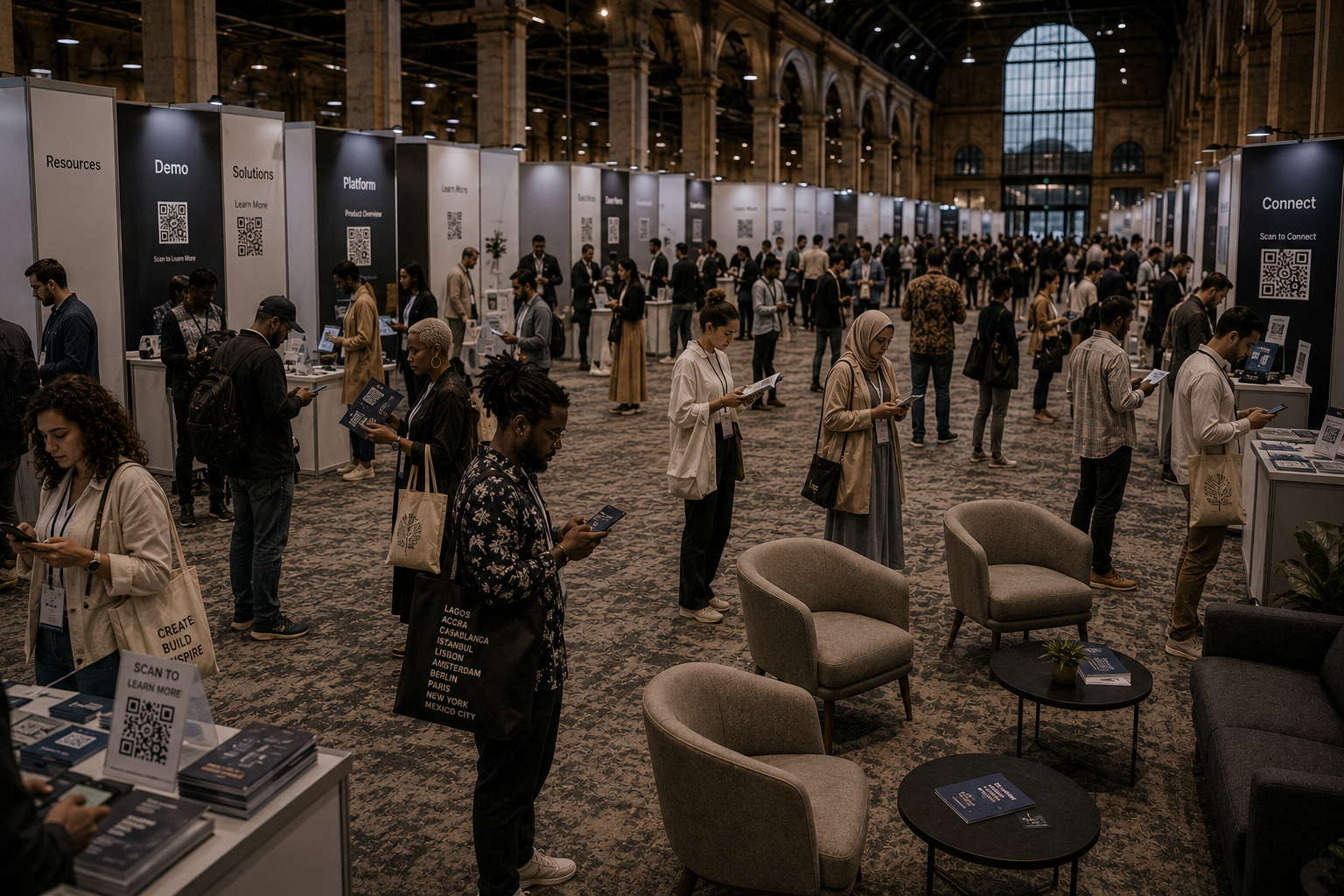
Everything on that surface was designed for volume. Nothing on it is specific to any individual person.
The second table is in a restaurant, eleven at night, the same city. The official event ended three hours ago.
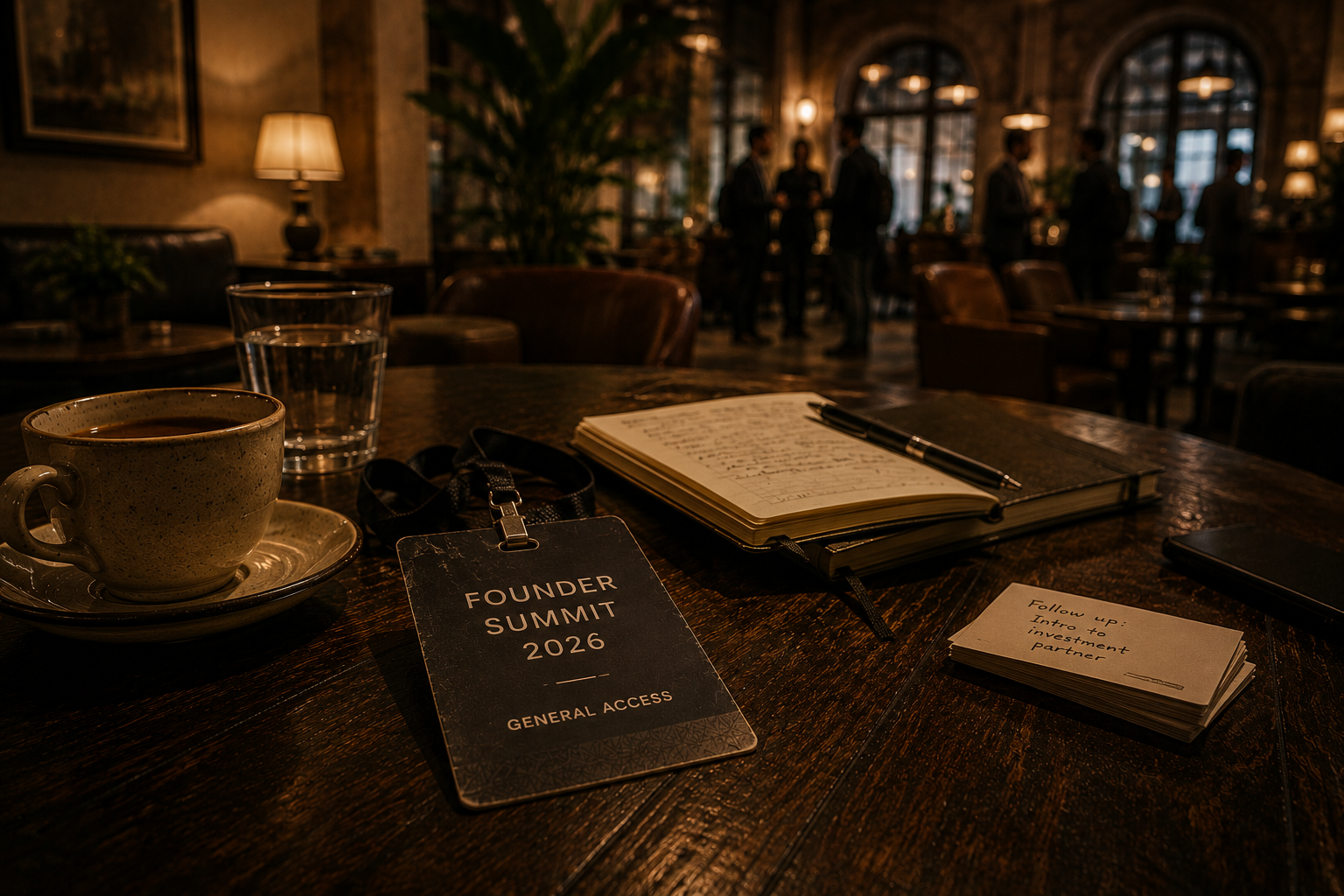
A convention badge lies on the wood, lanyard still attached, creased from being folded into a pocket. Two glasses, one nearly finished, a ring left on the surface underneath. An open notebook. Handwriting: names with lines drawn between them, one name underlined twice, a question written and crossed out and written again below itself. A follow-up task with a time noted beside it.
Same event. Same three days. Look at what each surface produced.
READING THE SECOND TABLE
The badge is off.
Small thing, and it is the whole evening. At some point in the last three hours this stopped being an event and became a conversation, and the badge came off because nobody at that table needed a name tag to know who they were talking to.
Everyone at the first table still has theirs on.

Two glasses, and a ring under one of them.
A ring means a glass sat long enough to leave a mark. Nobody was working the room. Nobody left to go work the room. The conversation went somewhere and the people in it stayed with it, which is the rarest thing that happens at a convention and the least likely to appear in any recap of it.
Names with lines drawn between them.
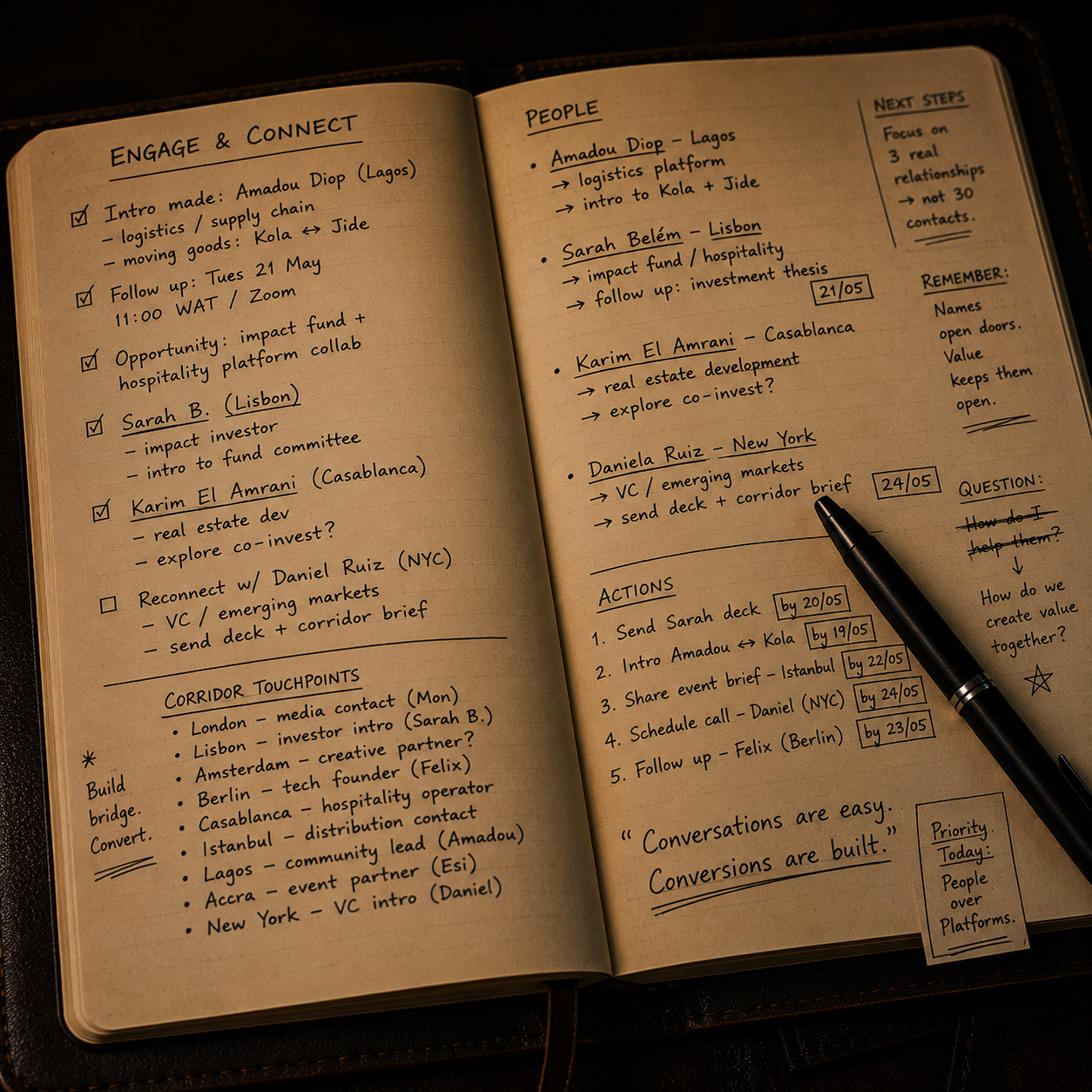
Not a list. A list is what you write when you are recording who was present. Lines between names is what you draw when you are working out who should know each other, which means the person holding the pen had stopped collecting and started thinking.
A question crossed out and rewritten.
This is the detail that matters most and it is almost invisible. The first version of the question was not good enough, and somebody noticed, in the middle of a conversation, and fixed it.
That is not note-taking. That is thinking, in real time, about somebody else's problem.
A time written beside a task.
Not a name. Not a reminder to follow up. A time. Which means the follow-up is already scheduled, and the thing you promised has a place to land.
Almost nobody does this and it costs four seconds.
WHAT THE FIRST TABLE PRODUCED
Brochures nobody folded. Cards nobody took. A pen. A cup from the morning.
The room did exactly what it was built to do. It moved a lot of people past a lot of surfaces, efficiently, on schedule, and everyone who attended can honestly say they attended.
That is the thing worth sitting with, because the convention was not broken. It worked as designed. It is simply that what it was designed to produce and what you needed from it were never the same thing, and nobody told you that, and the badge and the schedule and the room made it feel like they were.
The real conversation was in the restaurant, three hours after the room closed, and it was not on the programme.

THE PART NOBODY TELLS YOU
The founders who consistently end up at the second table are not more charming than you. They did one thing before the first table, and it took about five minutes.
They decided what this room was actually for. Not what the organisers said it was for. What it could produce, specifically, for them, and who would be in it, and what they had that was worth handing to someone, and where in the building the real conversation was likely to be.
None of that is charisma. It is a decision made in a taxi, and it is the difference between the two tables.
Think about the last room that mattered. What was left on the table after it?
If the answer is a badge you still have in a drawer and a contact you never wrote to, that is not a failure of confidence. It is a decision that was available to you and that nobody told you to make.
Download: The Founder Network Ledger
The strongest networks are built over time. Through trust. Through contribution. Through what happens after the introduction. The Founder Network Ledger gives you a way to see those relationships clearly and act on them deliberately.
Page D01 is where this episode continues: the five questions you run before the room, not after it.
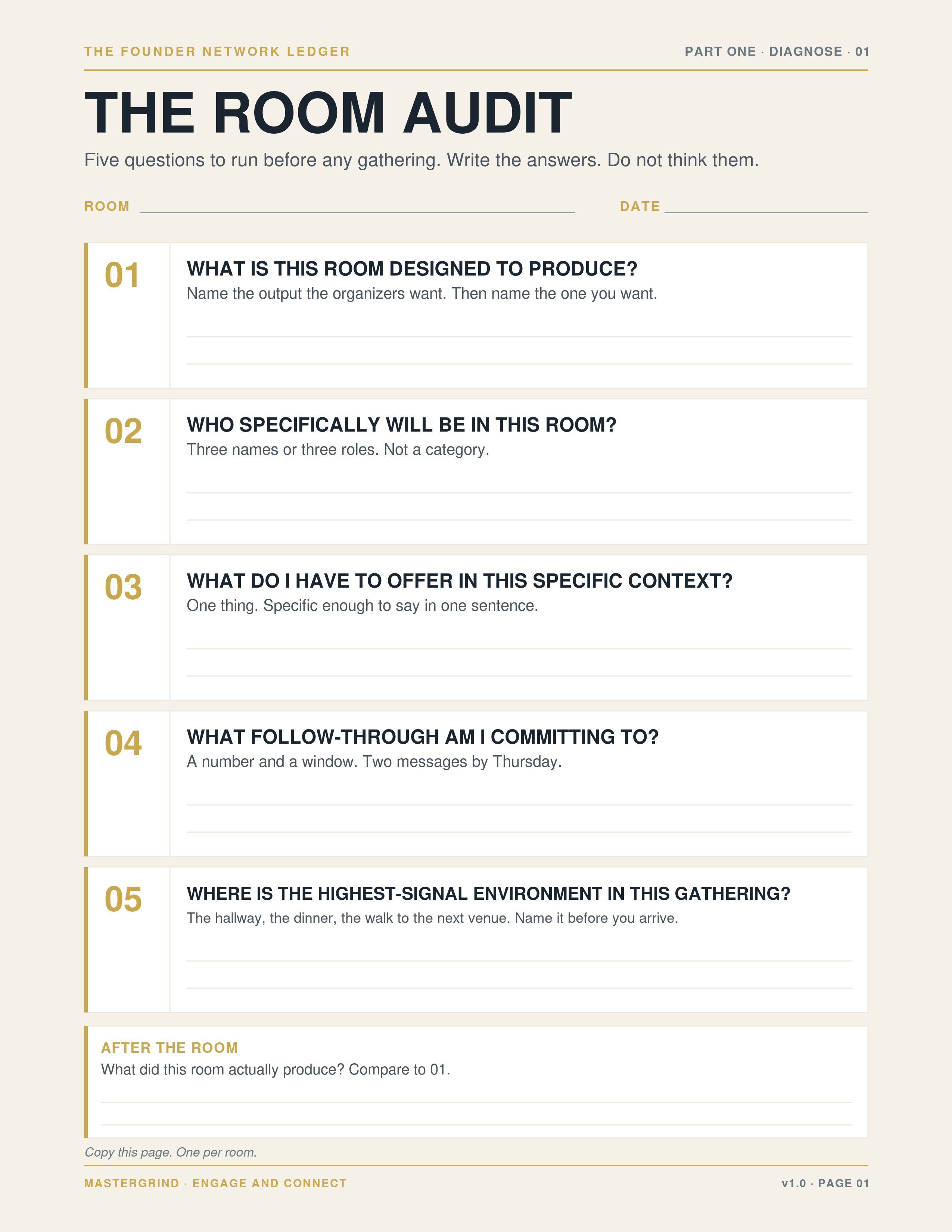
Seven pages. No noise. No performance. Nothing in it works until you write on it.
mastergrind.network/network-ledger
GET ACTIVATED. STAY ACTIVATED.

SOURCES REFERENCED IN THIS STREAM
Judy Robinett, How to Be a Power Connector: The 5+50+100 Rule for Turning Your Business Network into Profits. McGraw-Hill, 2014.
Keith Ferrazzi with Tahl Raz, Never Eat Alone: And Other Secrets to Success, One Relationship at a Time. Crown Business, 2005. Updated edition 2014.
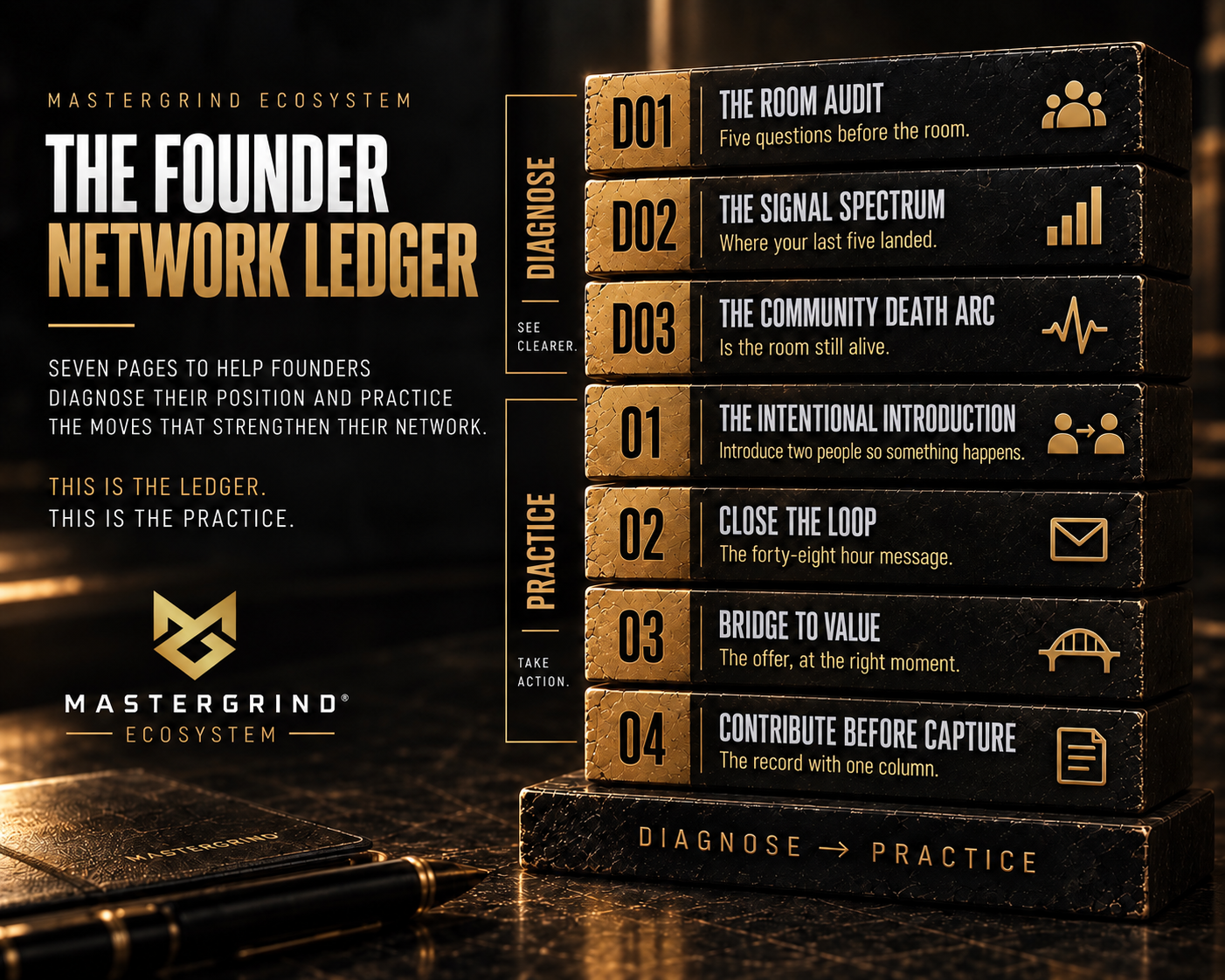
Download: Network Ledger
Download seven pages that help founders diagnose their position and practice the moves that activate their network.

Events:
Hosted by Mastergrind Club
Related:
Mastergrind Club


Spotlight:
The Founder Network Ledger
Stay close to what's being built!
Follow StreamsLocation:
New York City
Location Spotlight:
Shop at BKLYN Fitness
Marketplace:
Ecosystem Activation


Explore:
Mastergrind Network
Spotlight:
The Founder Network Ledger


Stay close to what's being built.
Follow Streams

Mindset: Fear of being average
Follow & Activate


Your Club-GOLD Membership
These Club benefits are available to you during your Trial Membership until the launch of Mastergrind Club.
Your Club-Silver Membership
These Club benefits are available to you during your Trial Membership until the launch of Mastergrind Club.
Your Club-Blue Membership
These Club benefits are available to you during your until the official launch of Mastergrind Club.
Your Limited Access Account
Limited Access to Mastergrind Network & Club Events. A curated set of past Club event recordings and select resources from the Club library.
Not the full Club. A real look inside it.


