




Secure Does Not Mean Sovereign
Episode 2: Control what happens to your data.
From
Alexander D. L. Oliver
The Founder Infrastructure Map
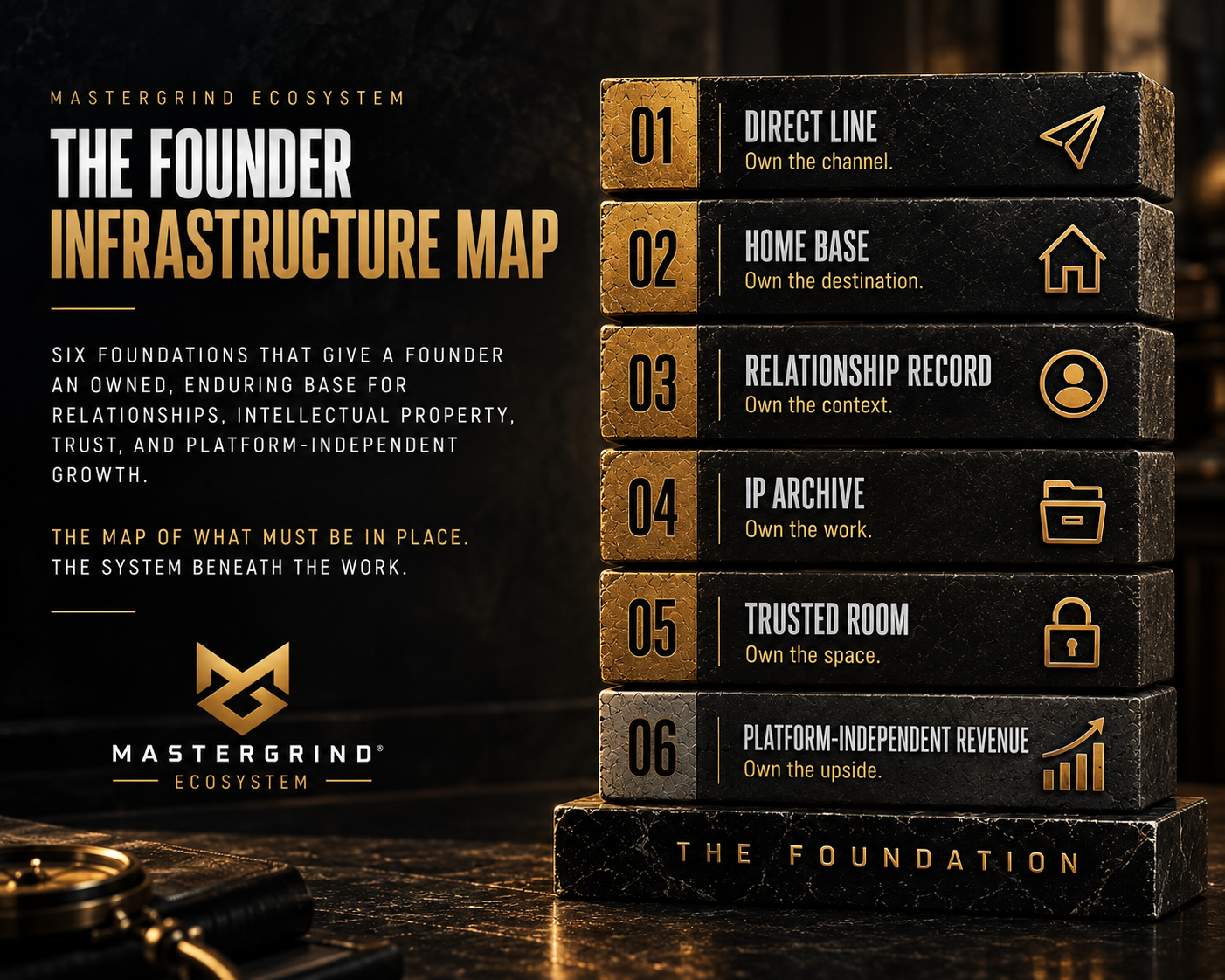
A free PDF map showing exactly what to build underneath your public presence, in what order, with what tools, and why it matters now.
There is a question most founders never think to ask.
Not whether their platform is working. Not whether their reach is growing. Not even whether their content is landing the way they intended.
The question is this: if the platform disappeared tomorrow, what would you still have?

Most people, when they sit with that honestly, realize the answer is smaller than they expected. A following they cannot contact. Content they cannot export. A reputation that lives inside someone else's system. Relationships mediated by an algorithm they never had access to.
The platform feels like yours. That feeling is the problem.
1. The Hidden Distinction
When founders think about platform risk, they tend to think about security. Hacking. Account theft. Data breaches. These are real concerns, and they are worth taking seriously.
But they are the wrong concern for most founders. Because the deeper threat is not that someone takes your account. It is that you never really owned it to begin with.
Security and sovereignty are not the same thing. Security means your data is protected from outsiders. Sovereignty means you control what happens to it.
A vault in a bank is secure. But the vault belongs to the bank.
Most founders have spent years depositing into vaults that do not belong to them, calling it wealth-building.
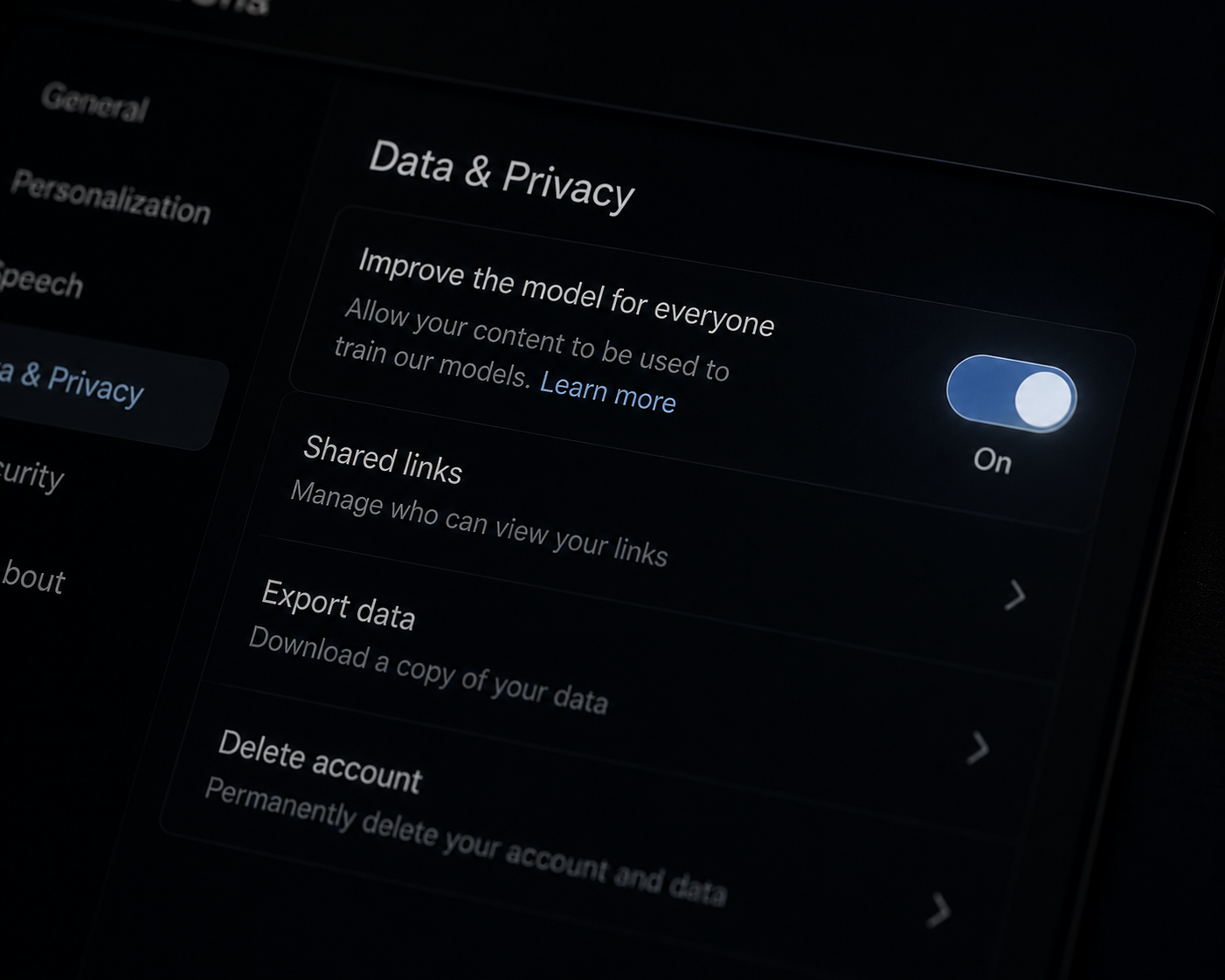
LinkedIn defaulted users into AI training in September 2024. Not after updating its terms of service. Before. Your posts, your articles, your videos feeding into a system before you were even notified it was happening. When the story broke, LinkedIn's response was to offer a toggle you could switch off. Buried in settings. Available on desktop only.
The account was perfectly safe. Nothing was breached. But the value inside it was already being harvested, and the default assumption was that you had consented simply by showing up.
That is not a security failure. That is sovereignty by design, assigned to someone other than you.
2. What Ownership Actually Looks Like
This is the part that tends to get abstract, so let me make it concrete.
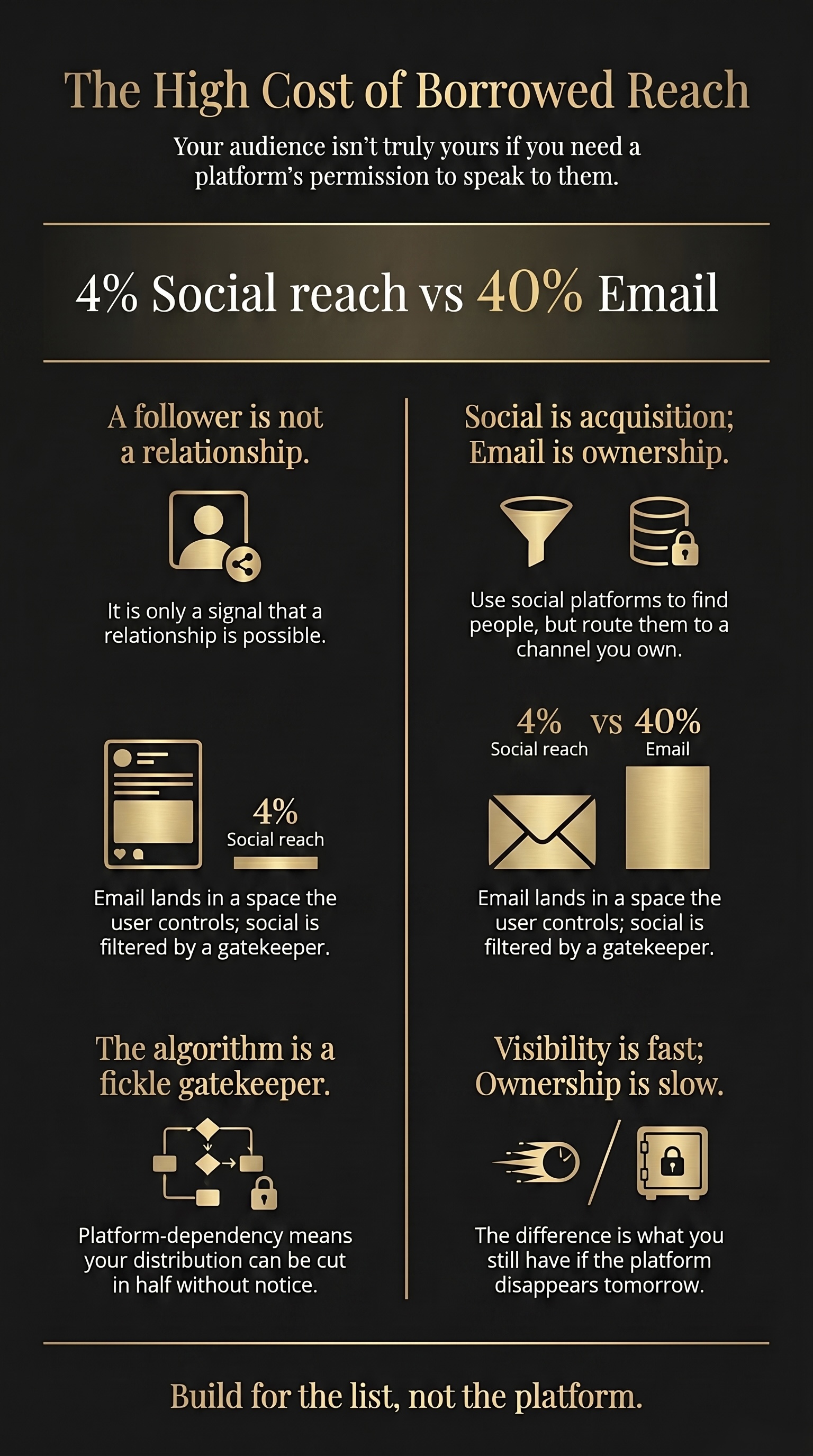
Owning your audience does not mean having a lot of followers. It means being able to reach those people directly, without asking anyone's permission, regardless of what any platform decides to do next week.
An email list is ownership. You exported it, you control it, you can take it anywhere. If your email provider shuts down tomorrow, you can move the list to a different provider and send on Monday.
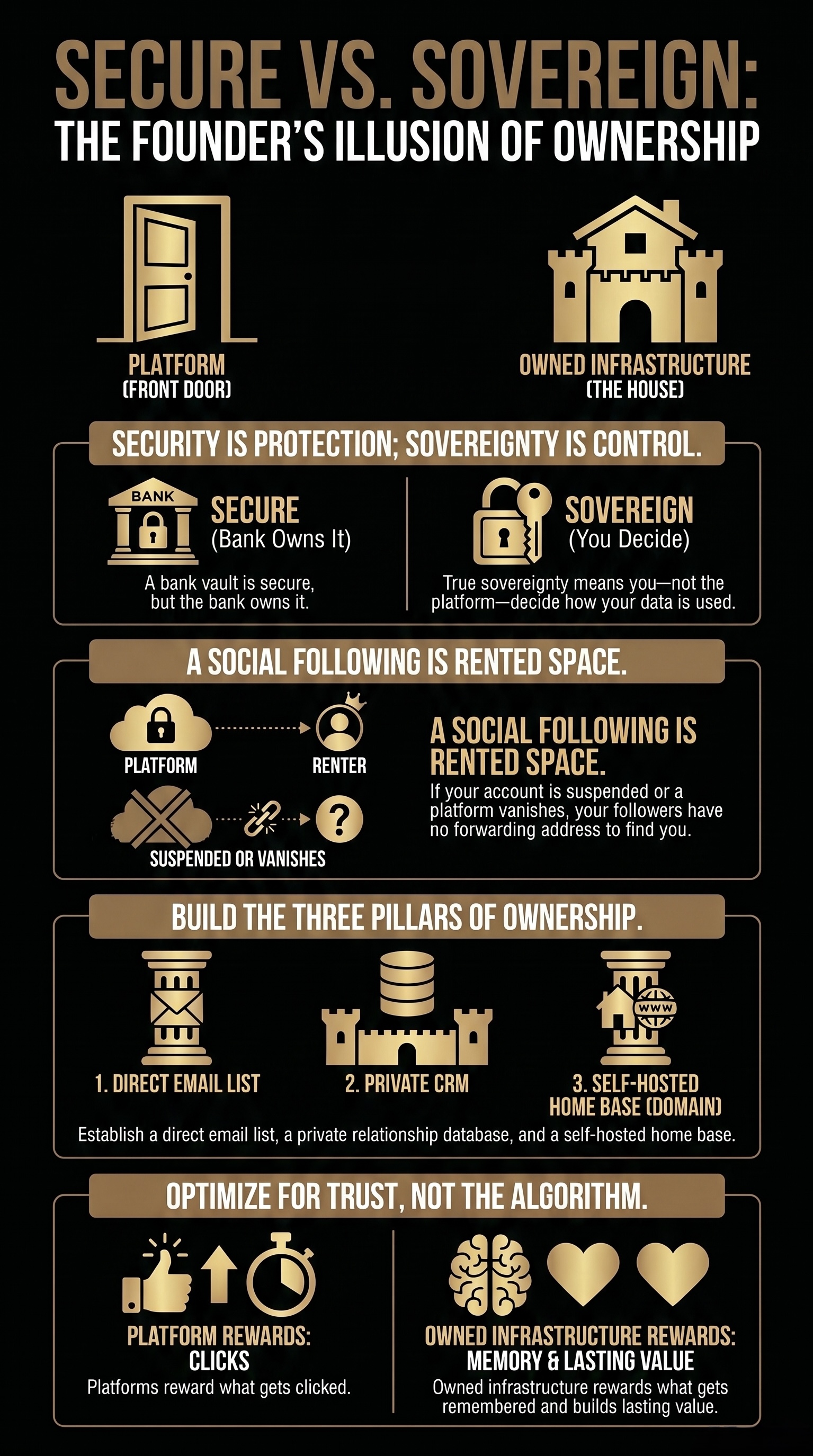
A social following is not ownership. If Instagram shuts down your account, your followers do not receive a forwarding address. They have no way to find you. You have no way to reach them. The relationship existed inside a system that belonged to the platform, and when the platform is gone, so is the relationship.
"The question is not how many people follow you. The question is how many of them could you reach if the platform was gone."
Most founders, when they answer that honestly, realize the number is much closer to zero than they thought.
This is not a theoretical future risk. Becky Stone built eleven years of work on Instagram. 95,000 followers. 4,300 posts. She was paying for Meta Verified when the platform permanently suspended her account for impersonating herself. The path back in required a U.S. Congressman's office to email Meta's PR department directly. That was the appeals process.
She got it back. Most people in her situation do not.
3. The Uncomfortable Middle
I want to be fair about something here, because I think the honest version of this conversation is more useful than the comfortable one.
Building owned infrastructure is harder than posting on a platform. Setting up an email list, building a newsletter, creating a community you actually host, producing content that goes out directly without a platform to amplify it for free, none of that is easy in the beginning.
The platform made distribution feel effortless because they needed your content. They had an audience and no product without creators filling it. So they made the on-ramp as easy as possible. The algorithmic reward for showing up felt like growth. It was growth. But it was also dependency being built one post at a time, without you fully understanding the terms.
Building underneath that is slower at first. An email list grows differently than a following. A private community builds differently than a public one. The feedback loops are longer and the vanity metrics are quieter.
But the compound works differently too.
"A following is rented. A list is owned. And ownership compounds in ways that renting never can."
Casey Newton built Platformer to 170,000 subscribers on Substack before moving everything to a self-hosted platform he controls completely. He did not do that because Substack was bad to him. He did it because he had watched enough platforms change to know that no platform stays the same forever. He moved before a crisis arrived, not because of one.
That is the decision most founders put off until it is urgent. By then, the cost of building underneath is much higher because they are doing it under pressure rather than by design.
4. The Three Things Worth Building
When people ask what owned infrastructure actually means in practice, the answer is simpler than it sounds.
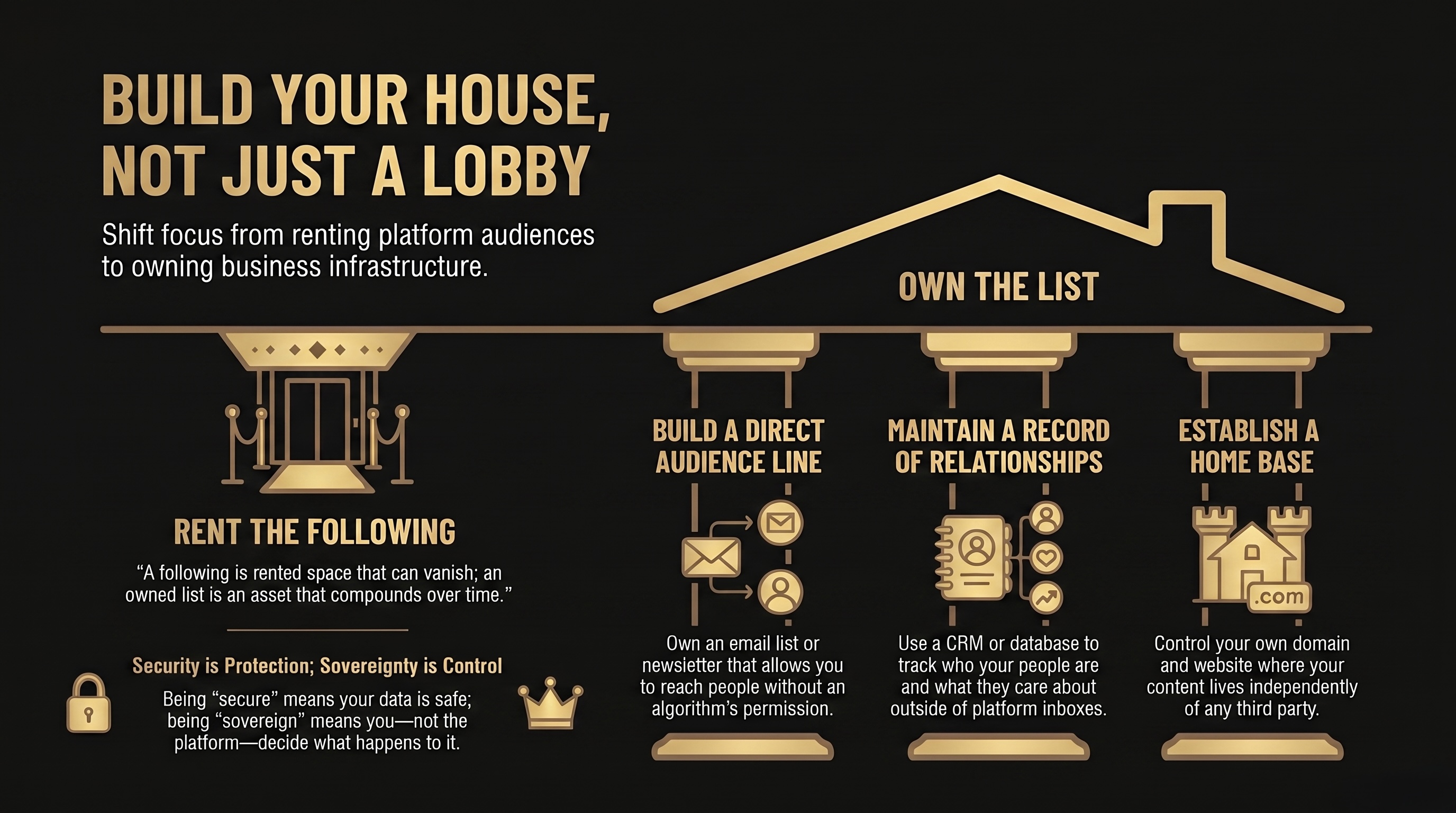
A direct line to your audience. An email list you control, a newsletter that goes out regardless of any platform's algorithm, a way to reach people without asking for permission first. This is the minimum.
A record of your relationships. A CRM, a database, some system that knows who your people are, what they care about, where the conversation is. Not inside a platform's inbox. Inside something you can access, export, and control.
A home base you own. A domain you control. A place where your content lives that does not depend on any third party choosing to keep it live. This does not have to be complicated. It just has to be yours.
These are not expensive to build. They are slow to build, and most founders skip them because the platform is working well enough today that the risk feels abstract.
The risk is not abstract. It is just invisible until the day it is not.
5. The Shift That Changes Everything
What I have found is that the founders who build this infrastructure early do not just have more resilience. They operate differently.
When your audience lives in your own system, you stop optimizing for the algorithm and start optimizing for the relationship. The content changes. The tone changes. The cadence changes. You are no longer producing for the feed. You are producing for people.
That shift is subtle but it changes everything downstream. The quality of the work goes up because the incentive is no longer to grab attention. It is to earn trust. And trust compounds in ways that attention never does.
"The platform rewards what gets clicked. Owned infrastructure rewards what gets remembered."
Lenny Rachitsky's newsletter crossed a million subscribers without running ads, without gaming an algorithm, and without a media company behind it. His distribution method was so simple it sounds like a joke: he wrote something worth reading and let people share it. That only works when the relationship is real enough that people want to pass it on.
That kind of relationship does not live on a platform. It lives in something you own.
Conclusion: Start Before You Need To
The best time to build owned infrastructure was before your following was large enough to feel like you had something to lose. The second best time is now.
Not because the platforms are going away. Not because your account is in danger. But because the gap between what you think you own and what you actually own is wider than most founders realize, and the only way to close it is to build something underneath.
You do not have to leave the platforms. You do not have to abandon what is working. You just have to stop treating visibility as a foundation.
"The platform is the front door. What you build behind it is the actual house. Most founders have spent years decorating a lobby they do not own."
Build the house.
If You Want to Know What to Build First
Knowing the gap is not the same as knowing the sequence. Most founders understand they should be building owned infrastructure. Fewer know what to build first, what good looks like when it is in place, and what tools to use without over complicating it.
I mapped it out. Six foundations, in order, with a clear explanation of what each one does and where to start. It is called the Founder's Infrastructure Map.
Download: The Founder Infrastructure Map
The two-layer model. The six foundations. What to build, in what order, with what tools, and what good looks like when it is done.
Link: Download The Founder Infrastructure Map PDF
Download: Infrastructure Map
Download a free PDF map showing exactly what to build underneath your public presence, in what order, with what tools, and why it matters now.

Events:
Hosted by Mastergrind Club
Related:
Mastergrind Club


Spotlight:
The Founder Network Ledger
Stay close to what's being built!
Follow StreamsLocation:
New York City
Location Spotlight:
Plan Your Wedding with Lisa Brooks!
Marketplace:
Ecosystem Activation


Explore:
Mastergrind Network
Spotlight:
The Founder Network Ledger


Stay close to what's being built.
Follow Streams

Mindset: Fear of being average
Follow & Activate


Your Club-GOLD Membership
These Club benefits are available to you during your Trial Membership until the launch of Mastergrind Club.
Your Club-Silver Membership
These Club benefits are available to you during your Trial Membership until the launch of Mastergrind Club.
Your Club-Blue Membership
These Club benefits are available to you during your until the official launch of Mastergrind Club.
Your Limited Access Account
Limited Access to Mastergrind Network & Club Events. A curated set of past Club event recordings and select resources from the Club library.
Not the full Club. A real look inside it.


