




Your Audience Is Not Yours Until You Can Reach Them
Episode 3: There is a test every founder should run, and almost none of them do.
From
Alexander D. L. Oliver
The Founder Infrastructure Map
A free PDF map showing exactly what to build underneath your public presence, in what order, with what tools, and why it matters now.
There is a test every founder should run, and almost none of them do.

Not a business audit. Not a brand review. Something simpler and more uncomfortable than either of those.
The test is this: if the platform you use most disappeared tonight, how many of the people you call your audience could you actually contact tomorrow?
Not find. Not hope to reconnect with. Contact. Directly. Without asking anyone's permission.
For most founders, the honest answer is close to zero.
1. The Difference Between an Audience and a Relationship
We use the word audience loosely. It gets applied to followers, subscribers, fans, connections, readers, listeners. We use it to mean anyone who has encountered our work and registered some signal of interest.
But an audience, in the real sense, is not a list of people who once clicked something. It is a group of people you can reach when you need to. When you have something important to say. When you launch something. When you need the relationship to do work.
Most founders do not have that. They have visibility. They have reach in the algorithmic sense of the word. But the relationship between them and their so-called audience is mediated by a platform that can change, restrict, or remove that access without notice.
"A follower is not a relationship. It is a signal that a relationship is possible. The relationship only becomes real when you can reach that person directly."
That distinction matters more right now than it ever has. The era of free, reliable organic reach on any major platform is over. The algorithms have matured. The business models have shifted. What was a growth tool is now an advertising platform, and the organic layer is getting thinner every year.
If your strategy depends on the algorithm delivering your message to people who already chose to follow you, you are already operating with a significant and compounding disadvantage.
2. What Reach Actually Means
Here is the number that makes this concrete.
Your email list reaches 30% to 40% of the people on it every time you send. Your social posts reach 1% to 4% of the people who follow you. That is not a marginal difference. It is a structural one.
10,000 email subscribers means 3,000 to 4,000 people receive your message directly. 10,000 social followers means 1 to 400 people see your post, on a good day, depending on how the algorithm feels about you that week.
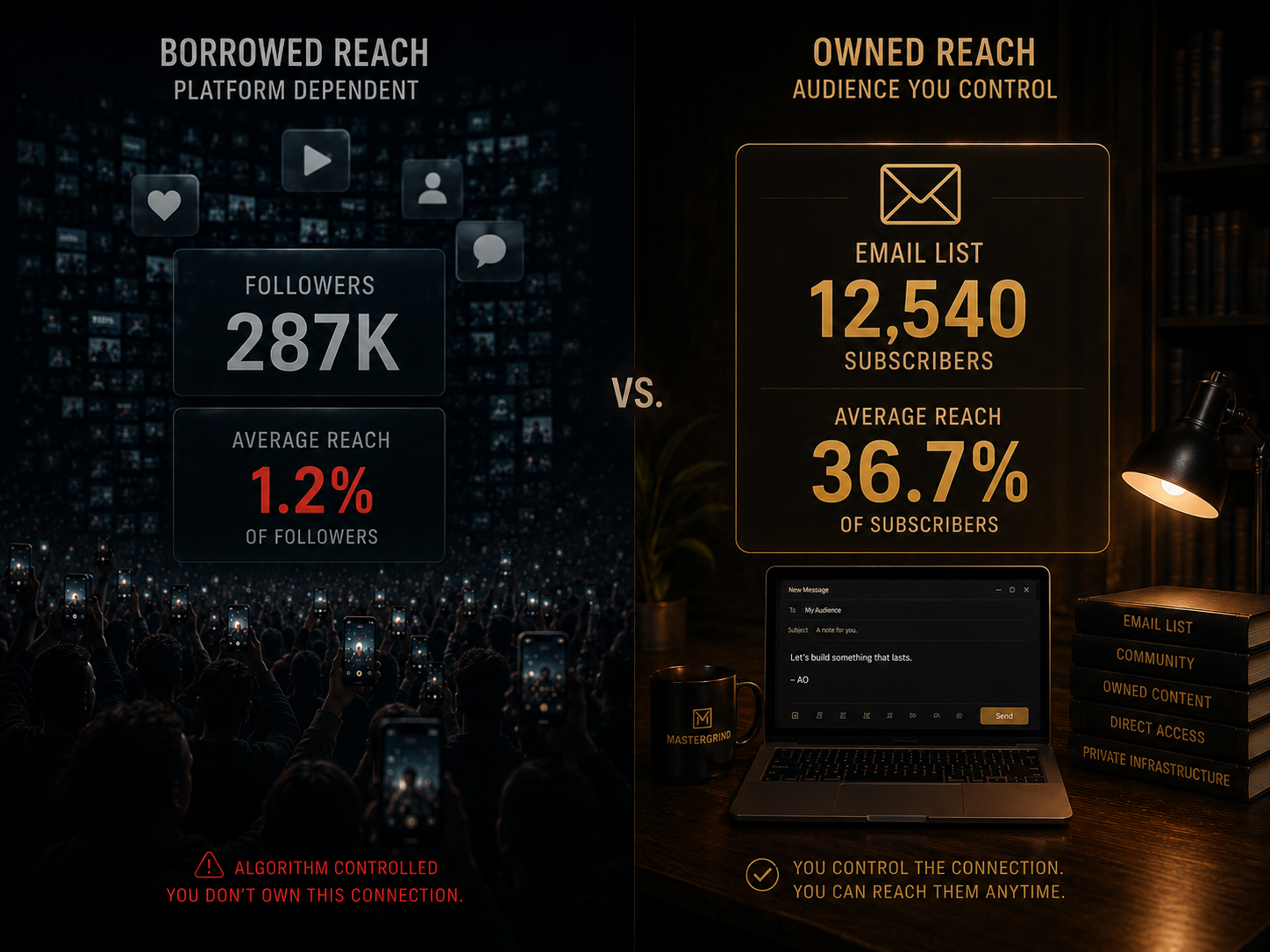
But more important than the open rate is what happens when you send an email versus what happens when you post. When you send an email, the message arrives in a space that person controls. Their inbox. They chose what goes there, and they see everything that lands in it. When you post, the message enters a space the platform controls. Whether it surfaces depends on variables you cannot see, predict, or reliably influence.
"One of those channels is a relationship. The other is a broadcast that may or may not get through."
Most founders have spent years building the broadcast side. The relationship side, the owned side, the side that actually reaches people, is thin or nonexistent.
3. The Quiet Cost of Borrowed Reach
The cost of platform-dependent reach does not show up on a balance sheet. It shows up in slow, invisible ways over time.
A launch that underperforms because the algorithm decided this was not a good week for your content. An announcement that reaches a fraction of the people who should have seen it. A conversation you wanted to start that never gained traction because the post got buried before it had a chance to spread.
These are not catastrophic failures. They feel like normal variance. That is what makes them expensive. Because you adapt to them. You optimize for the algorithm instead of optimizing for the relationship. You start producing content for reach rather than producing content for the people who are actually listening.
The platform trains you to play by its rules. And over time, you get good at a game that does not build anything you own.
"The algorithm is not your distribution partner. It is a gatekeeper that changes the terms whenever it wants."
The founders who feel this most acutely are the ones who have spent years building a strong social presence and then watched a policy change, an algorithm update, or a platform shift cut their effective reach by half. The audience did not leave. The platform just stopped showing them the content.
That is not a business problem. That is an infrastructure problem. And the solution is not to produce better content for the algorithm. The solution is to build a channel that does not need the algorithm's permission to reach the people who already said they wanted to hear from you.
4. What Ownership Actually Requires
Building an owned audience is not complicated. It is just slower than building a social following, and the feedback loops are quieter, which is why most founders deprioritize it.
The mechanics are simple. You need a way to collect email addresses and contact people directly. You need a reason to send something worth receiving. And you need to do it consistently enough that the list grows and the relationship deepens over time.
What founders get wrong is treating email as a secondary channel, a place to repurpose content that already ran on social. That approach produces a list that nobody opens. The founders who build genuine owned audiences treat email as the primary channel and social as the acquisition layer.
Social is where people find you. Email is where you actually talk to them.
"The relationship begins when someone gives you their email address. Everything before that is introduction."
Building that list is not fast. But it compounds. Every person on your list is a relationship you can reach without asking anyone's permission. Every post that converts a follower into a subscriber is a permanent upgrade to the quality of your audience.
The founder who has 10,000 social followers and 500 email subscribers has a weaker audience than the founder who has 3,000 social followers and 2,000 email subscribers. Because the second founder can actually reach the people who said they wanted to hear from her.
5. The Practical Starting Point
If you are reading this and you do not yet have an email list you own and maintain, the starting point is simpler than it sounds.
Pick one email provider you control. Set up a simple form. Add it to every piece of content you produce with a clear reason to subscribe. And start sending something worth receiving every two to four weeks.
Not a newsletter about your newsletter. Not a roundup of content you already published. Something original, specific, and useful enough that someone who is not already a fan would find it worth reading.

That is the minimum. It is not complicated. The reason most founders do not do it is not that they cannot. It is that the social platforms make visibility feel easier and faster, and they are. They just do not build anything durable.
"Visibility is fast. Ownership is slow. The difference is what you have five years from now."
The founders building something durable are not posting less on social. They are routing the social activity toward something they own. Every piece of public content becomes an invitation to a more direct relationship.
That inversion is the shift. Stop building for the platform. Start building for the list.
Conclusion: When the Platform Goes Away
The TikTok near-ban of January 2025 did something useful. It made a question visible that most founders had been avoiding.
If the platform went away tonight, what would you still have?
For the founders who had spent years building for the algorithm and nothing underneath it, the answer was terrifying. For the handful who had been routing their platform activity toward an owned list, a private community, or a direct relationship system, the answer was straightforward.
The platform going away would be inconvenient. It would not be existential.
That is the difference between an audience and a relationship. And that is what this series is about.
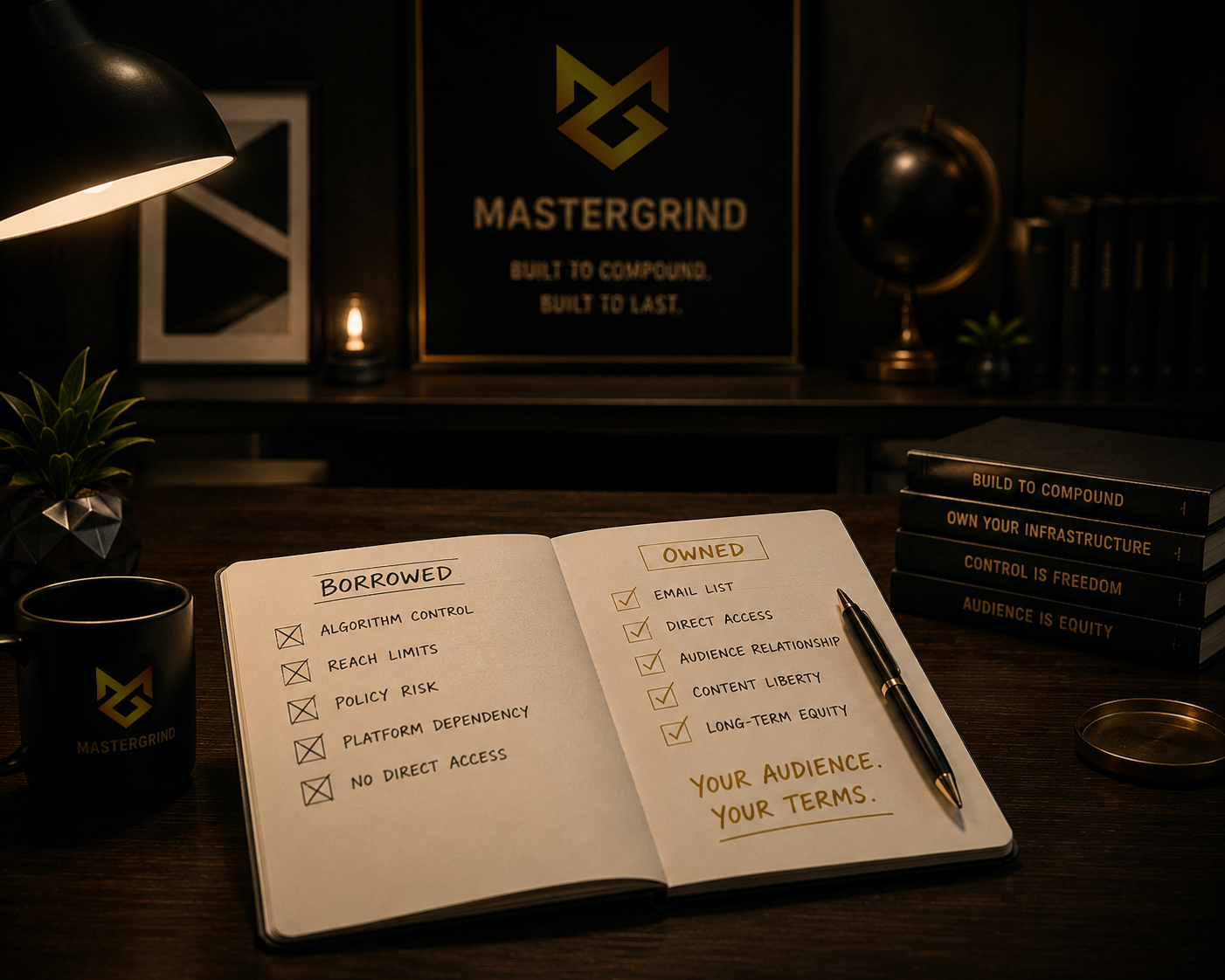
If You Want to Know What to Build First
Knowing the gap is not the same as knowing the sequence. Most founders understand they should be building owned infrastructure. Fewer know what to build first, what good looks like when it is in place, and what tools to use without over complicating it.
I mapped it out. Six foundations, in order, with a clear explanation of what each one does and where to start. It is called the Founder's Infrastructure Map.
Download: The Founder Infrastructure Map
The two-layer model. The six foundations. What to build, in what order, with what tools, and what good looks like when it is done.
Link: Download The Founder Infrastructure Map PDF

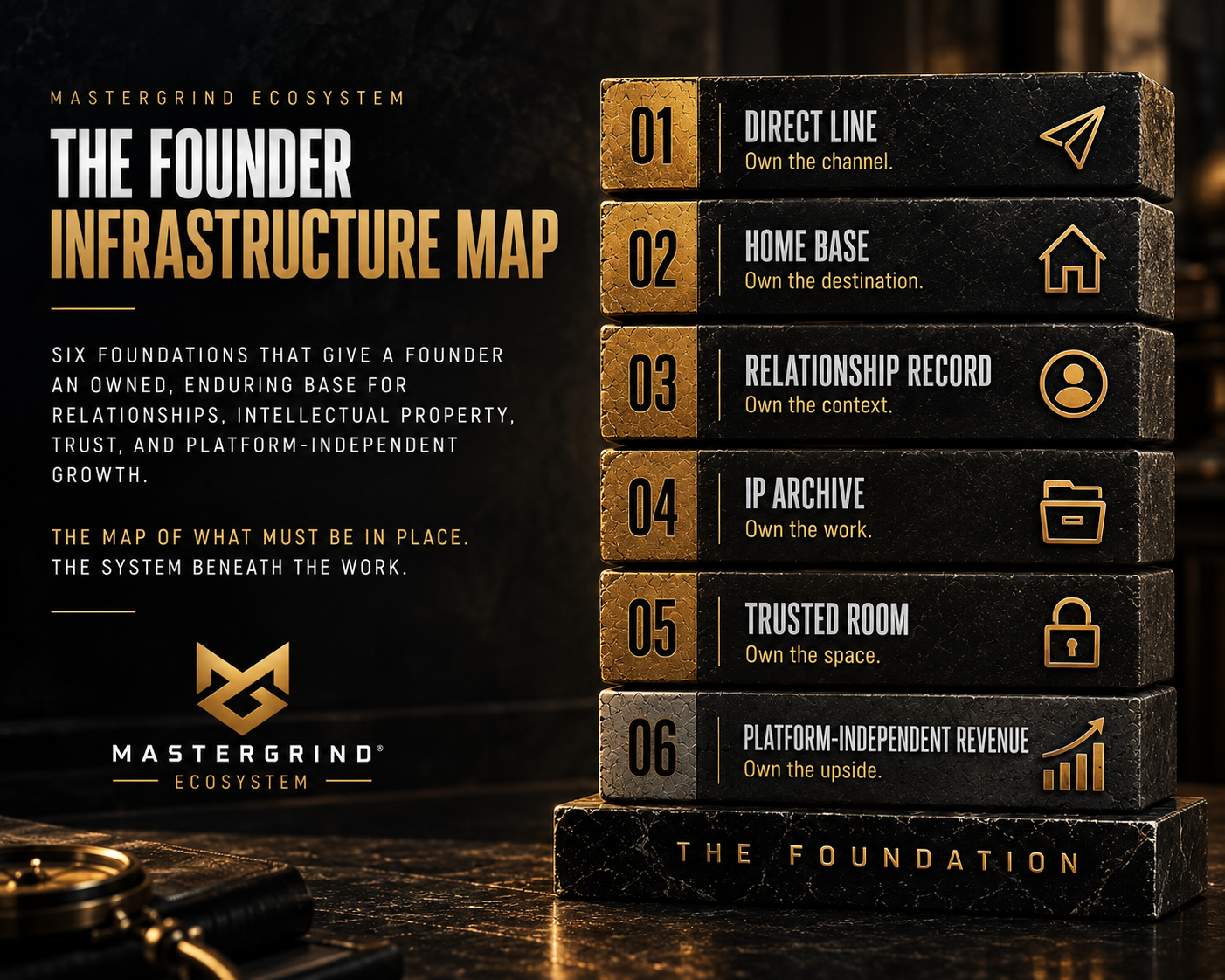
Download: Infrastructure Map
Download a free PDF map showing exactly what to build underneath your public presence, in what order, with what tools, and why it matters now.

Events:
Hosted by Mastergrind Club
Related:
Mastergrind Club


Spotlight:
The Founder Network Ledger
Stay close to what's being built!
Follow StreamsLocation:
New York City
Location Spotlight:
Paper Hearts EP
Marketplace:
Ecosystem Activation


Explore:
Mastergrind Network
Spotlight:
The Founder Network Ledger


Stay close to what's being built.
Follow Streams

Mindset: Fear of being average
Follow & Activate


Your Club-GOLD Membership
These Club benefits are available to you during your Trial Membership until the launch of Mastergrind Club.
Your Club-Silver Membership
These Club benefits are available to you during your Trial Membership until the launch of Mastergrind Club.
Your Club-Blue Membership
These Club benefits are available to you during your until the official launch of Mastergrind Club.
Your Limited Access Account
Limited Access to Mastergrind Network & Club Events. A curated set of past Club event recordings and select resources from the Club library.
Not the full Club. A real look inside it.


