




Signal or Noise?
Episode 2/12: What You Are Actually Producing
From
Alexander D. L. Oliver
The Founder Network Ledger
Download seven pages that help founders diagnose their position and practice the moves that activate their network.

Engage & Connect: Foundation Arc, Episode 2
Two objects on the same dark table, lit from opposite sides.
On the left, a phone. The screen is showing a contacts list, and the glow off it is the only cold light in the frame. Forty-one new entries from the past eight days. Names, companies, a few job titles autofilled from a card scan. No notes on any of them.
On the right, an open notebook under a warm lamp. Nine pages used in the same eight days. Names with lines between them. A question crossed out and rewritten. A pricing problem sketched out with somebody else's numbers in it. Three tasks, each with a time.

Both objects represent the same week. Both belong to people who worked hard that week and would describe the week the same way.
Which one produced something?
THE UNCOMFORTABLE PART
You already know the answer, and the discomfort is not about the answer. It is about how similar the two weeks felt from the inside.
Forty-one entries took real effort. Conversations happened. Hands were shaken. Somebody was present, engaged, and putting themselves in rooms, which is what everyone told them to do, and at the end of eight days they had a number that went up.
Nine pages produced nothing measurable at all.
READING THE TWO OBJECTS
Forty-one entries, no notes.
A contact with no note is a record that someone existed near you. In three weeks you will not remember which conversation was which, which means the contact is functionally a name you cannot use.
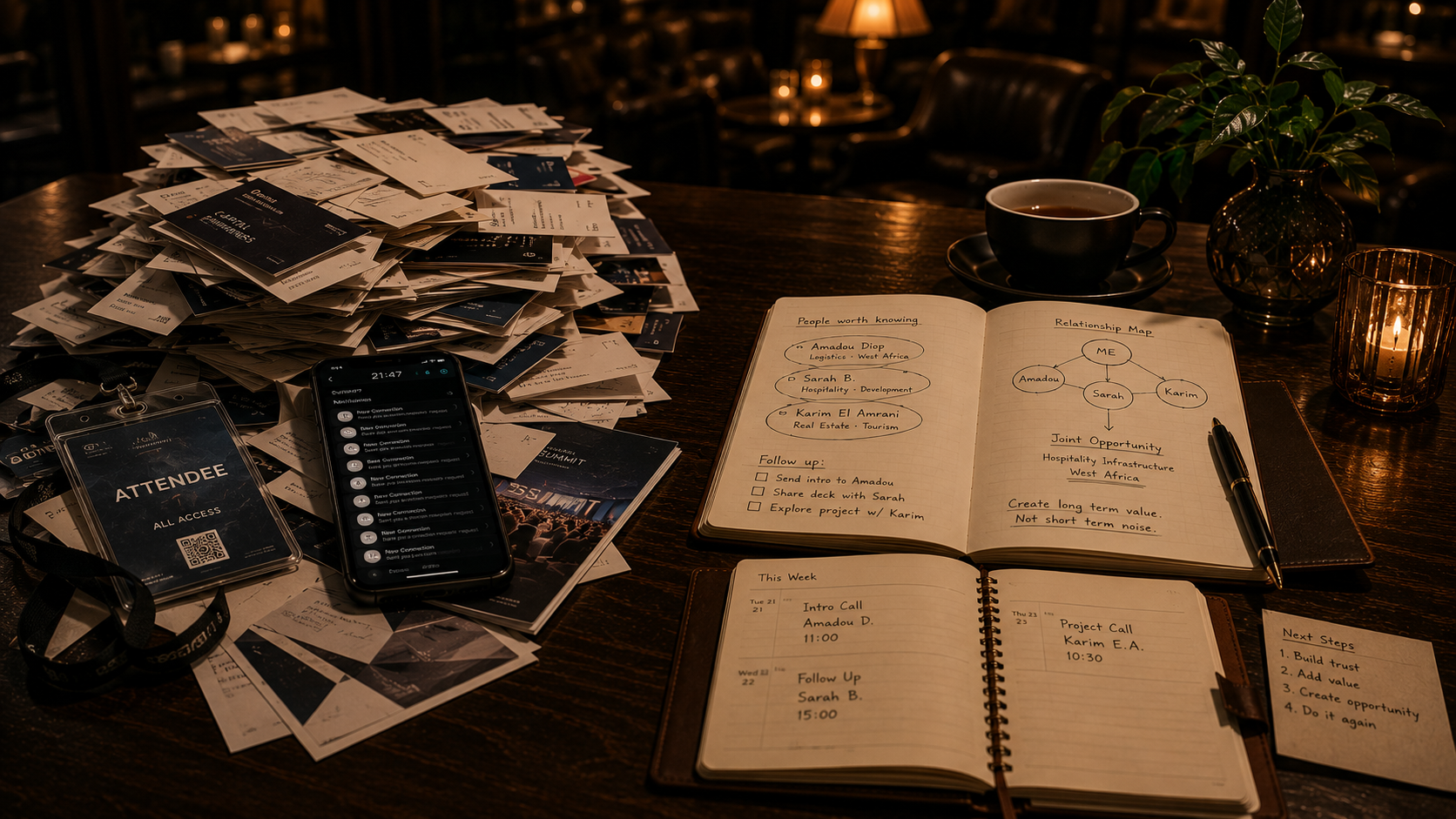
The phone is not the problem. The phone is a perfect record of a week spent producing nothing another person could point to.
The cold light.
Worth noticing that the screen is the only cold thing in the frame. It is the one object in this series that generates its own light rather than catching someone else's, and there is something exactly right about that. It is self-illuminating. It shows you a number. It tells you nothing about anyone else.
A pricing problem with somebody else's numbers in it.
This is the entry that separates the two objects.
At some point that week, somebody described a problem out loud, and the person holding the pen worked it through with them rather than waiting for their turn to talk. Those numbers are not theirs. They wrote them down because they were going to do something about them.
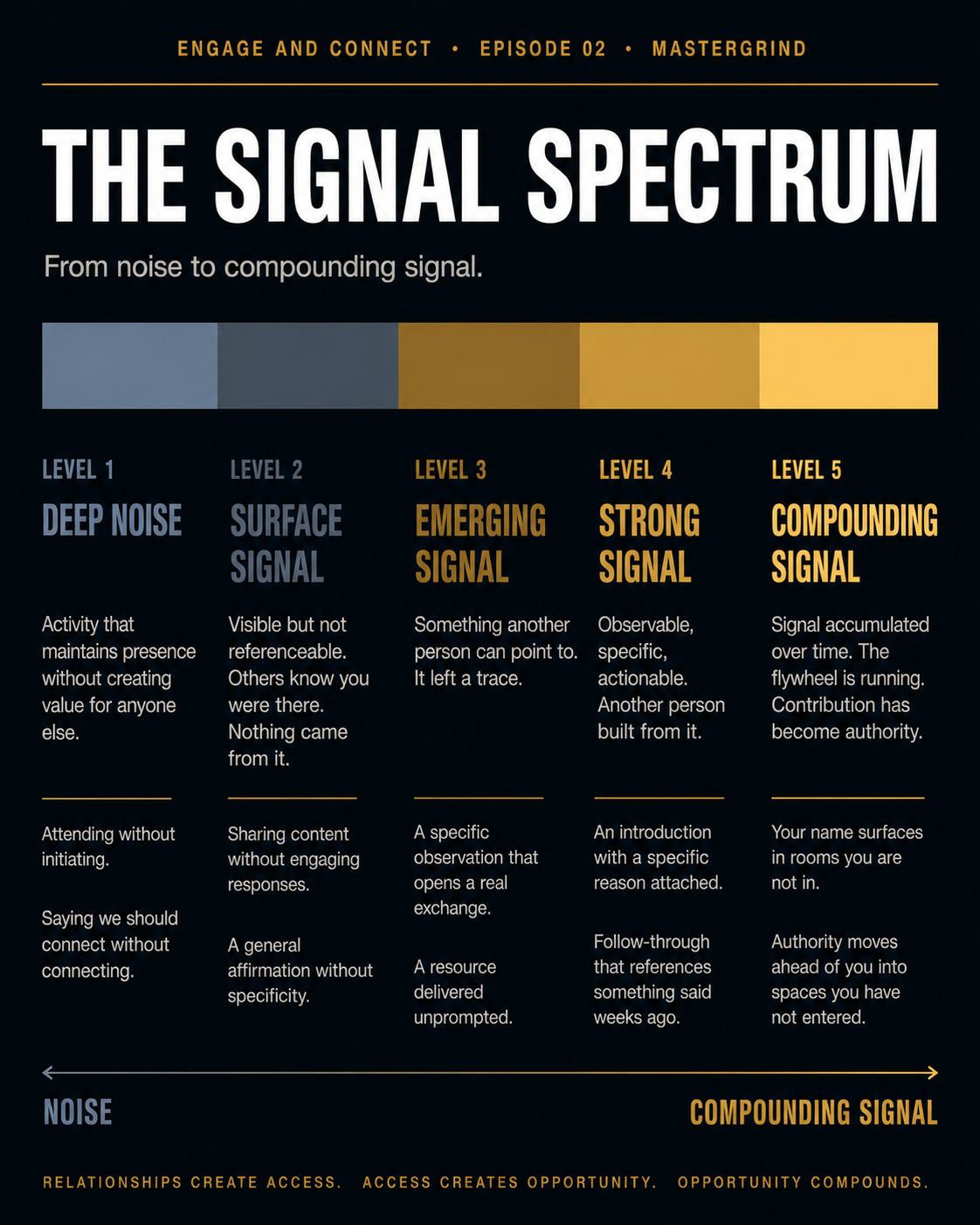
You cannot fake that page. It only exists if the conversation was real.
Three tasks with times.
Each one is a small promise with a place to land. Nine pages, three promises. That ratio is what signal looks like when you write it down: most of what happens in a good conversation is not actionable, and the small part that is gets a time beside it.

THE QUESTION THIS EPISODE IS ACTUALLY ASKING
Not how many people did you meet.
What can anyone point to?
That is the whole test and it is harder than it sounds, because it moves the judgement outside your own head. You cannot answer it by remembering how a week felt. Somebody else has to be able to say: this person did this specific thing, and here is what came of it.
By that test, most professional activity is noise. Not bad, not lazy, not insincere. Simply invisible to everyone except the person doing it.
Signal is anything that leaves a trace in somebody else's life. A resource that arrived unasked. An introduction with a reason attached. A follow-up that referenced something said three weeks ago and proved it had been remembered.
The gap between the two is not effort. Both of those people worked. The gap is whether anything survived the week in a form another person could use.
Go and look at your last eight days. Not the calendar. The residue.
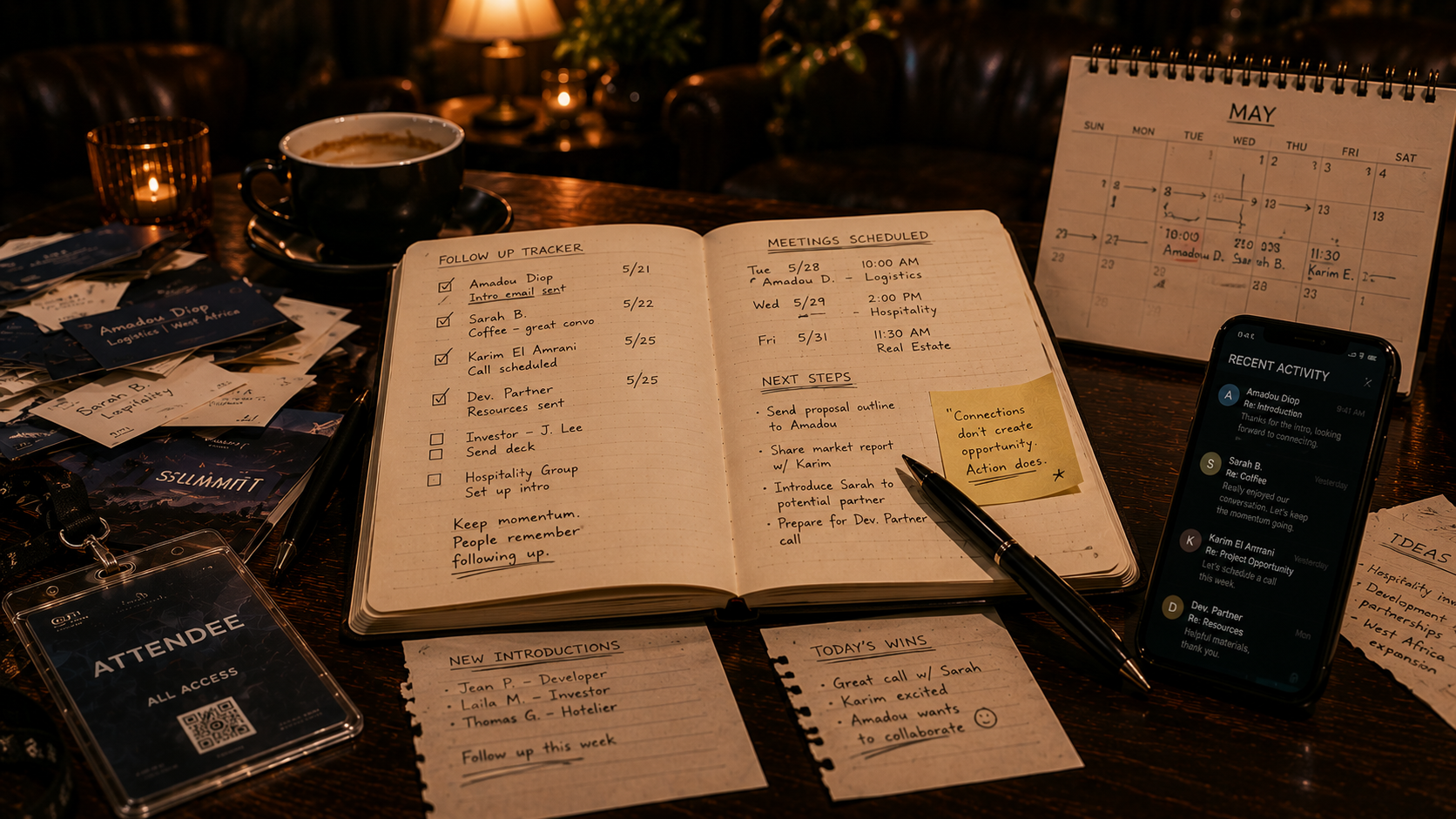
Download: The Founder Network Ledger
The strongest networks are built over time. Through trust. Through contribution. Through what happens after the introduction. The Founder Network Ledger gives you a way to see those relationships clearly and act on them deliberately.
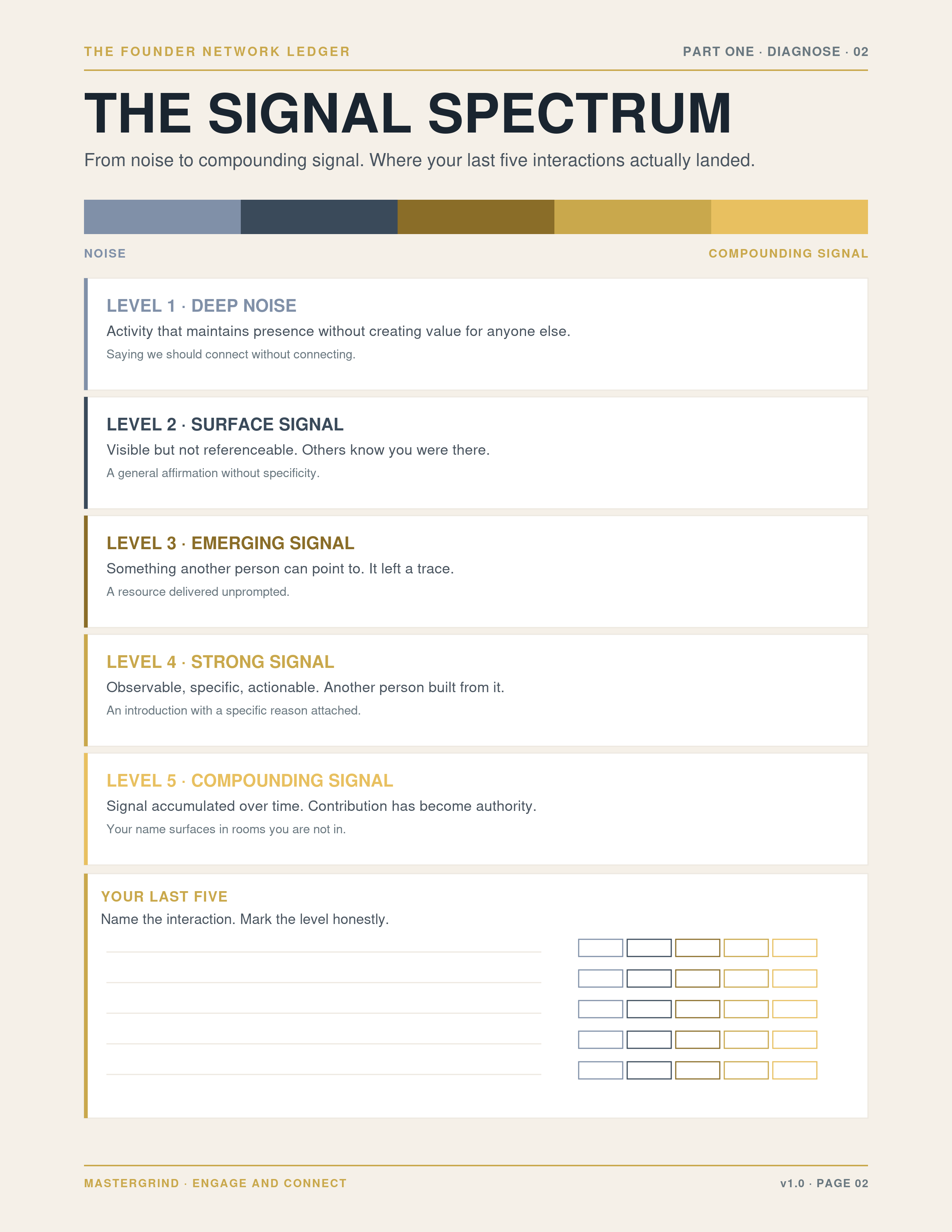
Seven pages. No noise. No performance. Nothing in it works until you write on it.
mastergrind.network/network-ledger
GET ACTIVATED. STAY ACTIVATED.
Sources Referenced in This Stream
Adam Grant, Give and Take. Viking, 2013.
Mark Granovetter, The Strength of Weak Ties. American Journal of Sociology, 1973.
Judy Robinett, How to Be a Power Connector: The 5+50+100 Rule. McGraw-Hill, 2014.
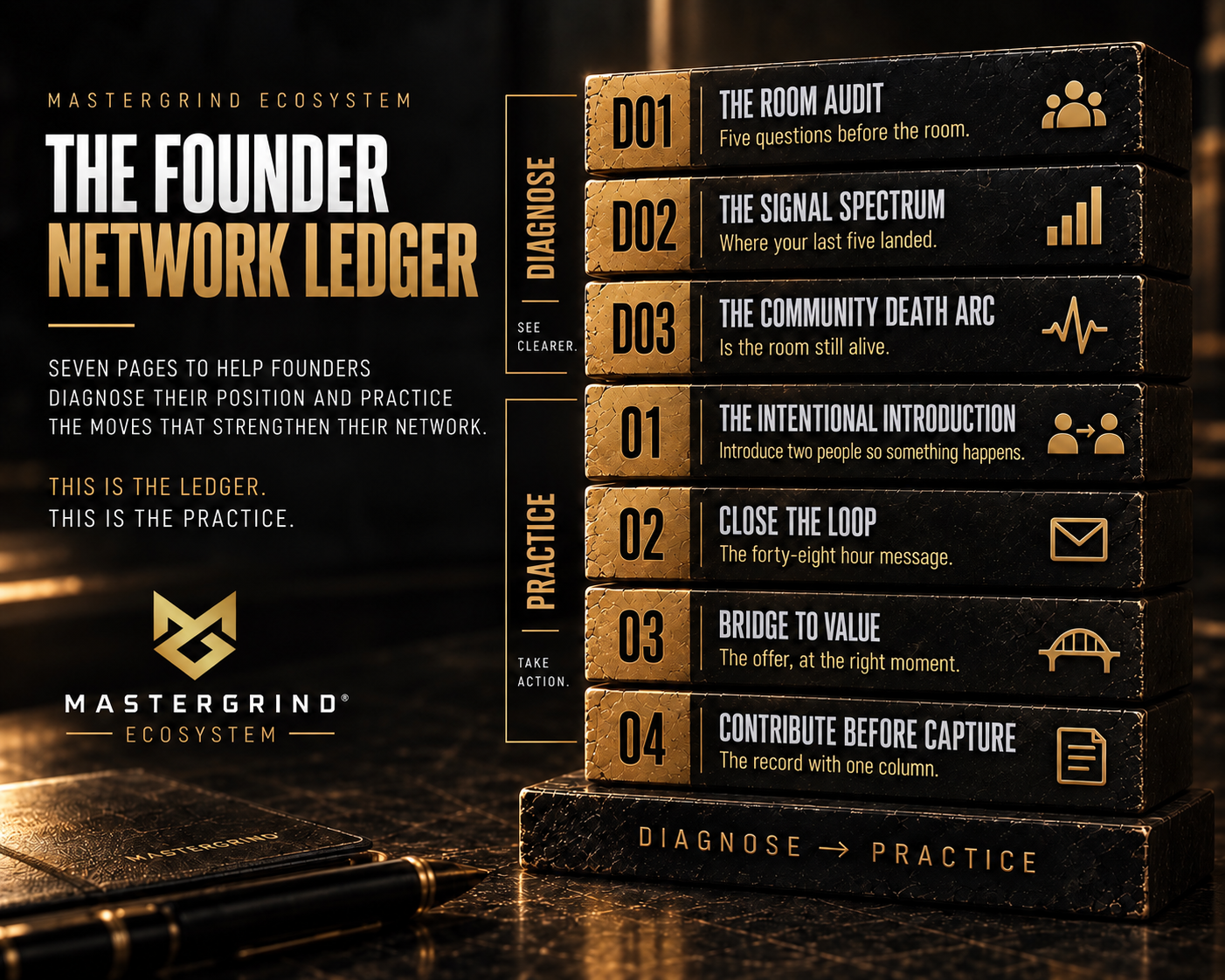
Download: Network Ledger
Download seven pages that help founders diagnose their position and practice the moves that activate their network.

Events:
Hosted by Mastergrind Club
Related:
Mastergrind Club


Spotlight:
The Founder Network Ledger
Stay close to what's being built!
Follow StreamsLocation:
New York City
Location Spotlight:
Listen to Drown (single)
Marketplace:
Ecosystem Activation


Explore:
Mastergrind Network
Spotlight:
The Founder Network Ledger


Stay close to what's being built.
Follow Streams

Mindset: Fear of being average
Follow & Activate


Your Club-GOLD Membership
These Club benefits are available to you during your Trial Membership until the launch of Mastergrind Club.
Your Club-Silver Membership
These Club benefits are available to you during your Trial Membership until the launch of Mastergrind Club.
Your Club-Blue Membership
These Club benefits are available to you during your until the official launch of Mastergrind Club.
Your Limited Access Account
Limited Access to Mastergrind Network & Club Events. A curated set of past Club event recordings and select resources from the Club library.
Not the full Club. A real look inside it.


