



The Feed is Not Your Foundation
Episode 1: The Shift from Presence to Ownership
From
Alexander D. L. Oliver
The Founder Infrastructure Map
A free PDF map showing exactly what to build underneath your public presence, in what order, with what tools, and why it matters now.
There is something strange about the way we talk about building an audience.
We say we are building something. We use that word like we are laying a foundation, stacking something that belongs to us, something that will still be there tomorrow because we put it there.
But most of the time what we are actually doing is performing inside someone else's theater, hoping the owner keeps the lights on.
I have been sitting with this for a while. Because I understand the appeal. The platforms make it easy. They already have the audience. They hand you the megaphone. You show up, you produce, people find you and for a while it feels like momentum.
What it actually is, is rented momentum.
And the lease has terms you did not read.
1. The Architecture of Dependency
Every major platform you use to grow your business operates on the same fundamental arrangement: you create the value, they own the relationship.
You build the audience. They control the access. You produce the content. They decide who sees it, when they see it, and under what conditions you are allowed to keep doing this.
That is not a bug. It is the business model.
Every platform that has ever existed followed the same arc. First it is generous. It wants your content, it rewards your effort, it grows with you. Then the incentives shift. The investors want returns. The algorithm tightens. Organic reach quietly collapses. The thing that used to amplify you starts asking you to pay for what it used to give away.
This is not a surprise. This is not a malfunction. It is the natural progression of a platform that was never built for you. It was built for its own growth, and your content was the fuel.
"Most founders are not failing because they lack ambition. They are building inside environments that were never designed for them to win."
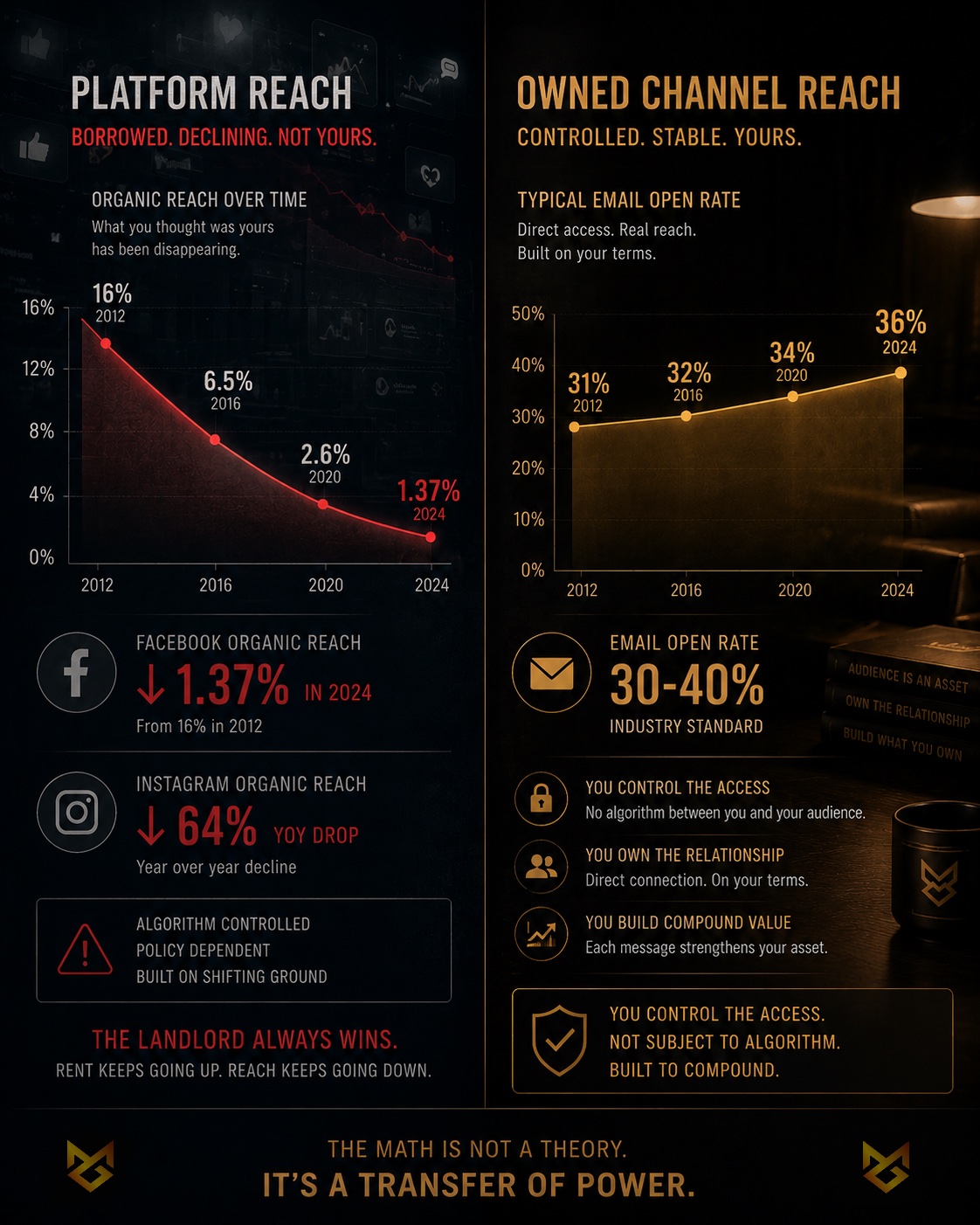
Facebook organic reach for brand pages sits at roughly one percent of followers today. Instagram reach dropped sixty percent in a single year. These are not anomalies. They are the platform maturing, extracting more value from the inventory you have spent years creating for it.
You were the supplier. The audience was the product. And somewhere along the way, you started calling it your business.
2. The Distinction That Changes Everything
Most founders think about platform risk the wrong way. They ask whether their account might get hacked, whether their data is protected, whether the platform will stay up.
That is a security question. And it is the wrong one.
Security means keeping outsiders out. Sovereignty means you actually control what is inside.
A platform can be fully secure while you have no meaningful control over how it operates, who sees your content, what it does with your intellectual work, or whether you continue to have access tomorrow.
This is not a security failure. It is a sovereignty failure. And it is the most expensive mistake a founder can make, because it is invisible until the moment it is not.
When a creator named Anna Vatuone watched TikTok go dark in January 2025, she did not talk about cybersecurity. She said something far more honest:
"The truth is, we don't own our profiles anywhere."
Not from a privacy researcher. Not from a tech critic. From someone watching the specific machinery of her business become inaccessible in real time, and naming what most founders have not been willing to name about their own situations.
3. The Cost of Rented Land
The TikTok near-ban of January 2025 produced the clearest case study of platform dependency risk the business world has seen. Not because TikTok shut down permanently. It did not. But because for approximately fourteen hours it went dark, and in that window the real cost became visible.
A small business owner named Jessica Simon built her Mississippi Candle Company from her stovetop in 2018. She launched on TikTok Shop in 2023, crossed six-figure monthly sales for the first time by late 2024, hired staff, leased a warehouse. Between 90 and 98 percent of her sales flowed through a single platform she did not own.
When the ban approached, she told reporters: "I am heartbroken for my staff."
Not for herself. For the people she had hired because a platform was working.
She is not an edge case. She is the logical outcome of building your foundation on rented ground. The Ghost Agency, a real marketing firm with real clients, laid off 80 percent of its staff before the deadline. Even after the temporary reprieve they shut down anyway. Their reasoning was simple: the platform could shift overnight and they had nothing underneath to catch them.
The platform changes. The account gets flagged. The algorithm shifts. The reach collapses. And then you find out what you actually built.
4. The Math Behind the Feeling
There is a reason this feels right even if it has not happened to you yet. It lives in the numbers.
An email list reaches thirty to 40% of the people on it. A social post reaches one to four percent of the people who follow you. That is not a small gap. It is a structural difference in who controls the relationship.
Email marketing returns approximately $36 for every $1 spent. Social media returns roughly $3. The math is not close and it has never been close.
Yet most founders allocate the majority of their content effort to the channel where they reach 1% of the people they have already earned, and call it a growth strategy. The feeling of dependency is not paranoia. It is your business correctly reading the architecture it is sitting on.
5. The Shift from Presence to Ownership
The alternative is not abandonment. It is architecture.
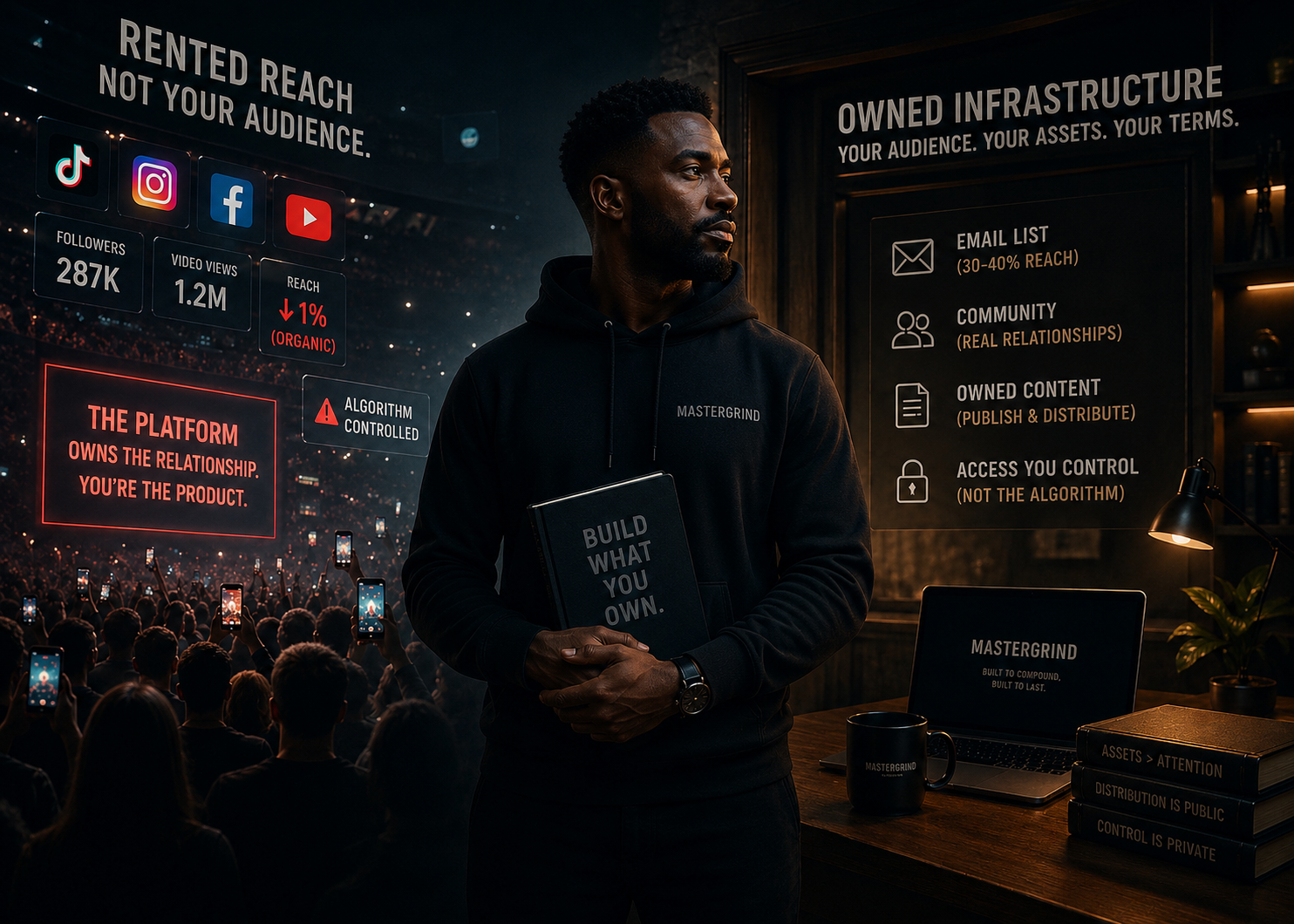
Visibility matters. Reach matters. Public platforms are genuinely useful for reaching people who do not yet know you exist. The question is not whether to use them. The question is what you are building underneath them.
"Distribution should be public. Control should be private. The feed is where you are seen. It is not where your business lives."
The founders who have figured this out are not hiding from the platforms. They are routing through them. They use the feed for discovery. They move people into owned environments: an email list they control, a community they host, a publication that goes out directly. The content on the platforms is real, but it points somewhere. It earns the right to move people into a relationship that is not intermediated by an algorithm.
Lenny Rachitsky left a product role at Airbnb in 2019 and built a newsletter. By early 2025 it had crossed one million subscribers and generated over two million dollars annually from subscriptions alone. His advice to founders still chasing the feed: stop tweeting and do the work.
Casey Newton built Platformer to 170,000 subscribers on Substack, then in early 2024 migrated off entirely to a self-hosted platform where he controls his subscriber data. His reason: platforms change in ways that make staying impossible for the creators who depend on them. He moved before a crisis arrived.
That is the difference between a presence and a platform. One lives at the discretion of a landlord. The other compounds without permission.
Conclusion: What You Are Actually Building
I write this not as someone who has solved it perfectly. I write it as someone who has been thinking about it seriously, because this is one of the most consequential decisions a founder makes right now, mostly without realizing they are making it.
Every day poured into a platform without building something underneath it is a day spent enriching a system that does not share your long-term interests. The cost is invisible until the algorithm shifts, the account goes down, the reach collapses, or a government decision makes fourteen hours feel like a decade.
That is when you find out what you actually built.
"The old internet rewarded access. This next era will reward structure. The old platforms scaled attention. The next great environments will scale trust."
Build the platform beneath the persona. Own the environment you inhabit. Everything above it can change. Everything below it compounds.

If You Want to Start Building Underneath
Everything in this post is pointing toward the same practical question: what does the owned layer actually look like, and where do you begin?
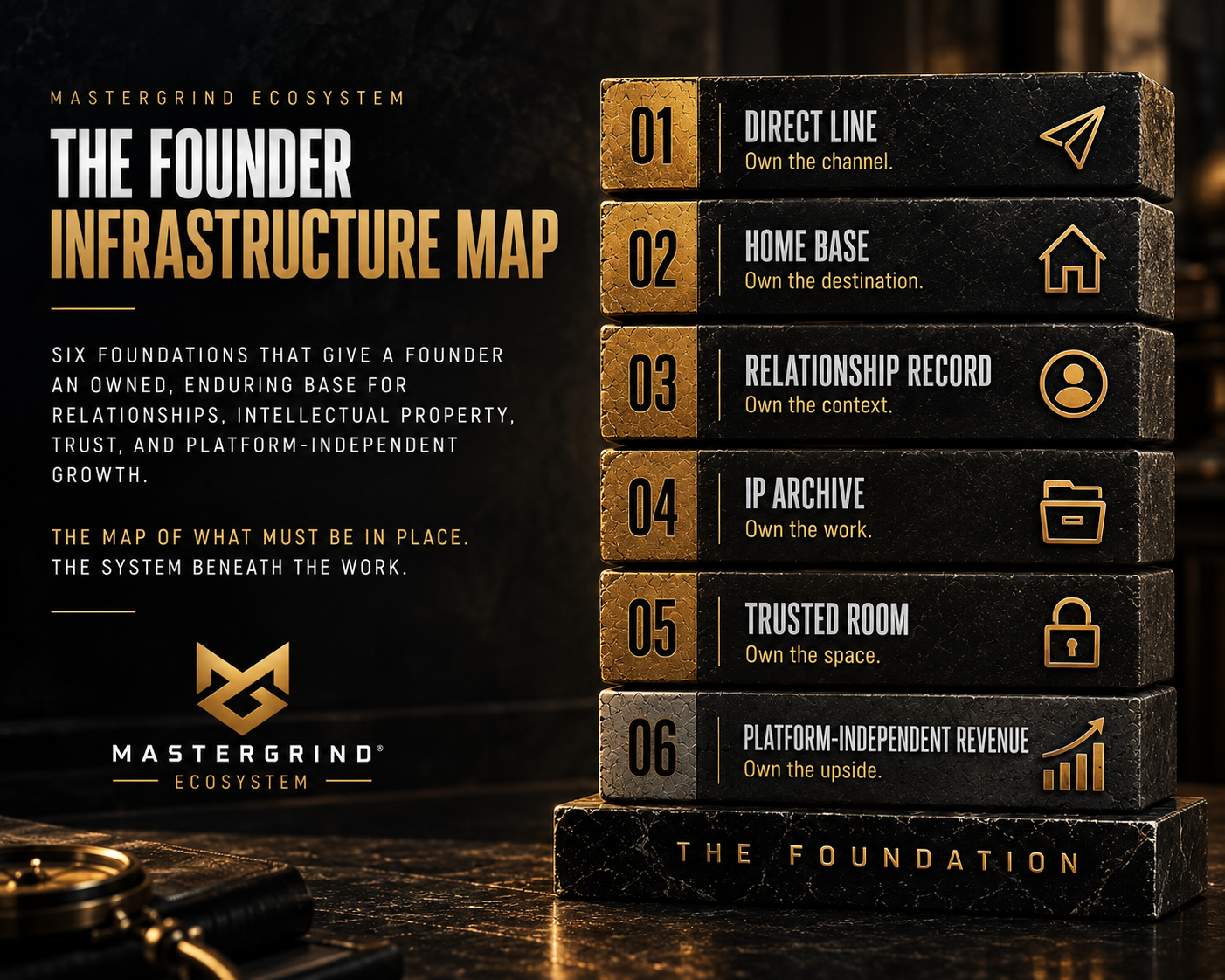
I put together a guide that answers it specifically. It covers the two-layer model and the six foundations of owned infrastructure. What each one does, what good looks like, what mistakes to avoid, and what to use to build it. It is called the Founder's Infrastructure Map.
Enter your email below and it comes directly to you.
Download: The Founder Infrastructure Map
The two-layer model. The six foundations. What to build, in what order, with what tools, and what good looks like when it is done.
Link: Download The Founder Infrastructure Map PDF
Download: Infrastructure Map
Download a free PDF map showing exactly what to build underneath your public presence, in what order, with what tools, and why it matters now.

Events:
Hosted by Mastergrind Club
Related:
Mastergrind Club


Spotlight:
The Founder Network Ledger
Stay close to what's being built!
Follow StreamsLocation:
New York City
Location Spotlight:
AO’s Soirée in NYC
Marketplace:
Ecosystem Activation


Explore:
Mastergrind Network
Spotlight:
The Founder Network Ledger


Stay close to what's being built.
Follow Streams

Mindset: Fear of being average
Follow & Activate


Your Club-GOLD Membership
These Club benefits are available to you during your Trial Membership until the launch of Mastergrind Club.
Your Club-Silver Membership
These Club benefits are available to you during your Trial Membership until the launch of Mastergrind Club.
Your Club-Blue Membership
These Club benefits are available to you during your until the official launch of Mastergrind Club.
Your Limited Access Account
Limited Access to Mastergrind Network & Club Events. A curated set of past Club event recordings and select resources from the Club library.
Not the full Club. A real look inside it.


