

our mission
Mastergrind Club exists to rebuild the system that was never built for founders; a curated ecosystem where exceptional builders are the center, not the bottom, and where relationships, recognition, and opportunity compound in their favor.

07 — Mastergrind Talk
A polished, singular founder presentation — the Authority Activation Moment for many members.
Production Tier: Tier B
Event Category: Mastergrind Amplified
Amplification: High Potential
Primary Signal: Authority
Secondary Signals: Media Asset, Culture
What This Format Is
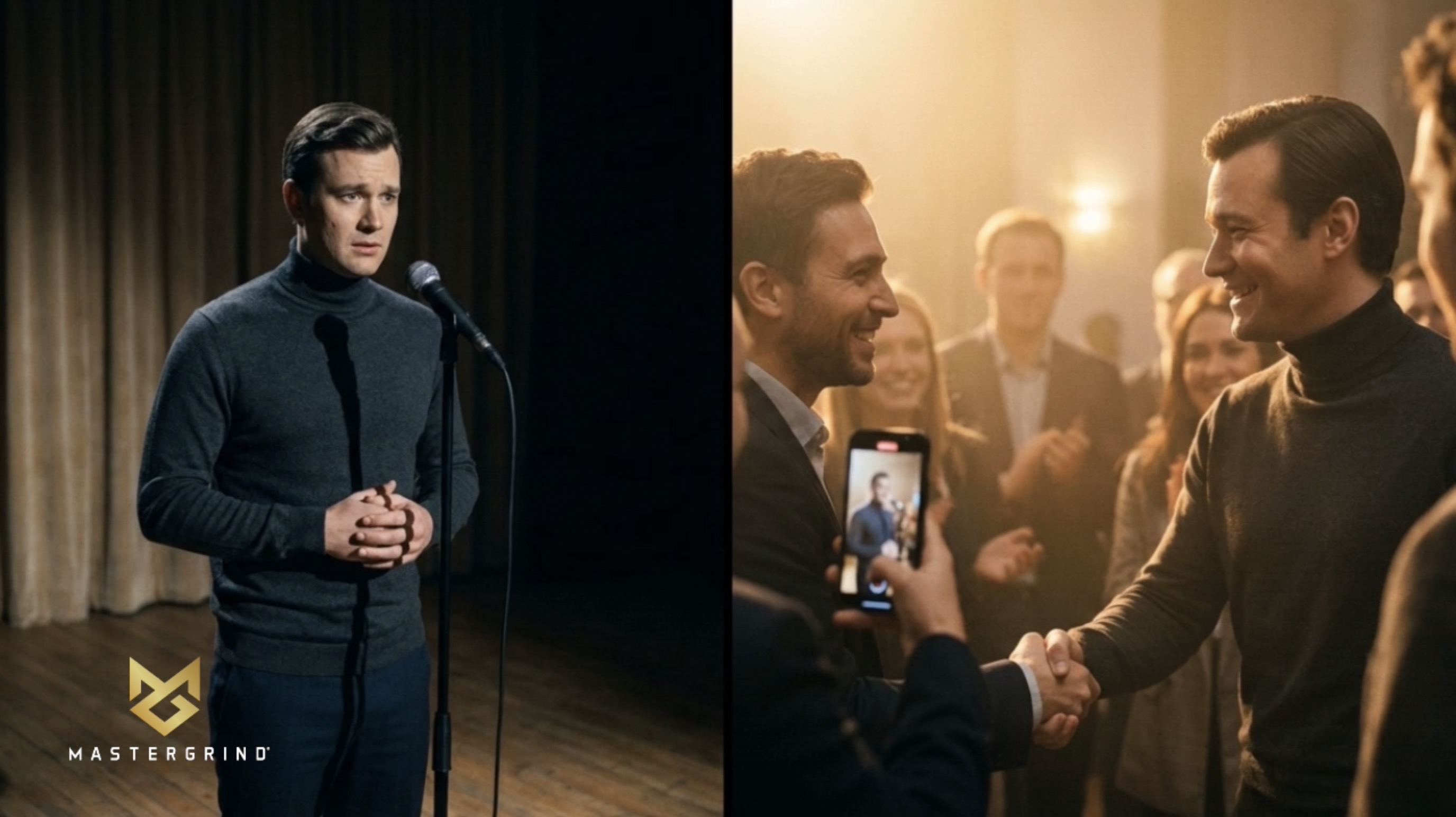
The Mastergrind Talk is the ecosystem's flagship single-speaker format. It is designed to give one founder or creator a defined moment of public authority — a recorded, distributed, polished expression of their perspective. This is often a member's Authority Activation Moment: the first time their work is seen by the ecosystem and beyond. The standard is high. That is the point.
Amplification Eligibility
Status: High Potential
The talk must be original, specific, and worth watching more than once. Generic inspiration does not qualify. The speaker must have a clear, defensible perspective — not a motivational speech.
Who This Format Is Built For
Coaches and Consultants
A talk that articulates a unique methodology, challenges a prevailing assumption, or shares a framework that only this person could have developed — this is the format that separates a coach from the market. The talk becomes the most powerful marketing tool they have, because it demonstrates the thinking, not just the result.
Example: A leadership consultant gives a Mastergrind Talk: 'Why Most Accountability Systems Fail and What Actually Works.' Twenty-three minutes. A specific framework, two case studies, one counterintuitive conclusion. The clip reaches 8,000 views in three months. Twelve inbound inquiries directly attributable to the talk.
Realtors and Property Experts
A realtor with a genuine perspective on a market or a method — not just a sales pitch dressed as insight — can use the Mastergrind Talk to become the public authority in their niche. The talk must be opinion-forward and data-supported, not a market update.
Example: A commercial realtor gives a Mastergrind Talk: 'Why the Retail Apocalypse Was a Media Narrative, Not a Market Reality.' She cites specific deals, specific data, specific predictions. She is willing to be wrong publicly. The talk positions her as someone who thinks independently about the market — which is who serious investors want to work with.
DJs and Creative Founders
A DJ or creative producer giving a Mastergrind Talk on the business of creative work, the economics of a music career, or the intersection of culture and commerce — this is a powerful format for creatives who are often seen as performers rather than thinkers.
Example: A DJ gives a Mastergrind Talk: 'What 15 Years Behind the Decks Taught Me About Audiences, Rooms, and Reading Energy.' The talk is about attention, presence, and the moment — with application far beyond music. The room is full of founders. The creative's perspective unlocks something for people who had never thought about their work through that lens.
Run of Show
Phase
Duration
What Happens
Pre-Event Setup and Briefing
45–60 min before
FRAMESx sets up equipment. Speaker does a technical check and a final brief with the facilitator. One last run through the talk structure — not the full talk, just the arc.
Audience Arrival
20–30 min
Doors open. Music plays. Creator captures arrivals and energy. Anticipation is part of the experience.
Introduction
2 min
A brief, specific introduction by the host or facilitator. One sentence about who this person is, one sentence about why this talk matters. No lengthy bio.
The Talk
18–25 min
The core presentation. No slides are required — but if slides are used, each slide should carry one idea. The speaker does not read from notes.
Q&A
10–15 min
Facilitator fields questions from the audience. Filters weak or off-topic questions. Amplifies the strongest.
Networking
30 min
Informal close. Creator captures post-talk energy and conversations. Speaker is available for connection.
Environment
[Facilitator — Internal]
Facilitator Guide
Talk development — this is the most important pre-work
Amplification preparation
Day of the event
[Host/Member]
Member Briefing
Creator and Documentation Plan
Follow-Up Protocol
KPIs — How to Know It Worked
Common Mistakes
Generic inspiration
Speaker gives a motivational talk full of universal truths and no specific perspective. It is forgettable. Fix: the talk must have an argument — something the speaker believes that not everyone agrees with.
Too long
Speaker runs 35–40 minutes. Audience loses focus. Fix: 18–25 minutes is the ideal window. Cut ruthlessly.
Insufficient preparation
Speaker shows up without having rehearsed the full talk. The structure breaks down under pressure. Fix: require at least two full run-throughs with the facilitator before the event.
Reading from notes
Speaker reads slides or cards. Authority dissolves. Fix: the talk should be in the body before it hits the stage. Notes are a sign of under-preparation.
MASTERGRIND EVENT OS — 07 Mastergrind Talk
Facilitator Guide + Member Briefing

These Club benefits are available to you during your Trial Membership until the launch of Mastergrind Club.
These Club benefits are available to you during your Trial Membership until the launch of Mastergrind Club.
These Club benefits are available to you during your until the official launch of Mastergrind Club.
Limited Access to Mastergrind Network & Club Events. A curated set of past Club event recordings and select resources from the Club library.
Not the full Club. A real look inside it.





.png)


